
June 1996 € Volume 23 € Number 3
OR vs. Oracle
HIV/AIDS care in Tanzania: Planning and policies based on sound data
rather than speculation and moral principles offers the only hope for a
desperate situation.
By Steffen Flessa
The desire to anticipate future events is as old as mankind. All cultures
have developed certain techniques to investigate events before they happen.
Tarot cards and astrology -- prediction tools dating back to ancient times
-- are still prominent in certain parts of the world.
In Africa, the role of prognosticator has traditionally belonged to the
oracle. A seer or healer throws little sticks or bones and, being a medium,
predicts future events. Knowing about future developments is the basis for
all planning. Thus, the oracle becomes a dubious tool of traditional management,
which raises the question of alternatives.
Tanzania, one of the least developed countries in the world, is facing distressing
health care problems. More than 50 percent of the country's health care
relies on the institutions and programs of Christian churches. Two major
organizations, the Christian Medical Board of Tanzania (CMBT) and the Tanzania
Christian Medical Association (TCMA), as well as the medical secretaries
of specific dioceses, must take precautions now if they want to see their
hospitals, dispensaries and public health projects run well as they enter
the new millennium. Planning data is required and requested in many fields.
The threat of acquired immune deficiency syndrome (AIDS) constitutes an
especially difficult probem to all providers of health care in Tanzania.
AIDS is one of the 10 most frequent diagnoses in almost all Tanzanian hospitals
and in many health care institutions, and it is the No. 1 cause of death.
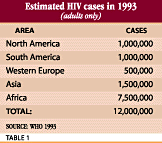
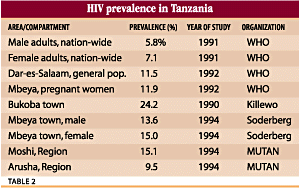
Tables 1 and 2 provide an impression of the situation.
For maintaining the existing standards of health care in Tanzania, not to
mention "Health for all in the year 2000" as proclaimed by the
World Health Organization (WHO), reliable data about HIV and AIDS prevalence
must be obtained by the churches of Tanzania. It will not be enough to guess
or give rough estimates. Rejecting the traditional oracle as unchristian,
the churches sought an alternative and the answer is quite clear: OR practice
instead of the oracle.
Predicting the unpredictable: The basic model
In looking for practical answers to particular questions, I used and extended
an existing model of the spread of AIDS. The basic model is described in
detail by Heidenberger and Flessa [1993]. It divides the entire population
of Tanzania into 20 compartments based on age, rural or urban habitation,
and degree of risk. The compartments are further subdivided according to
age sets, health status and incubation periods, forming a complete demographic
and epidemiological model in which the following paths of infection are
incorporated:
- infection by partnership contacts,
- infection by promiscuity,
- pre-natal infection,
- infection by blood-transfusions,
- infection by needle-sharing in hospitals, and
- infection by circumcision.
This existing model had to be revised in order to supply an answer to the
contemporary planning needs of church health care in Tanzania. Some changes
concerning the variables (e.g., lower incubation period in Africa) and the
structure (e.g., on average two bottles of blood per transfusion) were made.
Survey: Needs of the health care institutions in Tanzania
In order to supply professional, sustainable and sufficient health care
by the year 2000, officials need reliable data now about the future spread
of HIV. The following points were taken into consideration and modeled:
1. Planning HIV screening.
Most churches have implemented AIDS-control projects, including the screening
of blood transfusions for HIV. The price per check per half-liter bottle
of blood is about $5. The number of HIV screening kits is calculated by
multiplying the number of transfusions per year with the average number
of bottles per transfusion. Two bottles of blood are used per patient on
average. Taking an HIV prevalence of "p percent" in the donor
population for granted, the number of donations to be checked will be higher
than the number of bottles required, as some have to be rejected as HIV
positive.
In order to plan the expenditure for that important part of the control
program on time, details about the expected number of transfusions are necessary.
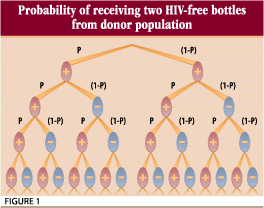
Figure 1 provides an insight into the probability of receiving two bottles
that have been proven negative (the sensitivity of the test does not influence
the stochastic process as the actual number of bottles tested is determined
and not the number of HIV-free bottles).
The blood-donor prevalence p is the arithmetic mean of the prevalence of
those compartments contributing to the pool of blood- donors weighted with
its share in the pool. The probability of screening a certain number of
samples can be received by combinatorial analysis and the expected value
of HIV checks -- "x" -- is then calculated as an indefinite series.
The epidemiological model, as represented by Heidenberger and Flessa [1993],
was enriched by a module recording the prevalence of blood donors in rural
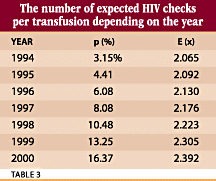
areas (where most church hospitals are), giving the results shown in Table
3.
This means, for instance, that the Machame Lutheran Church Hospital, with
about 500 transfusions per year, will need 1,196 HIV screening kits in the
year 2000 instead of 1,000, as estimated by management. This means that
an underestimation of almost 20 percent would have appeared, thus making
the budget meaningless. By multiplying the expected number of transfusions
with the variable x for all church hospitals, a better estimation can be
given.
2. The Use of Condoms
Another fiercely discussed issue is the question of whether the spread of
AIDS could be efficiently restrained by the use of condoms. This discussion
in the churches of Tanzania is mainly a moral topic, as condoms are closely
associated with promiscuity and a sinful sexual lifestyle. Our interest
was determining whether such an attempt was even possible, given the costs
of supplying the population of Tanzania with condoms.
In order to determine the costs of condoms, the demand for the product must
first be calculated. To arrive at a useful figure, the coitus frequency
of different sub-populations must be known, a figure that is hardly available
in Europe, much less in Africa where talking in public about sexual affairs
is a traditional taboo. Since such data is not available, it must be calibrated
by means of modeling the transmission by partnership and promiscuity. The
new figures available on AIDS in Tanzania were used to recalibrate these
important social parameters. Afterwards a counter for the number of sexual
intercourse occurrences was introduced into the basic model. The result
for intercourse occurrences during partnerships shall be "number of
coiti partnership," and the corresponding variable for promiscuity
is calculated as well. The results are presented in Table 4.
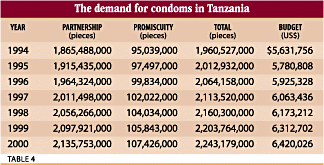
The last column of Table 4 represents the budget for the purchase of condoms.
It was suggested that condoms could be distributed by the WHO at a price
of $2 per 100 condoms if the WHO, the government or another international
non-profit organization could supervise production and distribution [Reichel
1994]. (The price for condoms in Tanzania ranges from 15 to 45 cents per
condom). Taking an HIV prevalence of more than 15 percent in the adult population
for granted, it is certainly not enough to supply condoms only for promiscuous
intercourse, because the partners of truck-drivers, migration workers and
traders must also be protected. The last column in Table 4, therefore, shows
the budget required if all promiscuous relationships and 10 percent of the
rest of the population are provided condoms.
One can easily realize that the amount exceeds by far the entire AIDS control
programs of the churches of Tanzania. It will certainly not be possible
for the church to solve the problem of AIDS by distributing condoms. But
leaving moral issues aside, the programs building mainly on the distribution
of condoms are bound to fail, as they are not sustainable. In a country
with a health budget of less than $2 per capita per year, condoms are an
unaffordable luxury and churches will certainly have to continue to fight
AIDS by stressing fidelity to a single partner. Condoms can support such
efforts, but never replace them.
3. Taking Care of Orphans
One aspect of AIDS that is often forgotten is the increasing number of orphans.
Multiplying numbers of children without parents will put an unbearable burden
on the remaining community and challenge the traditional social welfare
system. The social responsibility of the Tanzanian people will be neglected
and the churches will be overwhelmed with thousands of additional orphans.
Data about the expected number of additional orphans due to AIDS casualties
is not available for Tanzania, but it should certainly constitute the basis
for planning. If all AIDS orphans are to be taken care of in the coming
years, planning and decision making must start now in order to provide the
necessary resources on time. In our model, a counter tallies the number
of AIDS casualties. The effective number of children per adult is calculated
as average. As shown in Figure 2, the conditional probability that a child
loses both parents (and only those are counted here) is one-third, and that
a child loses only one parent is two-thirds, if the condition "at least
one parent is positive" is taken for granted.
Therefore, one-third of the AIDS casualties will leave orphans behind. Multiply
the average number of children per couple and then total for all fertile
departments results in the expected number of orphans for the years 1994-2000
as presented in Table 5.
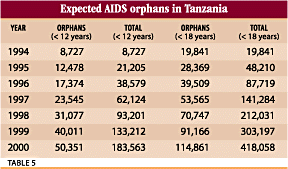
Two scenarios are given: the first two columns give the figure if we regard
a person as an adult beyond the age of 12 and assume he can take care of
himself and his younger brothers and sisters. The last two columns assume
that a person is an adult at 18 and only then can take care of himself and
children or younger brother and sisters.
The figures in Table 5 indicate that the burden of AIDS is tremendous. The
costs per year of taking care of a Tanzanian orphan in an orphanage can
be estimated at roughly $200. Even taking the lower figure of the orphans
under 12, the present value of the expenditures for taking care of AIDS
orphans on the basis of the 1994 figures will amount to more than $87 million.
This figure corresponds to an ordinary annuity of $10.7 million, which is
more than the annual budget of most dioceses in Tanzania.
But let's not forget: these are only orphans whose parents have died of
AIDS. The natural mortality will generate even more orphans due to accidents
and other diseases. We realize that the orphanage cannot be the solution.
Ways must be found to keep the orphans in their community. Although the
simulation shows that the average family size will steadily increase from
4.3 children in 1994 to 5.2 children in 2000 due to the orphan problem,
the churches must convince relatives to bear the burden and support the
orphans as much as possible. The churches have, however, very good opportunities
to do so, as they are present in almost every village and people trust them.
Our simulation results might be the basis of a village-based orphans program.
4. Treating AIDS patients
Officials need to know the number of expected AIDS patients not only to
budget for patient care, but to plan for hospitals and the training of professional
staff engaged in AIDS treatment. The question of whether special AIDS wards
should be opened is fiercely debated and should be based on solid information.
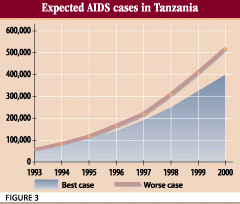
Figure 3 gives the number of AIDS cases (not cumulative figures but "living
cases") expected in Tanzania. The "worst case" indicates
the number of cases expected if no measures to restrain AIDS are taken;
the "best case" indicates the number of cases if all possible
measures to restrain the transmission are followed (assuming that one-third
of promiscuous intercourse occurrences can be protected).
There are no figures available about the correlation between the rate of
arrival in hospitals and the prevalence of AIDS, as AIDS is usually not
the main diagnosis and its prevalence among the population is usually unknown.
Also, the question of whether the percentage of patients seeking help in
the hospital will increase or decrease is unanswered. On one hand, the patients
learn that nobody can help them in the hospital and tend to die at home.
On the other hand, the families are totally overcome with sick relatives
and are inclined to send them to the hospital.
I investigated these matters in 1989 at the Machame hospital and found that
about 40 percent of the expected AIDS cases in the catchment area of a hospital
are coming to the hospital in a year with an average stay of 33 days [Flessa
1989]. Research is very rare due to the poor medical recording in most hospitals.
This would lead to the number of bed days as shown in Table 6 for Tanzanian
hospitals (for the "best case").
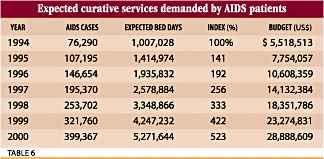
These figures demonstrate that a hospital manager must multiply his actual
figures of AIDS patients in the year 1994 with the appropriate factor presented
by the index in order to find the number of AIDS patients expected over
the next few years. In that way, planning becomes possible. The analysis
of the income and expenditure statements of rural church hospitals (for
this purpose I visited 40 rural church hospitals in Tanzania, analyzing
their statements [Flessa 1993]) reveals average costs of $5.48 per bed per
day. As no further analysis is possible due to poor cost accounting in Tanzanian
hospitals, we assume that this amount will be spent for AIDS patients as
well, which provides for the figures in Table 6.
Compared with other estimates [World Bank 1992], our figures might be called
conservative, as they are on average lower than those given by other institutions.
They reveal, however, that the burden to be borne is very large: More than
one-fifth of the national health budget would have to be spent for the treatment
of AIDS patients, and 62 percent of hospital beds will be filled with AIDS
patients by the year 2000. The 50 percent share to be borne by the churches
will amount to almost $14.5 million -- nearly the entire health budget of
all Tanzanian churches in a year.
Taking these figures into consideration the answer can only be: training
for home care. The hospitals will not be able to take care of all AIDS patients
during the coming years. The discussion of whether special AIDS wards are
opened for dying AIDS patients is just beating around the bush; it will
be impossible to take care of all of them. Village elders, public health
nurses, rural medical aids and pastors must be trained in how to take care
of AIDS patients. They must be supported to bring this idea to all people.
The immense tragedy calls for support from outside, but the main load will
have to be shouldered by the Tanzanian society itself.
The disease AIDS certainly involves many more aspects than mentioned here.
The most efficient portfolio of AIDS control programs must be discussed
and the stigma lifted. All these issues should not be based on poor speculation
or useless moral principles, but on sound data. The source of this data
could, from our point of view, be only a multi-compartment model as presented
here. Everything else seems to be of no more value than the traditional
oracle.
Reliability of the model
All of the estimates presented here depend entirely on the reliability of
the basic model. If the results calculated in 1989 proved to be unreliable
in 1994, there is no reason to trust them for the next few years. We would
therefore like to challenge our old results with the new data and make some
inference on the reliability of the entire model.
The median incubation period had to be reduced by 40 percent and the median
length of survival of the final stages of AIDS had to be diminished by 50
percent due to new research [Hubley 1990; Benn 1994]. The social and medical
variables were recalibrated in order to fit the new data available for the
prevalence in Tanzania. The result indicated that the promiscuity in rural
areas had been overestimated in the old set of variables (in 1989 there
was hardly any reliable data available on the spread of AIDS in these areas).
Additionally, the average number of bottles of blood per transfusion increased
from one to two, making a minor change in the model structure necessary.
Figures 4 to 7 show both alternatives.
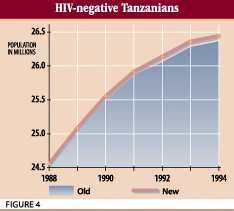
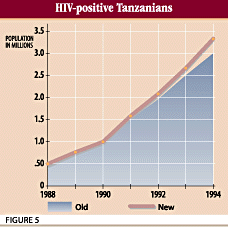
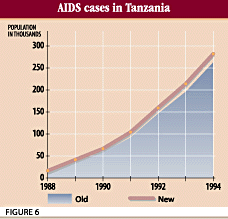
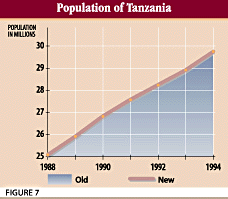
We realize that the HIV-prevalence is decreasing due to lower sexual activity
in the country side. Yet, there is an increase in AIDS cases as the reduced
incubation period shows the final states of AIDS occurring earlier than
in the old set of variables. The lethal end is reached earlier and therefore
the population is slightly lower.
The X2 values for HIV prevalence were calculated for the entire population
(0.00169) and for the rural population (0.006684), since these are the most
important figures for the estimates given above.
The deviation of our estimates of the HIV prevalence in the rural population
is four times higher than in the general population, as we had no accurate
statistics in 1989 for rural areas. The X2 values are, however, so little
that we must accept our former results as good estimates. The fact that
the simulation of 1989, based on 1988 data, gave an acceptable forecast
for the years 1989 to 1994 encourages us to believe that the estimates by
our enriched model of 1994 will be valid until the year 2000 and will present
a proper foundation of decision-making for the churches of Tanzania.
References
1. Benn, Ch. (1994), personal letter, July1994.
2. Flessa, S. (1989), "Die gesundheitsökonomischen Auswirkungen
von AIDS auf das kirchliche Gesundheitswesen in Tanzania," Master's
Thesis, University of Erlangen-Nürnberg, Germany.
3. Gould, P. (1993), "The Slow Plague," Blackwell, Oxford/Cambridge.
4. Heidenberger, K and Flessa, S. (1993). "A system dynamics model
for AIDS policy support in Tanzania," European Journal of Operational
Research, Vol. 70 (1993), pp.167-176.
5. Hubley, J. (1990), "The AIDS Handbook," MacMillan Publishers,
London.
6. MUTAN (1994), "The AIDS-Situation in Kilimanjaro," unpublished
Paper
by Bergsjo, Masoka.
7. Reichel, R (1994), "Markt oder Moral," Fischer, Frankfurt a.M.
8. World Bank (1992), "Tanzania - AIDS Assessment and Planning Study,"
A World Bank Country Study, Washington, D.C.
9. World Health Organization (1993), Weekly Epidemiology Record, 68:193-200.
- Soderberg, S.e.a. (1994), "Prevalence of HIV-1 infection in rural,
semi-urban and urban villages in Southwestern Tanzania: Estimates from a
blood donor study" (unpublished).
- Killewo, J.e.g. (1990), "Prevalence of HIV-1 infection in the Kagera
Region of Tanzania: A population-based study," In: AIDS 4:1081-1085.
Further Reading
A growing number of quantitatively oriented scientists, including operations
researchers and statisticians, are pursuing AIDS-related research. A sampling
of contributions in this area includes:
- Interfaces, Vol. 21, No. 3 (May-June 1991), special issue on
AIDS modeling (Shan Cretin, issue editor).
- Roy M. Anderson and Robert M. May, "Infectious Diseases of Humans:
Dynamics and Control," Oxford University Press, Oxford, 1991.
- Ron Brookmeyer and Mitchell H. Gail, "AIDS Epidemiology: A Quantitative
Approach," Oxford University Press, Oxford, 1994.
- Edward H. Kaplan and Margaret L. Brandeau (eds.), "Modeling the
AIDS Epidemic: Planning, Policy and Prediction," Raven Press, New York,
1994.
Steffen Flessa is a research assistant (health economics) with the University
Erlangen Nuernberg's Department of Management Science and Operations Research.
This article is based on his work at the Masoka Management Training Institure
in Moshi, Tanzania, where he was a lecturer on health care management during
a 4 1/2-year stay. He is also a management consultant with the Lutheran
Church of Tanzania, and will return to Tanzania for seven months beginning
in August. He recently completed his Ph.D. thesis on the application of
management games for developing countries. He can be reached via E-mail
at: [email protected]