
April 1997 € Volume 24 € Number 2
The operations research community is as vast as it is diverse, and brings enormous resources from cross-disciplinary sciences to bear on an incredible array of problems. This cross-disciplinary aspect of operations research has long been recognized by the Federal Aviation Administration (FAA) as a powerful tool in solving the myriad concerns encountered within the National Airspace System. As steward of the National Airspace System (NAS), the FAA has a duty to the NAS to ensure safe and orderly air travel, and an obligation to the taxpayer to squeeze top-notch service from every dollar.
Complexity of the NAS is almost beyond comprehension. If we could
describe the NAS in a single snap-shot [1], what would we see? For
the 1995 calendar year we would see a vast and complex system
composed of over 639,184 licensed pilots flying into 18,224 U.S.
airports. These flights would generate 34,787,000 flight activities
annually. They support an aviation industry that earned
$92,618,000,000 in revenue. During that year passengers flew
519,161,000,000 miles. All of this is overseen by 48,370 permanent
FAA employees of which, yours truly, is but one.
Three Epochs of Air Travel
The NAS evolved in roughly three "epochs." The first epoch spans the
time from the advent of powered flight by heavier-than-air machines
until about the close of the First World War. The technologies
associated with this epoch were those simply necessary to keep the
machines in the air. The second epoch, from roughly the beginning of
the Second World War to the mid 1950s, involved technologies that
imposed discipline and structure on the NAS. This was necessary to
accommodate the public's increasing demand for air travel, and to
keep pace with the tremendous technological advances in aircraft. The
legacy of the second epoch is largely still with us, as air route
structures, procedures and standards. These paradigms are being
pressed to their limit by the advent of the third epoch.
The third epoch, from the current time into the next century, might be characterized as the desire to remove restrictions from certain aspects of the NAS while maintaining or expanding discipline and safety. This may best be thought of as the idea of "free flight," an innovative concept designed to enhance the safety and efficiency of the NAS. The concept moves the NAS from a (rigid) centralized command-and-control system between pilots and air traffic controllers to a (more flexible) distributed system that allows pilots, whenever practical, to choose their own routes and file flight plans that follow the most efficient and economical route [2].
How does the FAA manage the changes coming in this third epoch? How can we anticipate the user's needs, and plan technological, architectural and procedural improvements necessary for the NAS to evolve into a system capable of handling the demands of the 21st century? The answers to many of the questions posed by the third epoch naturally reside in the broad field known as operations research.
The FAA has been engaged in operations research activities in the past, either through its own resources, by association with "contractors," or in partnership with the academic community. More often than not, large and complex projects necessitated at least a loose affiliation among these partners. It was equally as common for these individual partners to go their separate way after completion of the project. The FAA recognized that this tended to lead to isolated pockets of expertise in certain areas. Under the loose arrangement, the FAA could have sought a solution to a problem and, due to a lack of communication, not have known that the solution, or one substantially similar to it, already resided in one of the isolated areas of expertise. Representatives of the FAA, industry and academia discussed the situation over the years, searching for ways to bring things together.
The FAA's Office of Investment Analysis and Operations Research
began a dialogue among various industries and academic partners about
how to form a partnership that, among other things, would create a
continuing presence of expertise and experience that could be called
on for its corporate knowledge. This partnership would draw from the
academic community, industry and government, and would focus on
operations research as it applies to aviation issues for the benefit
of all partners. Interesting thought, but how to proceed?
Centers of Excellence
In 1990, Congress enacted a public law that allowed for the creation
of Centers of Excellence (COE). The purpose of these Centers of
Excellence is to generate a "critical mass" of expertise and produce
work of unsurpassed quality, value and relevance. In addition,
Congress mandated that Centers of Excellence provide for continuing
education of students, professional networking, and the collection
and distribution of information. The FAA created two Centers of
Excellence, one for Computational Modeling of Aircraft Structure, and
the other for airport pavement research.
In 1995, the FAA began the process of formally establishing a Center of Excellence for Aviation Operations Research. Our intent was to focus the operations research community on aviation issues, hence this new partnership would be the Center of Excellence in Aviation Operations Research. We wished for our new COE to have a broad operations research mandate. Accordingly, we defined the scope of the COE along several functional areas:
The FAA identified these functional areas by surveying the user community. We believe these functional areas best represent the concerns of a broad spectrum of NAS users.
Once we established the scope for our COE, we began a public
information campaign to notify eligible colleges and universities
that soon we would be soliciting proposals. Eventually we received
six proposals representing 13 academic institutions. After a thorough
review of these proposals by a panel of FAA technical experts, the
FAA selection panel made its recommendation to the administrator.
A Bold, New Partnership
On June 27, 1996, the FAA forged a unique
industry-academic-government team and commissioned the new Center of
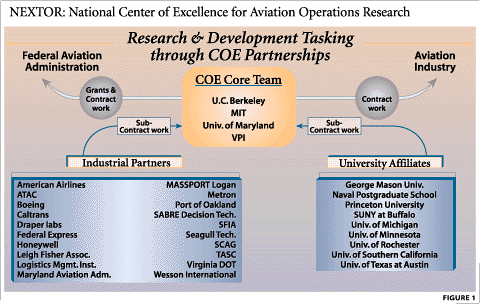
Excellence in Aviation Operations Research. As noted in Figure 1, the
COE centers around four core universities: the University of
California at Berkeley, the Massachusetts Institute of Technology,
the University of Maryland at College Park, and Virginia Polytechnic
Institute and State University. At the selection of this team, FAA
Administrator David R. Hinson remarked, "We have created a unique
consortium, composed of some of the best minds in the country -- an
aviation 'dream team' -- to work collectively on business and
operational issues of mutual interest and concern. Such collaborative
efforts are essential in this era of shrinking budgets and scarce
resources, as industry, academia and government learn to combine
resources to achieve common goals."
The team, known as NEXTOR (for National Center of Excellence for Aviation Operations Research), initially brought with it 22 industry partners, shown in Figure 1.
(Correction: The Air Force Institute of Technology
was indvertently omitted from the list of universiy
affiliates.)
The Center of Excellence for Aviation Operations Research offers
an opportunity to break out of the arms-length relationships typical
of most industry-government-academic transactions. The FAA's
leadership role in aviation research is enhanced through mutual
collaboration. Universities will increase their technical strength
and will provide greater academic potential to their students.
Airlines will gain insight to improve their operational efficiency
and profitability, as well as participate in projects that, through
information sharing, create a joint operational objective. Private
industry will benefit from being exposed to the rapid technological
advances sweeping through the aviation community.
Goals
Our goals are a union of the private sector, public sector and
academic institutions to create a world-class consortium ready and
able to address the needs of the third epoch in the evolution of the
National Airspace System. In this partnership we will affirm a shared
commitment to national leadership in aviation operations research
through modeling, optimization, simulation, cutting-edge
technologies, and by working together.
This combined effort:
Leveraging Resources
Administrator Hinson remarked that "Collaborative efforts are
essential in this era of shrinking budgets and scarce resources ..."
Congress recognized this fact in the law that authorizes
commissioning Centers of Excellence, and made as one of its
requirements the condition that all centers of excellence must match
any federal grants awarded to the centers. This Congressional mandate
effectively doubles the FAA's research funds, as the COE must match
grant monies dollar-for-dollar. The match may be in the form of cash,
or in the value of "services" such as tuition breaks for students.
In addition to the usual grant vehicle, the Center of Excellence for Aviation Operations Research has a unique relationship to industry through an indefinite delivery, indefinite quantity (IDIQ) contracting vehicle. We anticipate that grants to the COE will total on the order of $2.5 million over the first three years of COE activity, and that contracts may total as much as $5 million. Note the grant portion will be matched by the COE. Note also that here we have an interesting addition to our COE, namely "contracts."
It is frustrating to award a grant, but not be able to specify a
schedule of deliverables should the need arise. The $10 million IDIQ
contracting authority resident in the COE allows for the FAA to
specify deliverables. The FAA contracts for these deliverables with
the COE, who in turn may subcontract a portion of its work in order
to achieve results quickly. This is truly unique, as the COE has the
ability to quickly follow up on grant research by ordering specific
deliverable products according to specific requirements and
schedules. With the IDIQ contract, we can bridge the gap between
basic research and development of an end-product. The COE is not
required to match the value of the IDIQ contracts as it is for
grants.
Current Research
Work at our new COE is well under way. Some of the current and
upcoming research activities include:
This short summary of ongoing and proposed research activities
represents a partnership with NASA, the Department of Defense and FAA
program offices.
The Way of the Future
The FAA's budget is shrinking, and current levels of research and
development dollars are simply no longer attainable. As we have seen,
the demands placed on the FAA to meet and solve the challenges of
this "Third Epoch" in aviation evolution can be staggering. The FAA
is now forming deep and meaningful partnerships with academia and
industry to meet the demands of the NAS in the 21st century.
The Center of Excellence for Aviation Operations Research has provided the means for meeting a substantial part of that challenge.
|
On May 20, 1926 the Air Commerce Act authorized the federal government's regulation of civil aviation. That landmark legislation passed at the behest of the aviation industry, which believed the airplane could not reach its full commercial potential without federal action to improve and maintain safety standards. In 1936, the Department of Commerce assumed the important new task of air traffic control (ATC). The pioneer air traffic controllers used maps, blackboards and mental calculations to ensure the safe separation of aircraft traveling along designated routes between cities. Later the Civil Aeronautics Act transferred the central government's civil aviation role from the Commerce Department to a new independent agency, the Civil Aeronautics Authority (CAA). That legislation also expanded federal civil aviation responsibilities by giving the CAA the power to issue air carrier route certificates and regulate airline fares. The approaching introduction of jet airliners, and a series of midair collisions, spurred passage of the Federal Aviation Act of 1958. That legislation transferred CAA's functions to a new independent body, the Federal Aviation Agency, which had broader authority to combat aviation hazards. The act took safety rule-making from Civil Aeronautics Board (CAB) and entrusted it to the new FAA. It also gave FAA sole responsibility for developing and maintaining a common civil-military system of air navigation and air traffic control, a responsibility CAA had shared with others. In 1966, President Lyndon B. Johnson announced his intent to seek legislative authority for a new cabinet department that would combine all major federal transportation responsibilities. The move reflected a growing belief that such an organization could best meet the nation's need for integrated systems and policies to facilitate the movement of goods and people. The result was the Department of Transportation (DOT), which began operations on April l, 1967. The FAA was renamed the Federal Aviation Administration and became one of several modal organizations within the new Department. At the same time, the CAB's accident investigation duties were transferred to the new National Transportation Safety Board. -- Anthony Vanchieri |
Tony Vanchieri is a senior operations research analyst and the FAA's
program manager for the Center of Excellence in Aviation Operations
Research. He can be reached via e-mail at:
[email protected]