
April 1996 € Volume 23 € Number 2
Promising Future, Disappointing Present
Figures from U.S. Bureau of Labor Statistics present mixed bag for OR/MS
employment
By Douglas A. Samuelson
Note: Figures 1-6, which appear throughout this article,
represent actuals (dots), mid-point projections (lines) and projection ranges
(vertical bars) of employment for the years indicated, based on BLS data.
If your job opportunities in the past few years have seemed less exciting
than you expected, there's a good reason why. New figures recently released
by the U. S. Bureau of Labor Statistics (BLS) indicate that employers still
expect to hire many more operations research/management science analysts
by 2005, but actual employment in the occupation declined from 54,490 in
1990 to 43,728 in 1992, about a 20 percent decrease, and was virtually the
same -- 44,370 -- in 1994.
The figures also imply that the vast majority of OR/MS practitioners, including
those in most of the sectors with the largest projected growth, are not
members of INFORMS. This mismatch makes it more difficult for job hunters
and prospective employers to connect through INFORMS meetings and publications.
The news is not all bad, however. More recent, if less solid, information
shows signs of an upturn in the commercial sector and a slower, more limited
improvement in government-related analysis. For example, this reporter's
personal leading indicator swung sharply in the "good" direction
in September 1995. Starting then and continuing since, the number of calls
I've received from people seeking employees has exceeded the number of calls
from people seeking jobs. Since the sudden turn of this indicator in the
other direction proved to be one of the first warnings of the profession's
woes of the early 1990s (as reported in OR/MS Today, April 1990),
it deserves attention.

Figure 1
Recruiters familiar with the profession have similar impressions. Pierre
Dowd, president of Ability Resources (Alexandria, Va.), states that the
government-centered sector is "slow" but commercial areas are
"hot," especially market research, credit scoring, financial risk
analysis, financial forecasting, yield management for airlines, fleet management
for trucking, and econometrics for litigation support.
"The huge modeling efforts of the 1970s are no more," he adds,
"but the opportunities are there and improving in the new hot areas."
Dowd says that prospects in the Washington, D.C., area have been poor, as
the federal shutdown and downsizing have had a large effect. "New York
is always hot," he notes, "partly because it's a financial center
and partly because it's always hard to get people to move there. Los Angeles
and Dallas have been hot lately, too, especially in transportation."
Lauren Kamens, of New York City-based Analytic, agrees that "the financial
sector is where we see the most opportunity now. Consumer credit cards,
retail banking, especially mortgages and home equity lines, database marketing
and investment risk management are the high-growth areas for our clients.
Now business is all about special niche marketing. Advertising has gotten
expensive, so businesses want to target segments of the population. People
with good statistics and quantitative skills are needed for this work.

Figure 2
"We also see transportation companies wanting people who can help with
yield management, and telephone call centers trying to forecast staffing
and resource needs," she adds. "And there's a little in manufacturing."
In contrast to Dowd's comments, Kamens says, "New York is our quietest
market. I guess the grass is always greener somewhere else for employers,
too. Delaware, North Carolina, California and Texas are the places we hear
about with the most opportunities."
This latest BLS update indicates declines in OR/MS employment in almost
every major industrial sector, although employers in most sectors still
expect large increases in OR/MS jobs over the next 10 years. In many sectors,
the projected increases would only bring OR/MS employment back to around
its 1988-1990 level. Only engineering and management services firms have
experienced a big increase in actual OR/MS employment; not surprisingly,
they forecast a bright future as well.
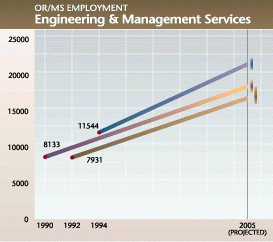
Figure 3
Services account for the most OR/MS actual and projected employment: nearly
48 percent of the 1994 total and 55 percent of the total projected for 2005.
The industries which anticipate adding the most OR/MS jobs are engineering
and management services (9,000 to 10,000 new jobs by 2005) and computer
and data processing services (4,300 to 6,300). In the finance, insurance
and real estate sector, the industries with highest anticipated growth of
OR/MS jobs are insurance carriers (3,200 to 3,700) and commercial banks
(1,000 to 1,300).
Note, however, that actual OR/MS employment in most of these industries
significantly decreased since 1990: from 8,408 in 1990 and 8,831 in 1992
to 7,317 in 1994 in computer and data processing services; from 5,684 in
1990 to 3,655 in 1994 in commercial banks; and from 9,370 in 1990 to 7,752
in 1994 in insurance carriers. Therefore, the projections should be interpreted
with some skepticism.

Figure 4
The decline of OR/MS employment has been most pronounced in the manufacturing
sector, which went from 9,167 OR analyst jobs in 1990 to 4,461 in 1994,
with projected employment nearly flat from the new, lower base. This trend,
combined with the decline in both actual and projected employment in the
federal government and U. S. Postal Service, appears to indicate not only
a change in employment levels, but also a shift in what kinds of OR/MS activities
will be most in demand.

Figure 5
Large-scale analyses of logistics and production may be giving way to market
analyses and business restructuring. If this is so, "softer" interpersonal
and communication skills and an understanding of marketing may take on greater
importance for job-seekers, while proficiency with the traditional tools
and techniques of the profession may be less valued.
The employment figures for the federal government and the U. S. Postal Service,
while relatively small, also portend a long-term shift in emphasis within
the profession. Federal contracts have supported large numbers of OR/MS
analysts; the decline of "in-house" OR/MS analysts indicates a
devaluing of this kind of work in the government and also reduces agencies'
ability to assess the quality and benefits of contractors' efforts.
Despite these problems, however, even the government-related picture may
be better than it seems, since the federal shutdown delayed much work already
planned and many agencies have yet to receive authorization to let new contracts.
The scramble to meet deadlines in spite of the delay has led some local
firms to start preparing to add people, and the release of the pent-up demand
by other agencies this spring and summer could lead to a surge of additional
hiring then, as agencies attempt to commit Fiscal Year 1996 money before
Sept. 30, when the fiscal year ends.

Figure 6
If this overview seems confusing, one reason is that the sources quoted
here are looking at different parts of the situation. Informal contacts
often run a few months ahead of orders -- or lack of orders -- to recruiters.
Recruiters see employers' current short-term needs, not their long-term
forecasts. The BLS figures are compiled from state-run establishment surveys
in which employers are given definitions of occupations and asked to give
actual and forecast employment for each occupation. An "operations
research analyst" is broadly defined, and includes anyone who does
quantitative analysis, preferably computer-assisted, of complex organizational
and technical problems. No educational requirements are specified, nor is
the use of any specific techniques.
This broad definition also helps to explain why the BLS total of approximately
44,000 OR/MS practitioners (college and university faculty are listed as
a separate occupational category, as are government and military) far exceeds
the total membership (about 12,000) of INFORMS, let alone the non-government,
non-academic practitioner membership, which is around 5,000. Unfortunately,
this also means that 80 to 90 percent of the employer-defined OR/MS practitioners
in the United States do not belong to INFORMS. Of course, this calculation
leaves unexplored the question of how many employer-defined practitioners
INFORMS would choose to include in its definition of the profession - a
question which is well outside the scope of this report.
The patterns of employment are pretty much consistent with earlier BLS reports
(see, for example, Samuelson, 1990 and Geoffrion, 1992) but the declining
numbers of actual jobs also indicate that past forecasts have been optimistic,
at least in the short term. In addition, both actual and projected employment
in the computer and data processing services have declined since the 1990
report, which may indicate that some jobs classified as OR analysts in 1990
in those sectors are now called something else. This in turn implies that
similar redefinitions may have occurred in other sectors as well.
Readers should also note that occupational misclassifications apparently
occur both ways. While some people who clearly would not fit INFORMS' usual
definition are counted as members of the profession, some people who do
fit INFORMS' definition are not counted. In Delaware, for example, long-time
INFORMS member Sid Hess points out that no OR analysts are listed in the
chemical industry, although several of the state's chemical companies have
OR departments. This could mean simply that none of these firms were among
those sampled, or it could mean (more likely) that the OR analysts were
counted in a different category.
On the other hand, the increase in both actual and projected employment
in the engineering and management services, and the decline in such sectors
as commercial banking, may indicate that, over time, employees are being
classified somewhat more consistently with INFORMS' definition of the profession.
In any case, the BLS statistics clearly imply that the profile of the profession,
as seen by employers, is changing significantly: market-oriented and process-oriented
skills seem to be gaining in importance, as do the sectors in which these
skills are paramount. This implication is consistent with recruiters' impressions.
The profession has endured a serious downturn, but the future is promising
for those OR/MS analysts who can meet the market's new demands.
References
1. Bureau of Labor Statistics, U. S. Department of Labor, "The Workforce
in 2005," Monthly Labor Review, Vol. 118, No. 11, November 1995;
and supplementary data tables available by request from the Office of Employment
Projections, BLS, USDOL, 2 Massachusetts Ave., N.E., Washington, DC 20212.
2. Geoffrion, Arthur M., "Forces, Trends, and Opportunities in OR,"
Operations Research, Vol. 40, No. 3, May-June 1992, pp. 423-445.
This was a revised and extended version of the Omega Rho Lecture delivered
at the November 1991 national meetings.
3. Samuelson, Doug, "Basic Research Threatened -- Squeeze on Analytical
Work Worsens," OR/MS Today, Vol. 17, No. 2, April 1990, p. 18.
4. Samuelson, Doug, "Labor Department Study: Major Changes in OR Opportunities,"
OR/MS Today, Vol. 17, No. 4, August 1990, p. 22.
Doug Samuelson is president of InfoLogix, Inc., a consulting firm in
Annandale, Va., near Washington, D.C. He is also a past president of the
Washington OR/MS Council and a frequent contributor to OR/MS Today.
For more information about this article, input the number
8 in the appropriate space on the Reader
Service Form
OR/MS Today Copyright © 2020 by the Institute for Operations
Research and the Management Sciences. All rights reserved.
Click here to
return to the table of contents.