
December 1996 € Volume 23 € Number 6
December 1996 € Volume 23 € Number 6
 Energy vs. the Environment
Exploring trade-offs with OR/MS: a fertile
source of challenges for the profession
Smog. Incipient global warming. Acid rain. Indoor air pollution. Burning fossil fuels cause most of our air quality problems.
Acid mine drainage. Oil spills. Disruption of salmon migrations. Our hunger for coal, oil and hydropower degrades water resources.
Nuclear waste repositories. Transmission lines. Off-shore drilling. Wind mills. Energy facilities dot our treasured natural areas.
Many environmental problems stem from decisions about how to satisfy our appetite for energy. Some problems are improving: The sulfur dioxide (SO2) emissions from power plants and smelters that cause acid rain are lower than they were in the 1950s. Others are stubborn: Industrial and vehicle releases of nitrogen oxides (NOx) and volatile organic compounds (VOCs) that lead to smog have remained constant for the last decade. Finally, emerging problems such as the greenhouse effect could worsen as developing nations rev up their economies and increase carbon dioxide (CO2) emissions.
Since the 1970 National Environmental Policy Act, U.S. agencies
have considered environmental impacts when making energy development
and regulation decisions. Private energy suppliers also weigh
environmental factors in planning and operations decisions -- not
only in response to government regulation, but also because consumers
search out "green" products. But numerous alternatives, complex
systems and conflicting objectives make such consideration difficult.
This article highlights some ways that OR/MS professionals help meet
these challenges.
Challenge No. 1: Sorting through the options
Environmental laws increasingly offer economic incentives to reduce
pollution. Many of these laws, such as the 1990 federal acid rain
legislation, have the added appeal of rewarding overall performance
(i.e., reductions in system-wide emissions). In contrast, traditional
"command-and-control" regulation micro-managed decisions about fuels
and emissions controls. Such regulations hamstrung energy firms,
yielding higher costs and more pollution than necessary. The new laws
take compliance decisions out of the hands of the plant engineer and
make them the concern of everyone in the company. With the focus now
on system performance, the new incentives affect any decision that
influences emissions -- including capital budgeting, marketing and
operations.
The advantage of the incentive-based approach to environmental
regulation is the flexibility it gives management. This flexibility
lowers the cost to electric utilities of accomplishing the goals of
the acid rain legislation several fold. Yet this flexibility also has
a disadvantage: more options and complexity. This creates a need for
people with OR/MS skills.
Planning and operations options for utilities
As an example of this complexity, consider electric utilities.
Planning and operating power systems involves several interlinked
tasks. Accomplishing each so that consumers receive power reliably at
an acceptable economic and environmental cost is hugely difficult for
several reasons.
First, the system itself encompasses an interconnected array of many electrical machines and circuits. Maintaining acceptable voltages and frequency under rapidly changing circumstances is daunting.
Second, scheduling short-run generation and load management to minimize costs is complicated because of the sheer number of possible schedules.
Third, long-term planning involves sorting through a wide range of possible energy supply and demand-side management (DSM) options and in-service dates, while keeping in mind their implications for short-term operations and numerous cost and non-cost criteria. Supply options include traditional hydro, fossil steam and nuclear generators, along with increasingly popular combustion turbine, combined cycle and renewable technologies (wind, photovoltaic, etc.).
DSM options are increasingly important. They consist of measures that alter the timing and amount of energy demands. Examples include energy efficiency (e.g., subsidization of high efficiency lamps), sales promotion, shifting of loads from peak to off-peak periods (e.g., thermal storage by customers), and pricing reforms such as peak load pricing.
Performance-based environmental laws affect all of these decisions. For instance, emissions are considered in operations when there are economic penalties for SO2 and NOx emissions. This results in "emissions dispatch," in which cleaner plants generate more power and polluting plants generate less than they would if they were dispatched to minimize fuel costs.
Environmental impacts are also important in intermediate range
fuel planning, especially because many power plants can switch fuels
(e.g., coal and natural gas). Finally, environmental factors
influence capital budgeting decisions; in particular, decisions
concerning what mix of supply and DSM resources to obtain, where to
site them, and what pollution controls to install.
Optimizing the options
Operations research professionals have stepped up to the challenge of
increased flexibility. For instance, with their help, the electric
industry has moved from a pre-1990 posture of "emissions dispatch is
impossible" to routine incorporation of emissions as constraints or
penalties in "energy management systems" [Talaq et al., 1994]. These
systems include mixed-integer nonlinear programs for scheduling
generation on a day- or week-ahead basis, and continuous nonlinear
programs for real-time dispatch. Utilities spend tens of millions of
dollars annually on these systems.
Fundamental mathematical challenges remain in utility operations, such as the inclusion of the nonlinear AC power flows in scheduling. Future environmental regulations will further complicate these models. An example is proposed seasonal rules that will allow limited trading of NOx permits in the northeastern United States. Thus, utility operations will continue to demand people with OR/MS skills.
Shifting to the long-term, OR/MS professionals have modified utility investment models to reckon with myriad emissions reduction. One approach is to add environmental decision variables (such as purchases of permits or scrubbers) to existing capacity expansion models. But because many options exist for each generator, some utilities instead adopt models that focus on emissions decisions.
EC-VIEW is an example of such a model which has been applied by
several utilities [EDS 1996]. It is based on the mixed integer
stochastic programming model of Huang and Hobbs [1994]. Generalized
Benders decomposition divides the problem into a master problem in
which 0-1 variables represent emissions controls and fuels at
individual generators, and subproblems that model system operation.
The subproblems use a convolution-based greedy algorithm called
"probabilistic production costing" to account for variations in
demands and generator availability.
Challenge No. 2: What are the impacts?
Markets and environmental systems are wonderfully and frustratingly
complex, making it difficult to trace the net environmental impacts
of decisions. Systems can react counterintuitively, with net
environmental impacts being different in magnitude and even direction
than anticipated.
For example, one of the arguments for DSM programs has been the emissions reductions they would yield. Yet in a dynamic context, where electric generation capacity is being added and technology improved, DSM can actually worsen emissions. The reason is that programs directed at reducing demand peaks delay new capacity additions. But these additions, usually fueled by natural gas, are much cleaner than existing, often coal-fired capacity. Deferring additions can increase pollution over the next 10 to 20 years.
This effect has been demonstrated using capacity expansion models.
For instance, the DP model PROVIEW/PROSCREEN II®, used by almost
100 electric utilities, showed that this occurs with certain DSM
programs in Florida [Westholm, 1994]. To obtain that insight, the
system-wide perspective provided by optimization models was
essential.
Market impacts
Market interactions also lead to surprising conclusions about the net
environmental impact of energy decisions. For instance, some
utilities want to choose energy sources and DSM programs that most
effectively lower CO2 emissions. It sometimes turns out that
increasing the company's sales and CO2 emissions would actually be
the best way to lower total national CO2 emissions -- which is what
counts! This can happen because the company competes with dirtier
energy sources.
Sorting out the net emission impacts of supply and marketing strategies is difficult and controversial. Optimization-based market simulation models can help. They have their roots in the Project Independence effort of the 1970s, and are widely used by policyanalysts [Murphy and Shaw, 1995]. For instance, the Comprehensive Electric Utility Model (CEUM) [ICF, 1995], a large-scale LP, has helped federal agencies project the emission and cost impacts of many proposed environmental and energy laws and regulations.
Because restructuring is making power markets more competitive (e.g., California's legislature unanimously passed a radical deregulation bill last August), utilities and power marketers are beginning to use such models for market intelligence. Those models are also useful for sorting out the net environmental impacts of a firm's actions.
Most of these models obtain market price equilibria by assuming that such markets are perfectly competitive (i.e., firms are price takers). Some models calculate such equilibria by maximizing the sum of producer and consumer surplus. Others use a complementarity approach, in which quantities are adjusted until marginal cost conditions are satisfied.
Environmental impacts depend not only on the amount of emissions, but also on where and when they take place. Thus, spatially and temporally disaggregate market models are preferred for projecting environmental impacts. An example of such a market model is PM-DAM (Power Market Decision Analysis Model) [Cazalet, 1991]. PM-DAM calculates spatial price equilibria for a range of hydropower and demand conditions. A search algorithm determines the Lagrangian multipliers at each location that satisfy complementarity conditions for a competitive power market.
The need for such an approach was evident in recent work I was involved in at BC Gas in Canada. The net impact of that utility's actions within a market context became the most controversial issue. An advisory group of stakeholders reached agreement on all issues except whether aggressive marketing of natural gas at the expense of electricity would have a net positive environ mental impact. The reason for this disagreement was a lack of understanding of where marginal gas and power supplies would come from. Would future power come from renewable sources in British Columbia, or would fossil generation elsewhere be required?
No model of North American energy markets was readily available to
answer the question; consequently, BC Gas had to withdraw its gas
marketing proposal. Wider use of market models like PM-DAM could help
settle such controversies.
Global impact assessment
Turning now to global issues, interactions among policies directed at
different environmental problems can also interact in unexpected
ways. For instance, policies aimed at decreasing acid rain can worsen
the greenhouse effect. This is because SO2 -- the target of such
laws -- is converted to sulfate, which increases the reflectivity
of the earth, which in turn can lower temperatures and partially
counter the warming caused by higher CO2 concentrations. These types
of issues are addressed using integrated assessment -- ensembles of
interfaced economic, emissions, climate and other models whose
purpose is to simulate impacts of alternative policies upon global
environmental conditions [Dowlatabadi, 1995].
The OR/MS challenges in such undertakings are many. Some concern modeling: How can economic and physical processes be aggregated to multinational or global scales and still respond in a credible manner to changes in national policies? Other challenges are about decisions: How can we assess dynamic strategies for preventing and adapting to climate change that account for the resolution of climate uncertainties over time? How can the results of such models, including criteria trade-offs and risks, be effectively communicated to policy makers?
Presently, integrated assessment often seems like an autonomous
activity, divorced from any specific decision-making context. And, as
OR/MS people know, information that cannot alter decisions has no
value.
Challenge No. 3: Comparing apples and oranges
Due to the extent of the energy industry's environmental impacts and
the many public agencies who oversee it, multiple criteria are a fact
of life for energy decision makers. Routing transmission lines, for
example, involves trade-offs between cost, reliability, aesthetics
and, potentially, human health. Generator dispatchers must weigh
economic, system security, and emissions effects. Resource planning
encompasses economic, financial, social and environmental criteria.
Finally, energy policy makers, as the debate over President Clinton's
proposed BTU tax showed, must deal with the broadest trade-offs of
all. Consequently, energy has become one of the most important
applications for the OR/MS tool of multicriteria analysis.
Multicriteria analysis serves two purposes: displaying trade-offs and
quantifying value judgments.
Trade-off case study: BC Hydro
As an example of the first purpose, Figure 1 plots eight portfolios
of supply and DSM resources available to BC Hydro. The performance of
these plans on two criteria are shown: cost (present value) and CO2
emissions. The figure reveals that no plan is superior in both
criteria, although some plans are dominated by others. To emit less
CO2, higher costs must be incurred as a result of, for instance,
substituting more costly renewable or DSM resources for coal. Such
plots give important insights.
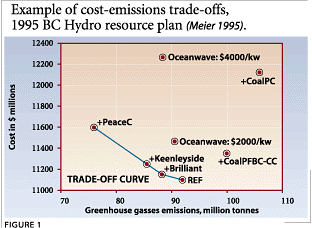
The BC Hydro 1995 resource plan provides an example of such insight. Sixteen stakeholders, representing a range of interests, gathered to make recommendations on resource additions. Prior to that time, environmental groups objected to BC Hydro's intention to upgrade its Burrard natural gas-fired plant. The fear was that such "repowering" would encourage fossil fuel use and more emissions. However, trade-off plots such as Figure 1 demonstrate that most nondominated points included Burrard repowering. After exploring the reasons for this result, environmentalists decided to support the Burrard repowering.
Trade-off displays have been similarly used in New England and
elsewhere to build insight and promote consensus in energy planning
[e.g., Andrews, 1992]. For instance, such an analysis contributed to
the Tennessee Valley Authority's recent cancellation of its
unfinished nuclear plants.
Quantifying values
The second purpose of multicriteria methods is to help users define
and articulate their values and apply them consistently. The hope is
to inspire confidence in the decision without being unnecessarily
difficult. Multicriteria methods can also help negotiation, by
communicating the different people's priorities.
A difficulty with value quantification is that most people will be unsure of their priorities when a decision involves a unique problem along with strongly held yet conflicting values. Ample evidence shows that articulated values will then depend on supposedly irrelevant details, such as the exact phrasing of questions. As a result, different methods may yield different decisions.
Indeed, experiments I've conducted with energy planners have shown
that the method applied can affect plan ranks as much as who uses the
method. In such circumstances, multicriteria methods are most
appropriate for helping people form a coherent, defensible set of
values, and understand the implications of those values for the
decision.
Value quantification Case Study: BC Gas
BC Gas assembled a group of stakeholders in 1995 to advise them on
their resource plan [Hobbs and Horn, 1996]. The stakeholders
evaluated
20 DSM programs, ranging from efficiency improvements to promotion of natural-gas vehicles and switching of water heating from electricity to gas. Recognizing that the stake holders did not have value functions that were merely waiting to be extracted, I asked the stakeholders to apply more than one multicriteria method, hoping that viewing the problem in different ways would build insight and promote discussion.
Each stakeholder chose criteria weights for additive value functions by two methods. First, each person stated the dollar worth of a given change in each of the other criteria. Second, people applied a hybrid of swing weighting and the Analytical Hierarchy Process. They compared criteria two at a time; the ratios of their relative importance were obtained by asking which criterion each person would rather "swing" up from its worst possible value to its best.
Each stakeholder's two sets of weights were then used to evaluate
the proposed programs. Unsurprisingly, each person's evaluations were
contradictory, often strongly so. I then interviewed each
stakeholder, allowing them to resolve inconsistencies, and make a
revised set of weights and recommendations to bring to the group.
Usually, inconsistencies were resolved in favor of the swing
weighting/AHP results, although a minority of stakeholders preferred
the other approach. Group discussions led to a set of recommendations
on the programs. The stakeholders later indicated that the resolution
of inconsistencies gave valuable insights and was essential to the
success of the process.
Conclusion
Quantifying the environmental impacts of energy choices is a tricky
business, and the high stakes involved make decisions difficult and
contentious. OR/MS researchers and practitioners have helped
companies and public agencies deal with these problems by providing
tools for sorting through the options, quantifying their economic and
environmental impacts, and helping planners, policy makers and
stakeholders understand and make trade-offs.
Many difficult choices will be made in the next few years, including prevention of global warming, restructuring our energy industries, disposing of nuclear waste, and dealing with our stubborn urban smog problems. The energy and environment field promises to remain a fertile source of challenges to our profession.
|
Applications of Operations Research Here are just a few suggestions for future development and application of OR/MS tools in the energy and environment field:
|
References
1. Andrews, C.J., "Spurring Inventiveness by Analyzing Tradeoffs: A Public Look at New England's Electricity Alternatives," Environmental Impact Assessment Review, Vol. 12, pp. 185-210, 1995.
2. Cazalet, E.G., 1991, "Power Market Decision Analysis Model Methodology Report," Report submitted to the Bonneville Power Authority, Consulting Decision Analysts, Los Altos Hills, Calif., 1991.
3. Dowlatabadi, H., "Integrated Assessment of Climate Change, An Incomplete Overview," Energy Policy, Vol. 23, pp. 289-295, 1995.
4. EDS Utilities Division, PROVIEW/PROSCREEN II®, Atlanta, Ga., 1996.
5. B.F. Hobbs and G.T.F. Horn, "Building Confidence in Energy Planning: A Multimethod MCDM Approach to Demand-Side Planning at BC Gas," Energy Policy, in press (1996).
6. Huang, W., and B.F. Hobbs, "Optimal SO2 Compliance Planning Using Probabilistic Production Costing and Generalized Benders Decomposition," IEEE Trans. Power Systems, Vol. 9, pp. 174-180, 1994.
7. ICF Inc., "Summary Overview -- ICF's Integrated Coal and Electric Utility System Models," Final Environmental Impact Statement on Rule 888, Federal Energy Regulatory Commission, 1996.
8. Meier, P.M., "Resource Trade-off Decision Analysis for BC Hydro's 1995 Integrated Electricity Plan," Prepared for the BC Hydro Planning Integration and Consultation Department by IDEA, Inc., Washington, D.C., 1995.
9. F.H. Murphy and S.H. Shaw, "The Evolution of Energy Modeling at the Federal Energy Administration and the Energy Information Administration," Interfaces, Vol. 25, pp. 173-193, 1995.
10. Talaq, J.H., F. El-Hawary, and M.E. El-Hawary, "A Summary of Environmental/Economic Dispatch Algorithms," IEEE Trans. Power Systems, Vol. 9, pp. 1508-1516, 1994.
11. Westholm, P., "Assessing the Impact of Direct Load Control Programs," in Third Intl. Energy Efficiency & DSM Conference: Charting the Future, Synergic Resources Corp., Bala Cynwyd, Pa., pp. 131-143, 1994.
Benjamin F. Hobbs is professor of Geography and
Environmental Engineering at The Johns Hopkins University. Hobbs
earned his Ph.D. at Cornell, and has held positions at Oak Ridge and
Brookhaven National Laboratories and Case Western Reserve University.
He is Area Editor for Environment, Energy and Natural Resources for
Operations Research and welcomes submissions on those
subjects. He can be contacted at
[email protected]