


VOLUME 1, NUMBER 4 | WINTER 1998

Featured Company:
Svedala Industri AB
As enterprises grow, they often take on new cultures and identities. This is especially true for companies that acquire or merge with others on their path to global success. The sum of these many parts can be enormously complex; the systems that tie them together even more so. An example of the "collection of companies" type of enterprise is Swedish manufacturer Svedala.
Managing Mergers, Acquisitions and Technology
By Tom Inglesby
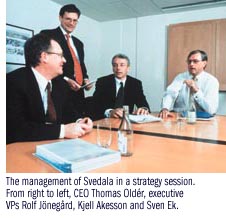 Its world headquarters is in Malmö along the southern coast of Sweden, but Svedala has offices in 48 countries to provide customer service and sales close to the purchasers of its heavy equipment. Sales are almost even in Europe — 41 percent — and North America — 31 percent — with Asia/Pacific accounting for 9 percent and the rest of the world at 18 percent. Svedala's revenue (net sales) for 1997 was 13.6 billion SEK ($1.68 billion) with a net profit of 676 million SEK ($83.4 million). In the same period, Svedala had acquired five companies and divested two others from its "collection."
Svedala's strategy is to:
- Serve as a total supplier of mechanical equipment and replacement parts for the construction and mining industries.
- Build its own sales and service organization in close proximity to customers in all major markets.
- Quickly become a global company and world market leader.
In 10 years, it has accomplished these targets quite handily. Thomas Oldèr, CEO of Svedala, admits, "Things have gone much faster than we envisioned at the start. We have experienced a downhill snowball effect with everything going faster and faster. But we have proved our concept is viable. Return on capital employed by the Svedala Group is equal to the best levels of return in the engineering industry and our operating margin is 7 to 8 percent despite acquisitions — including some companies with weak profitability."
In fact, Svedala has acquired about 100 companies, some with 50-100 years of industrial experience and well-known trade names. Oldèr comments, "Companies acquired by Svedala are characterized by good products and sophisticated technological skills. However, many of them were too small and local to provide profitable customer service in all parts of the world. Comprehensive structural changes we implemented help acquired companies reduce costs, release capital assets and quickly increase capital return when they gain access to our marketing and service organizations."
Oldèr continues, "We have developed a structure, a platform, we can live with for a long time. Acquisitions have become a matter of opportunity, not necessity. There are many companies that would supplement our present operations. We have learned how to integrate new companies in the Group and, through restructuring, quickly increase their capital return to our target level of 20 percent. In all our acquisitions, we always focus on certain key ratios, with particularly critical importance attached to what any acquisition will mean to our earnings per share, and its general suitability to our core business concepts."
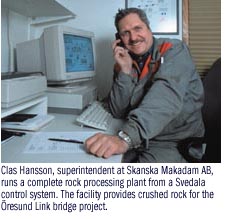 But Svedala doesn't just buy companies, it sells them as well. "We also divest companies," explains Oldèr. "Buying and selling companies is nothing out of the ordinary for Svedala but rather a normal part of operations that contributes to earnings growth. In many cases, after we restructured and raised the company's profitability, the operations have been divested. Over the years, we have sold companies with annual sales about 2.5 billion SEK ($307 million)."
A common set of standard systems is being implemented across all manufacturing operations. By moving acquired companies from a wide variety of legacy systems to a common standard, Svedala hopes to increase their profitability ratios even faster. In charge of the restructuring of information systems is Mats Tedenryd, IT manager. Tedenryd doesn't choose the systems; he is responsible for their evaluation from a cost performance, not technical performance standpoint. As he says, "We have about 500 people in our group working with information technology. They are very innovative. Basically, what we have done is scrutinize all ideas in our group. There isn't anything you could think of that somebody in our group hasn't thought about. We don't have to come up with many ideas. We judge ideas that other people come up with from a financial perspective."
Those ideas can be simple or esoteric. In the end, however, the question remains the same. "They come and say they want to buy this system," Tedenryd says, "and we ask them why. They have to explain that to us from a financial viewpoint. If there is any way that there will be a payback, then we do it. We have as a standard payback limit in our group of three years. As far as information technology is concerned, because of the greater risk and shorter life-length, we try to have a shorter payback."
Even so, there are other criteria Svedala uses. "We don't look purely at the time aspect," says Tendenryd. "It could be an investment with a payback of five years, or one that would never pay back but they have to have a new system. You can't make a serious calculation on it. Sometimes it's the payback of avoiding disaster."
In commenting on the integration of Svedala's spate of acquisitions, Tedenryd adds, "We have grown 30 times since we were founded in 1987. We have typically bought companies in our business that were in or close to bankruptcy. In some cases, they had many hundreds of employees and big plants. In some cases, we shut down a plant because it was located in a high-cost country. We kept the engineers and the sales force, reducing the number of employees drastically. But even after such a reduction in size, for some reason, the IT department tended to remain intact. They might have a mainframe computer, an IT manager and 20 employees, out of which 10 were programmers maintaining their homemade business system. Other people were maintaining the mainframe and supporting PCs and UNIX boxes. Three years ago, we had a lot of companies like that."
It takes a strong will to make changes with a new acquisition, but Tedenryd seems to have the will and the way. "When we started, we went into those companies and said from now on you aren't going to have that mainframe with a homemade system. You are going to have a standard business system running on an NT platform. You are going to have maybe eight people. We saved a lot of money there. We used to buy a new mainframe every three years to keep up in performance, maintenance and having the right operating systems. Today the cost difference isn't that great between a mainframe or mini-computer and an NT computer. Three years ago, the difference was great. Another cost was the employees themselves, especially in those countries that had high wages or salaries."
Under Svedala, the companies rapidly changed from centralized computing to a networked one based on Microsoft's Windows NT operating system. In examining the payback, Tedenryd comments, "When PCs became less expensive, we could replace an expensive mainframe and dumb terminals with very inexpensive PC servers and clients. It also was feasible since the number of users had decreased enormously at each of our companies. Still, they had an investment in the system, staff and everything. Many came up with arguments that they wouldn't change to a PC system, because it's less expensive to have centralized computing, but they did replace all the dumb terminals with PCs anyway. All users wanted Microsoft Office and e-mail, so they ended up with PC clients on all the desks anyway."
Svedala could have avoided using PCs if it could convince its users to give up their general-purpose office suites of programs. Then the "dumb terminal" approach would have saved additional money. But today, for total efficiency, the company realized that it had to have PC clients on most of the desks. An option is to have a fairly dumb PC, a so-called network computer (NC) or a terminal using terminal emulation, and then run office packages from a central server. "We are going towards that," acknowledges Tedenryd. "In our Colorado Springs, Colo., facility, we used to have a mainframe, and now we run our ERP system, Avanté, on a PC server. However, all the users don't have PCs. Some have terminals or NCs that are connected to the central NT servers where they run the office packages. That way we achieve centralized computing with an inexpensive PC server, and still have access to office packages and e-mail for all the users."
They are in the process of standardizing on one brand of PC across all the divisions. Once the decision is made, all replacement and new PCs will be from the chosen vendor. As an extreme example, with the reputation Compaq has for service after the sale, compared to Dell's "mail order" approach, it might come down to support as a critical element in the choice. Or, maybe not. "Service and support are obviously two of the basic elements," Tedenryd admits. "In the area of support and service, let's assume that Compaq is one of the best globally. It still is not good enough. You can't totally rely on the supplier's support. You have to have a disaster plan. You have to have a spare computer, spare server. Because of that, the service isn't as crucial in reality as it is in theory."
Tedenryd believes that Compaq, through the acquisition of Digital, has a more complete product portfolio with the Alpha servers. "We need to buy a batch of Alphas every year for the DataWorks installation. Looking at the number of boxes, it's just 2 percent or less of the total."
"We have 5,500 PCs in our group," Tedenryd continues. "That number is increasing. We still have a lot of dumb terminals that we are replacing. We have a lot of people who never had anything on their table at all. The sales force, for example, is being equipped with laptops. Even though the margins are not high in the PC business, especially on standard desktops, there is a margin that will allow them to give us a good discount. We have standardized on five types of computers: desktops, laptops, two different workstation models — one for CAD engineers, one for Parametric Technology's Pro-engineer — and one model of server. Individual IT departments can add on discs, processors and memory to the server. And if one server isn't powerful enough, we buy another. We aren't very strict on the server side, but we try to avoid overkill."
Acting in the capacity of a check against the often ambitious desires of the IT organizations, Tedenryd claims to be less interested in the technology than the benefits. "Purely from a financial perspective, if a computer is 20 percent faster than another one, it might save you a few minutes a day. But if that faster computer is 5,000 SEK ($615) more than another one, there's no payback in that for the company. You have to balance and be somewhere in the middle. Some of our IT people want Ferraris when a Volvo would do the job."
Standardization continues with the software systems Svedala is implementing across its many companies. Again, two companies represent the manufacturing or ERP software solutions they are buying. For smaller companies or divisions, the choice was software from a former Swedish company that is now based in The Netherlands, Scala Business Systems NV. For the larger companies, Svedala chose DataWorks of San Diego as its IT partner. They have implemented Avanté in five major facilities and recently signed an agreement to migrate the software to five additional sites.
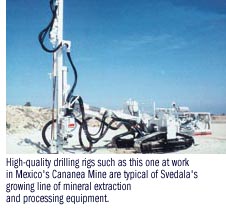 "Standardizing our business systems is going to improve and facilitate our work enormously," comments Tedenryd. "All 270 subsidiaries (divisions, offices and branches worldwide) report their monthly book closings to us here in the headquarters. They press a key and it's sent, consolidated and checked automatically. Within two or three hours, the database is available to hundreds of managers all over the world. We really feel it is an advantage to have a standard system all over the world to bridge the differences between the countries, to facilitate consolidations. If you have a standard, you can move people between locations. There are a lot of small advantages."
Svedala is very much a collection of small and mid-sized companies. That fact influenced its decision to go with a software system. Again, Tedenryd explains their evaluation process. "When we decided we wanted to standardize our business systems, we made an evaluation of the top business systems — SAP, Baan, PeopleSoft, Computer Associates, J.D. Edwards — and we looked at a few of the smaller ones. We formed a group of 12 people that represented all our companies all over the world, along with the different business areas within the companies. They also represented different kinds of manufacturing that we have. They were from different functions, like financial, manufacturing, data processing. We evaluated all those business systems. All of them, except SAP, were already installed at one or more of our locations."
Up against such competition, how did a small vendor come into the picture? "We had heard of DataWorks and that its Avanté product is designed for mid-range companies," Tedenryd says. "So we went to San Diego to check them out. Their idea was to make their product international, and the ambition of being global was impressive. In the end, we negotiated a mutually beneficial, win-win relationship. We would help them get established in new countries on a pace that was mutually acceptable. They would translate the product and nationalize it, open or buy a branch in the countries we were going into, and we would take the consequence of being their first customer. In effect, we would support and promote them. That's how we ended up with Avanté running on NT. It has proven to be practical up to 300 users.
"DataWorks is our standard system, but there will be exceptions. The most common exception is that the system is not available in that country," says Tendenryd. "In retrospect, we are glad we have taken DataWorks and Avanté because it's superior to the alternatives. Not that we could never think of having any other system besides Avanté. But it's the best in total."
We'd be very interested in hearing your comments and experiences with buying PCs from direct marketers such as Dell and Gateway vs. companies such as IBM, Hewlett-Packard and Compaq.
E-mail your comments and suggestions to: |