


VOLUME 1, NUMBER 3 | WINTER 1998
 |
Cell-Based Manufacturing Takes Off by Kathleen Bunten Senior Editor — Europe |
|
British Aerospace's Military Aircraft & Aerostructures division is part of one of the most powerful European aerospace companies and has partnership agreements with over 20 countries on a wide range of collaborative programs. It also is a leading systems integration and prime contractor for military aircraft. British Aerospace's Samlesbury plant in northwest England currently manufactures major units for military aircraft such as the T45A Goshawk, Harrier variants and Tornado. On the civil side, it produces leading/trailing edges and other wing subassemblies for the Airbus A320 family. Samlesbury will be applying its lean manufacturing techniques in producing the Eurofighter Typhoon, a major next generation aircraft collaborative project with Germany, Italy and Spain. In the process, the company is moving from a traditional manufacturing system to a largely self-managed, cell-based environment in which people are the key. Kathleen Bunten interviewed Stuart Mellor, site general manager at Samlesbury, about the challenges involved in making the transition. |

Bunten: What does lean manufacturing mean at Samlesbury and how are you applying it?
Mellor: The company went through a considerable readjustment period about six years ago when the old manufacturing site in Preston was closed, and it was decided to concentrate manufacturing at Samlesbury. We needed a strategy to ensure consistency in everything we did. We looked at four elements: our people, the organization, engineering and logistics, and the key enablers within those segments. We realized that if we drove those key enablers as strategy consistently over a period of time, it would take us down the lean manufacturing route. We also established five essential values: people; performance; partnerships; customers; and innovation and technology.
Lean manufacturing means improvements in logistics, introducing systems such as direct line feed (DLF), looking at issues such as schedule adherence, JIT (Just-in-Time) and using processes such as kanban, which pulls work through the system rather than pushing it as in the traditional manufacturing control system. The advantages of this is greater control over work in progress, improved efficiency and a much leaner operation with far fewer stores (inventory).
You can only drive the Just-in-Time philosophy if you have meaningful partnerships with suppliers. You can't expect suppliers to take all the risk and none of the benefits. You've got to share. You don't achieve that overnight.
 What are the important factors in switching from traditional manufacturing methods to innovative ones?
It is particularly important to address those issues that surround people. In a traditional manufacturing environment, work in progress is seeing huge piles around the factory, giving people a sense of security that they've got plenty of work. When you move away from that, you have to make sure that people understand the change in the operation and do not feel threatened. There are a number of ways of doing that. The constant elements are education, training and development of the people who work here.
What drives this learning environment?
We are producing a new aircraft, Eurofighter Typhoon, which involves completely new manufacturing technologies and new materials. Some of our traditionally skilled people are going to have to be completely retrained to work on this product. Given the competitive requirements of Eurofighter Typhoon, it really does drive us to make sure that it is successful. To this end, the work force is probably more involved in the business than ever before. Senior trade union officials, who represent the bulk of our employees, meet with company executives up to the level of chairman to talk about corporate strategy.
Manufacturing at Samlesbury is cell-based. How successful is that?
Cellular manufacturing is installed pretty well across the whole of the factory to different levels of success. In a number of areas we have almost completely self-managed teams, where the supervisor — the leader element of the cell — is almost lifted out of the cell to peripheral management control activities, and the cell is responsible for making sure that the work is achieved. People in the cells understand manufacturing metrics and how they apply to their areas of work.
Visitors from partners such as Lockheed-Martin and Boeing say that the real lead in lean manufacturing is achieved by the way in which people are managed. They are impressed by the autonomy and self-management potential that is afforded to people in the cells. Of course, there is quite a level of risk in the initial stages, but when you reach the level of empowerment where people have responsibility and accountability for their own performance within the cell, then things such as peer pressure within the cell help to achieve what managerial pressure alone cannot. Broadening the traditional roles of manufacturing workers to enhance their responsibility and accountability in the work environment creates motivation. The cells publish their targets and their shop floor colleagues give them a "reality check."
You have an innovative approach to workflow in terms of information throughput. Your designs accompany the product through the shop floor. Could you elaborate on how that has improved production?
Our company has been particularly successful in putting together an integrated process, and we have operated that through IPTs (integrated product teams). These pull together design, manufacturing, purchasing and elements of the supply chain. They work together at the initial design concept stage, so that the design that comes out of the IPT hits the shop floor right the first time.
We look at the way design information flows. This is a great improvement over the traditional system in which the design office designed a product through the first theoretical stages, gave it to the manufacturing people, who found that they couldn't make certain things, thus requiring changes being played back into the technical area. This was very time consuming.
 What has facilitated this information flow?
We have made considerable investment in IT (information technology), specifically in CATIA, our CAD (computer-aided design) system that includes a 3-D modeling system. That technology used within the framework of the IPT has enabled us to drive the improvements in manufacturing technology needed to make the Eurofighter Typhoon program targets. We are decreasing the traditional makespan (time from design to first product) from 36 months for the previous fighter program, the Tornado, to 18 months for the Eurofighter Typhoon. So we are actually halving the traditional makespan while looking at state-of-the-art tolerances which have never been achieved before.
How did you prepare for Eurofighter Typhoon production?
We established a Eurofighter Typhoon training school in which the operators move through a replica of the shop floor environment and learn all the competencies to put the aircraft together. They are taught to use what will be a paperless system — the people on the shop floor will access CATIA directly to get the information they need. Having state-of-the-art interactive computers on the shop floor is a totally new concept.
What innovations are being introduced for Eurofighter Typhoon production?
When we looked at manufacturing Eurofighter Typhoon, the technologies involved, the high tolerances that are often measured in microns, the differences in the aircraft structure and the way we put it together, it was obvious that the assembly environment would have to be entirely different compared to that for Tornado. For example, floor layout for assembly can now be changed at any time very easily. The concept of stanchions and a raised floor was actually put together by people in the work environment. We have the view that the people who are doing the job are the ones who know it best and can help with the process improvements.
The new tooling facility is a blend of an office environment — temperature controlled, immaculately clean and ordered, with well-kept tool control systems. The people who work there have an intense pride in their working environment.
Do you make a lot of your own tools?
With Eurofighter Typhoon, 80 percent of the required tooling workload is being made outside the company. Key value-added tooling work, that of strategic importance and with a high technological element, is being done within the company. We invested �14 million ($23.28 million) in our own tool room which was opened in May of 1998.
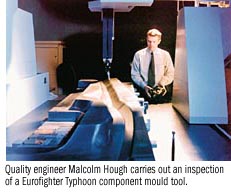
We will produce 22,000 tools for Eurofighter Typhoon. Among other things, they are designed to produce carbon fiber components. The levels of accuracy required mean that the tools are completely different from those for any other aircraft.
The tools are adaptable. We firmly believe in getting the processes and tools right. Though by and large they are singularly allocated against Eurofighter Typhoon in the initial phase, those tools will be kept for producing tools for other projects such as the Joint Strike Fighter.
You also work on a variety of other aircraft. How do you keep your manufacturing processes flexible enough to cope with relatively small numbers of military aircraft and larger numbers of commercial orders?
That is one of the joys of manufacturing, because we have learned a lot from both types of programs. On civil aircraft, affordability is the driver; with the military aircraft, it is technology. When you put the two together, it really does help us in manufacturing. It is unusual within UK aerospace that Samlesbury has the two aspects on the same site.
It is possible to apply lean manufacturing techniques across both civil and military aircraft production. Principles of kanban, JIT, production control and manufacturing support systems can be applied to both. There are some differences in technology, but they don't necessarily create problems with the manufacturing process when applied to both military and civil aircraft. Also, in both you want to delight the customer, and that's another one of our key values. Quite rightly, our customers are more and more demanding: They want better quality, the product more quickly, at a lower cost. It's a competitive market.
One of the main opportunities in the varied product range is the difference in skills competency for the projects. At present one of our key projects is the A320 Airbus family. The standards required for civil aircraft are different from those required for a military project, especially one like Eurofighter Typhoon, which has new technologies and materials being used extensively in the build process.
How do you ensure quality control?
Quality is ingrained in everybody at British Aerospace. Quality goes all the way through from the design process to the shop floor. Now that we have the IPT structure and people working together in teams, it tends to create an infectious belief in quality.
The IPT was designed to deliver concurrent engineering. The designer puts the product together, but with direct input from the manufacturing person on how to make it easier to manufacture.
A lot of the problems we used to have down the line in the traditional system are ironed out right at the initial phase. We also have purchasing and engineering planning people in the IPT. It creates a much better product for the customer. It isn't just whether you can make a piece and fit it to another piece, it's whether the fitter who fits it really feels he can get his hands around it and actually take it to bits. If he can't, what chance does a service fitter in the customer's service workshop stand? When we produce products now, we're talking about the whole life cycle. It doesn't end when we sell the aircraft. We're talking about maintaining and supporting it.
Have you applied principles from other industries in manufacturing?
One of our philosophies is that we look at best practice, not just in the aerospace industry, but throughout all industry. If we find something which saves time, we'll use it. We want not only to be best in aerospace, we want to be best in manufacturing.
We've done a lot of benchmarking across multiple industries across the world. We've had a lot of direct involvement with Japanese industry, for example. We've sent management working teams to Japan to learn about Japanese methodologies.
We've had a lot of teams out in the States with the aircraft manufacturers. We're partnered with Lockheed-Martin on JSF, and with Boeing on Nimrod. There have been quite a few lessons learned from the automotive industry, particularly in JIT, delivery by direct line feed, supply chain relationships, etc.
With projects like Airbus, the manufacturing technologies are completely open across the project. With programs like Eurofighter Typhoon, our partner companies are fully aware of the technologies we have and we of theirs. So it is two way: They are true working partnerships. We have also extended that to Saab of course, because we have purchased 35 percent of Saab and the Gripen fighter program is a true partnership.
What about the future for British Aerospace as a manufacturer?
In the future there may be certain centers of excellence for elements of manufacturing. Some may well be carried by partner companies, some by ourselves. It's still early, though. Certain higher technologies like avionics or systems design and systems integration might be specific to one of the partners.
For British Aerospace, the future will bring greater rationalization in terms of us manufacturing strategic items and probably greater use of the manufacturing base that exists outside of aerospace, that is, subcontracting. Once again, the message is that our people are fundamental to everything.
Web Site © Copyright 2020, 1999 by Lionheart Publishing, Inc.
All rights reserved.

Lionheart Publishing, Inc.
2555 Cumberland Parkway, Suite 299, Atlanta, GA 30339 USA
Phone: +44 23 8110 3411 |
E-mail:
Web: www.lionheartpub.com

Web Design by Premier Web Designs
E-mail: [email protected]