


VOLUME 1, NUMBER 4 | WINTER 1998
It is often difficult to understand the specific roles that each particular organization contributes to the design and launch of a new product. It is often true that members of individual departments have specific agendas in mind for their own reasons, and they believe that the demands placed on them by other departments to be unreasonable. Program directors and management teams have the complex task of bringing all facets of the company together to get a new product released to market in the correct configuration and at the right time.
A good example of this conflict is the discordance between a marketing team's expected set of features when compared against an engineering team's idea of what should be manufactured.
The following illustrates how one computer peripheral company used a software tool to convey information regarding engineering costs to a marketing department that had not yet decided on the correct product features for the intended market.
The company designs, manufactures, markets and maintains information storage and network solutions for end-user customers, OEMs and VARs worldwide. They have manufacturing operations in the United States and Puerto Rico. Their products are installed in more than 35 countries worldwide. The company's 1997 earnings were approximately $232 million.
The marketing department caused misery to the engineering team by continually adjusting the expected feature set in a new product. It appeared that the marketing team did not understand that what they considered to be minor changes in product design affected the demands on time and resources on the engineering design team. Simple memos and graphs did not accurately relay this information to them.
The engineering team decided to use a software tool called Definitive Scenario. This is a business analysis tool that allows modeling of a business situation, simulation of the results using Monte Carlo methods, and the ability to see the range and potential of most likely outcomes. It allowed the engineering team to graphically illustrate exactly how the product feature changes affected resources in their organization.
The manager in engineering built a model that encompassed each individual element in building the product, from the power supply chassis to the controller frame. A dollar value was given to each of the respective pieces of the product design. At this point, engineering took this graphical depiction of the product features and presented the information to marketing management.
A model can be created to show all of the different costs associated with the development of a new product. Each particular subassembly is modeled and the pieces are put together to show total costs. This model, shown in Figure 1, is too large to show all of the different product features in one screen. However, it is easy to see that you can represent each element in the product with a node and with a dollar value. Each element is also shown in relation to the parts of the product that affect one another.
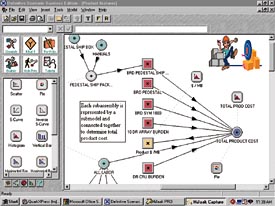
Figure 1: This model illustrates how the different subassemblies and their respective costs affect the Total Product Cost.
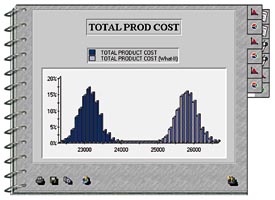
Figure 2: This histogram shows the product cost differences between the original feature set and the changes made during the sensitivity analysis or "What-If" scenario.
Using this method, the manager of engineering was able to convey, to the entire product team, each of the individual elements that make up the product and their respective costs. This program allowed them to map out the entire product breakdown in a manner that is easy to understand by all contributing departments.
Because Definitive Scenario is an interactive program, it can also be used to run sensitivity analysis, to see which parts of the model — and therefore which product features — are more sensitive to change. When one team wants to add or change product features, engineering can take this model, make the minor adjustments and run another simulation. The results show the original model along with the new features.
The collection of charts and graphs in Definitive Scenario showed just how much a change in product features affects one particular department. This gave the engineering team an effective way to communicate the difficulty in adhering to these new demands. The result is a smooth product planning process that supports team consensus, incorporates late changes where they would add to the success of the new product in the market, and a means for documenting the expected results to incorporate in future programs.

|
ABOUT THE AUTHOR |
| Judy McNary is president of Definitive Software Inc. and can be reached at (800) 732-9414 or via the company's Web site |
Web Site © Copyright 2020, 1999 by Lionheart Publishing, Inc.
All rights reserved.

Lionheart Publishing, Inc.
2555 Cumberland Parkway, Suite 299, Atlanta, GA 30339 USA
Phone: +44 23 8110 3411 |
E-mail:
Web: www.lionheartpub.com

Web Design by Premier Web Designs
E-mail: [email protected]