


VOLUME 1, NUMBER 4 | WINTER 1998

 Listening to the Customer —
Hearing the Results
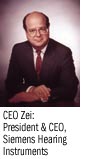
A discussion of technology and manufacturing quality with John J. Zei, president & CEO, Siemens Hearing Instruments.
by Tom Inglesby
Based in Germany, Siemens is a 150-year-old, $60-plus billion business with divisions that make everything from light bulbs to power plants. One of those divisions is Siemens Hearing Instruments, headquartered in Piscataway, N.J., a wholly-owned subsidiary of Siemens Medical Corporation. The New Jersey facility serves as a base for research and development, manufacturing and administrative marketing support. Additional manufacturing and sales offices are located in Cerritos, Calif.; Houston; Prospect Heights, Ill.; and Marietta, Ga.
John Zei is president and CEO of the Hearing Instruments division with responsibilities for North and South America and the development of custom products worldwide. This year the company will bring in revenues of about $150 million on sales of hearing aids, accessories, batteries, diagnostic and fitting equipment, with the bulk of it tied to the sale of custom products.
According to Zei, "We're the manufacturer and distributor to 'dispensers,' predominantly audiologists. They're located in private practice offices, clinics, hospitals, universities and physician's offices. We compete with no less than 30 companies in the U.S. for this business. To succeed in this competitive market, we concentrate on three fundamentals: quality, delivery (turnaround) and after-bill service. I believe very strongly that all the things we do in our business are based on that three-legged stool. If we don't deliver consistently those three values, which really apply to almost any business you can think of, then we fail."
Like most manufacturers, the idea isn't just selling product, it's selling the company. Zei continues, "We offer a lot on top of our products. We offer education, advertising and promotional support, marketing support, lots of training, lots of additional support for all our customer companies. But if we don't deliver those three fundamental values, it doesn't matter. We concentrate very hard on those values every day."
The Seimens hearing aid is a unique unit within the expanding realm of "mass customized" products. Each one is custom made — molded to a cast of the recipient's ear canal — and contains extensive electronics in greatly miniaturized form. Not something that can be planned for very well, as Zei admits. "It's a challenge because we don't know on any given day how many orders are going to come in. They just show up. We have to take that order, which is a generic description of a hearing aid, and translate that into a specific product custom made for the individual," says Zei. "We have to do that and deliver 80-90 percent of those orders within three days. That's in one day and out two days later. About 50 percent of the orders we take in, we turn around in one day.
"What's even more challenging is that not only are we building a product that is custom fitted to an individual's ear, but the product combinations are well over a million," Zei explains. "The various sizes, battery types, controls, amplifiers, performance criteria, are well in excess of a million. We have to narrow that down, develop the specific product that we're going to make for that individual, put it through our manufacturing process, and give it a quality assurance check at the end to verify that it's going to fit, that it's what the customer wanted, and that it meets our performance criteria."
When you look at the actual hearing aid, the part that fits within the ear, it's hard to believe that so much technology is packed in such a small space. Everything is contained within the button. "That's the whole thing," says Zei. "Typically when you design a hearing aid, the first thing you do is worry about the battery because that's the largest single component. Then you go down from there and worry about the transducers, the receiver (or speaker), the microphone and the amplifier, then the controls that go along with them. We can build an all-digital programmable hearing aid, battery, transducers, amplifier in a package so small that when it goes into the ear, not only is it virtually invisible, but in order to remove it, we need to supply a small filament so that you can pull it out. That's not just a cosmetic advantage, by the way. It's also an audiologic or acoustic advantage. The further down we can place the receiver in the ear canal, the more accurate the reproduction of the sound, and the less potential for problems with feedback."
One objective of this in-the-ear approach is to close off the outside noises, sealing the sounds from the hearing aid in the ear. But that can cause problems, too. "We still have to vent the hearing aid to equalize the pressure. Otherwise the consumer is going to feel very uncomfortable," says Zei. "You need the delicate balance of equalizing the pressure and not allowing a feedback loop to be created that results in whistling." Everyone who has been at a presentation where the microphone got in front of a speaker and heard the feedback sounds can appreciate not having that noise down deep in the ear.
Zei's company makes several styles of hearing aids based on their technology. Not only can people have the hearing improvement that such equipment provides, but they can have the cosmetic advantages as well. In fact, the best selling unit is the one that goes deepest into the ear and is therefore least noticeable while providing the best acoustic performance. Ah, the vanity of it all.
The only difficulty with the very small ones are that the consumer has to have sufficient dexterity to put it in and take it out. And, there are some limitations on the level of hearing loss that you can meet with that kind of product. Typically the larger the unit, the easier it is to fit people with the more severe, profound hearing losses. That's because the transducers get larger, and the power supply has to be larger to accommodate the amount of output. One of the reasons that CIC — completely in the canal — style is popular is that someone wearing one can work successfully with any telephone. The CIC is sufficiently down in the canal, when you put the telephone up to the ear, it doesn't create a feedback loop.
Mass customization requires careful production techniques. Zei explains the order to delivery cycle on a typical hearing aid. "What we get from the dispenser is a silicon impression of the customer's ear. With it we receive a piece of paper that shows the style and size of the hearing aid, and an indication of the amplifier type that they want — programmable, digital or conventional. We receive a copy of a pictorial description of the customer's hearing loss, an audiogram. We take those and convert them into a hearing aid," says Zei. "The process involves converting that silicon impression of the customer's ear into a plastic shell or case that is particular to that customer's ear. People's ears are very unique. Then we take the hearing loss and the amplifier requested and translate that into a selection of amplifiers, transducers, capacitors and all the other components that go into the shell.
"The heart of the unit is the amplifier," he continues. "We design and, in some cases, manufacture directly, or we work with an integrated circuit outfit to produce those amplifiers. All the Siemens products are proprietary and developed by our own integrated circuit development team."
Although Seimens has other divisions that produce electronics and chips, Zei's group is not required to use internal suppliers. "We go with the supplier that can provide us the best service, turn around and quality," he says. "We are highly dependent on process, because we're taking the most advanced product in an all-digital circuit — which is an analog-to-digital converter, a processor, and then a digital-to-analog converter again — and putting that into an amplifier that has to be reduced in size to fit inside someone's ear. We require the most advanced processing."
Not only is the unit small, it uses less electricity. "The other thing that distinguishes us from other integrated circuit developers is that we work with essentially one volt," says Zei. "Most integrated circuits work on three volts or better. That requires very strict tolerances in the manufacturing process and some unique application capabilities."
Zei works closely with his suppliers on their quality. As he says, "We have a very aggressive program with our suppliers. We have our Success Program, a true partnership program where we certify vendors. To do that, we go out and inspect their process, we work with their quality assurance organization, we do sampling and incoming inspection up to military inspection-level requirements. Our objective is to work with our key vendors to qualify them, to actually visit and review their quality assurance process, and eliminate incoming defects because we've got the kind of directly observed assurances that they're providing us with components that meet our quality environment. That's been quite helpful. We work with our suppliers in that area and also in kanban (pull system) deliveries to help us with our inventory management and our flexibility.
"You can imagine, considering the number of different, custom products we can manufacture, our potential for skyrocketing inventory is enormous. Yet, we want to avoid that at all costs. We work with the vendors, and they like that."
A multinational organization by its very nature, Seimens depends on a global supply chain. Some key suppliers for the Hearing Instruments division are in the United States, but they also work with companies around the world. This presents complex problems in inbound and outbound logistics. Zei notes, "One of the ways we were able to improve our productivity internally and our service to the customers is that we're tied directly to Airborne, our logistics partner. We've automated the shipping process with them."
When the hearing aid is finished, it goes through a quality assurance process, and a computer-based analysis of technical performances. It can't be shipped unless it passes. The quality assurance process is the gateway to the shipping process. When the computer says it's acceptable, that it meets required specifications, an individualized data sheet showing the specific performance for that hearing aid — frequency, output and about 15 other measurement parameters — is printed out along with the name of the quality assurance inspector. At the same time, an invoice and shipping document are generated. The instrument is packed and placed directly into an Airborne bag. A label is applied, and it goes right into the Airborne shipper, and directly into the Airborne manifest. "That assures that we have next day delivery without additional inputting errors. It allows us to track those shipments. It's a very successful program. Airborne is good about providing us with computer interfaces and support," claims Zei. "On the inbound side, we provide all our customers with shipping labels and bags; and for most of our customers, Airborne automatically visits their offices every day."
Seimens Hearing Instruments produces a product that is carefully scrutinized by regulatory agencies. Zei is proud of their compliance and quality. "We produce an FDA (Food and Drug Administration) regulated device in an FDA registered establishment. We took a very aggressive stance to become ISO 9001 certified and also to build quality systems into our organization," says Zei. "The result is, by doing that for the benefit of our customers, it provides us with a process and quality management approach that is first rate. In addition, we end up with a quality system that meets all of the FDA's requirements. We get semi-annual inspections from the FDA, and for the last two inspections, we've had no observations (complaints). Nothing, as in zero. We're very proud of that because it indicates that our quality system meets all the FDA requirements, and the market tells us that it meets requirements for our customers."
On a personal note, Zei sees what he and his division are doing as a very high calling. He recounts, "I started out as an attorney, working on legal problems for another company. For my first six years in this business, it was in legal. I came to enjoy the business and learned a lot, and liked business more than practicing law. It was more satisfying to me, and rewarding. I like this business because we help people who need to be helped. I don't have anything against other businesses, but it's satisfying to be in the business where you get letters, which I do, from people who tell me we changed their lives."
Web Site © Copyright 2020, 1999 by Lionheart Publishing, Inc.
All rights reserved.

Lionheart Publishing, Inc.
2555 Cumberland Parkway, Suite 299, Atlanta, GA 30339 USA
Phone: +44 23 8110 3411 |
E-mail:
Web: www.lionheartpub.com

Web Design by Premier Web Designs
E-mail: [email protected]