


VOLUME 1, NUMBER 4 | WINTER 1998

The Supply Chain Operations Reference model, better known as SCOR, is helping global manufacturers rethink their companies into best-of-class operations.
Best-in-class. Every company wants to be considered the "best," not just for the prestige and ego gratification, but because of a desire for staying in business for the long term. Market share and revenues dazzle the eyes of Wall Street analysts, but in the final analysis, annual earnings statements don't tell the full story, or anything even close to it. Just ask some of the world's biggest manufacturing companies.
Take telecommunications giant AT&T;, for instance. Back in 1995, before Lucent Technologies was spun out of AT&T; as a separate entity, the company's Consumer Products unit was earning $2 billion a year, with its 30 percent market share in the United States giving it a 2-to-1 margin over its nearest competitor. And yet, amazingly, the Consumer Products business was losing money substantially, and was finding it difficult to finance the development of new hardware — wireless telephones, cordless telephones and other telephone equipment. In fact, the situation was so dire that AT&T; was thinking of selling off the business entirely.
One of the biggest problems was the supply chain, according to Ed Salley, currently vice president of operations for AT&T; Wireless Services, who was part of the team entrusted with the monumental task of steering the company back on the right course. "The amount of inventory we had in the pipeline was something like three to four months' worth," he said. "And the life cycle of the products was increasingly becoming shorter and shorter, so there was as much inventory in the pipeline as there was in the life cycle of some of the products."
Adding to the problem was that the company's supply chain was largely being sourced out of the Far East. Much of the manufacture and design of telephone equipment was outsourced to the Asia/Pacific region, then shipped by boat to San Francisco, a journey which could take weeks. From San Francisco, the products were then shipped across the country to AT&T; warehouses, and finally from there to the warehouses of the retail channels.
"Cash flow was terrible," Salley said. "Our cash-to-cash cycle — which is the time from when you pay out cash to your suppliers to when you receive cash from your customers — could last as long as eight to 10 weeks. Overall, it was just a mess."
A Pyramid Scheme
Luckily, there is a tool designed to help manufacturers improve their supply chain performance to best-in-class levels: the Supply Chain Operations Reference (SCOR) model. Developed under the auspices of two Boston-based management consulting firms — PRTM and AMR Research — the SCOR model defines common supply chain management processes and matches them against best-in-class practices, benchmarking performance data and optimal software applications.
"The operations reference model approach is the logical extension of business process reengineering and other process improvement efforts," said PRTM director Bill Helming. "Early reengineering efforts considered little customer focus of competitive input, for example, and the effectiveness of benchmarking was limited by the lack of a common language and observations that didn't transfer well to new industries or even within an enterprise. The operations reference model combines the benefits and lessons of past methods into a configurable, cross-functional framework."
SCOR is available from the Supply Chain Council (www.supply-chain.org), an independent, not-for-profit trade association of 300 manufacturing companies, software vendors, providers of logistics services, consultants, researchers and educational institutions. The model is focused on the four key supply chain processes: plan, source, make and deliver.
"SCOR is a toolkit that you can use to define, measure and manage your supply chain process," explained Joe Williams, director of global productivity for Mead Johnson Nutritionals, another user of the model. The documentation to SCOR version 2.0 describes each function as follows:
Describe: Standard SCOR process definitions allow virtually any supply chain to be configured.
Measure: Standard SCOR metrics enable measurement and benchmarking of supply chain performance.
Evaluate: Supply chain configurations may be evaluated to support continuous improvement and strategic planning.
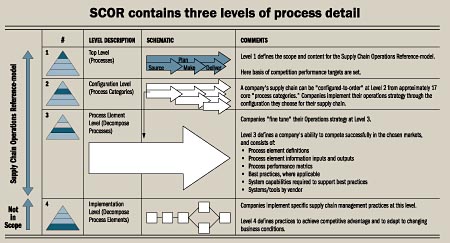
At the heart of the SCOR model is a pyramid of four levels that represent the path a company takes on the road to supply chain improvement (see Figure 1):
- Level 1 provides a broad definition of the plan, source, make and deliver process types, and is the point at which a company establishes its supply chain competitive objectives.
- Level 2 defines the 26 core process categories that are possible components of a supply chain (i.e., Source includes "source purchased materials," "source engineer-to-order products," and "source make-to-order products"). A company can configure both its actual and ideal supply chain by selecting from these core processes.
- Level 3 provides a company with the information it needs to successfully plan and set goals for its supply chain improvements. Planning elements include process element definitions, target benchmarks, best practices and system software capabilities to enable best practices.
- Level 4 focuses on implementation, when companies put specific supply chain improvements into play. Since changes at Level 4 are unique to each company, the specific elements of the level are not defined within the industry-standard model.
You Can't Be Best-in-Class in Everything
AT&T;'s Consumer Products unit dissected its operations and applied data collection through the SCOR template, which collected all of the company's operations performance data from numerous metrics, such as time, cost and quality. AT&T; was then able to compare its performance against the benchmarks that are in the SCOR benchmark database, allowing the company to isolate where the root causes of performance were.
"Once we identified where these root causes were in the business, we organized into six core teams," Salley said. "We then adopted a philosophy analogous to a decathlete's competitive strategy: You don't try to be best-in-class in every area of your business performance. If you try to chase too many improvement opportunities at the same time, you won't achieve any of them. We decided we wanted to be superior in quality and time-to-market."
AT&T; determined that it needed to change over from a make-to-stock environment to a make-to-order/assemble-to-order environment, which would greatly improve the cycle times. According to Salley, this changeover reduced a 12-week cycle time process down to two weeks. "We saw immediate financial improvements just by closing down and consolidating the supply chain into a make-to-order environment, and by automating the processes around it," he said.
"We've taken out 55 percent of the inventory by the end of 1995 to the end of 1997, reduced the cycle times by 80 percent, and reduced the cash-to-cash cycles by about 70 percent," Salley continued. "We improved the gross margin by 10 percent of revenues, resulting in $200 million worth of savings."
Very Significant Opportunities
Packaged goods manufacturer Mead Johnson Nutritionals is another company that turned to the SCOR model to help focus on its key business processes, particularly the supply chain. "We have challenging annual sales and productivity goals," Joe Williams noted. "We had taken all the typical cost-cutting measures, such as negotiating with vendors and closing plants, and decided we needed to take a more process-oriented look at the company."
Mead Johnson began its association with SCOR by participating in a benchmark study, which helped the company see how it compared with other packaged goods companies. The next step was to gather together all the business units and discuss with them such issues as what they considered the most important parts of the supply chain, what measurements were important, and what performance was important to help them sell more products. Like AT&T;, Mead Johnson decided to focus on just a couple of measurements in which to be best-in-class, based on the benchmarking study. For a couple of other measurements, Mead Johnson set a goal to be better-than-average, but not best-in-class. For the rest, they aimed at parity.
"We used SCOR as a tool to help educate our employees, and get our marketing and business unit people to give us a common language on how we wanted to compete from a supply chain standpoint," Williams said. "After we compared ourselves to other companies in the industry, we began holding workshops to spin off projects that would help improve our performance on a particular metric. Wherever we had sizable gaps, we concentrated on those areas to get the metrics better."
In terms of cost savings and increased sales, the results can be very significant. "For example, one of the SCOR metrics is total supply chain management cost as a percentage of sales," Williams said. "So if you're sitting at 8 percent of sales in that metric, and the best-in-class is 4 percent in sales, that 4 percent represents a $40 million opportunity for a billion-dollar company. Now, how you execute that transition and how much of that $40 million you achieve is up to you, but it certainly points out a huge potential."
One of the keys to a successful SCOR-influenced transition, Williams emphasized, is involvement by senior management. "Senior management has to buy in and support the whole concept of managing the process and sticking with it," he noted. "Otherwise the effort will fail, because it's a large undertaking to get it up and rolling."
Don't Wait Till You're in Trouble
While spun off now from AT&T;, Lucent is continuing to benefit from the SCOR model, Salley reported, and one important lesson the company has learned is not to wait till they're in trouble: Every year the company re-benchmarks and restates their goals. "Once you are back on your feet, you want to stay there and keep recalibrating how you're doing against the industry," Salley said. "You can improve 20 to 30 percent in something and still be behind if the industry has passed you by. So you've got to constantly re-benchmark your performance. And when you see areas of deterioration, or areas where you may have improved but you're still falling behind the rest of the industry, you need to focus your efforts quickly on that before it gets to be a disastrous situation. It's like preventive maintenance. You just don't wait till you're in trouble."
Rockwell Semiconductor Systems is yet another manufacturer that has successfully used SCOR in an internal supply chain improvement effort. Rockwell applied an early iteration of the framework in an assessment of the company's current supply chain practices and a configuration of its supply chain based on the Level 2 process elements, according to Vinay Asgekar, manager of Rockwell's business process reengineering as well as chair of the Supply Chain Council. The project then drove an enterprisewide effort to realign various functional groups and departments into a process-centric organization to enable supply chain improvement efforts.
"Various departments are now talking the same language," said Asgekar. "That's a notable achievement. The framework helped to break down functional silos and allowed people to look at the real issues and practices holding back supply chain management improvements. It gave people the chance to look at the supply chain with companywide needs in mind."
Making a Good Plan Better
Like any tool, SCOR is not flawless, and the Supply Chain Council recently approved Version 3, which among other things includes revisions to the "make" area (as in "plan, source, make and deliver"). The Council's technical committees are constantly reviewing and revising the model, as well as listening to comments from users.
"One of the biggest issues that's come up is that SCOR deals only with supply chain operations," Salley remarked. "What they don't have built into the model is the relevance of the new and changed design process and practices in support of the operations reference models. For instance, if you're a make-to-stock business, you could afford a different design practice and a design operation in terms of new product realization — the design lead times, for example — than if you're a make-to-order or assemble-to-order business, where you've got to be extremely fast. So the practices you use in other parts of your business need to support your supply chain reference model, and that's one area that I feel SCOR needs to address."
Another area SCOR should focus on, Salley continued, is customer operations. "What's the relevance of the whole ordering and customer interface, all the way back into your supply chain? How do you leverage that information into your supply chain faster, because there's intelligence there early that could be extremely valuable to suppliers in your supply chain about volumes? How do you integrate the customer operations front-end order management from your customers, whether they're retail or end customers, all the way back to your supply chain? That hasn't been addressed to date."
For his part, Williams has found the definitions of the metrics open to too much interpretation. "The definitions have to be sufficiently specific but also specifically vague, so that they cover everything, and it can get to be a pretty fine line. For example, if number of employees is one of the measurements, does that mean full-time employees, part-time employees, contract employees, management? There are a lot of questions like that you might have to guess on, and it may be the wrong guess. You want to make sure you do these metrics as close as you can to what everybody else is doing because of the benchmarks. So making sure everybody is measuring and figuring these metrics the same way is a real key issue."
Undoubtedly the Supply Chain Council will tackle these concerns, and others that arise, in future versions. While the metrics have existed in one form or another for a number of years, the current SCOR model dates back only to 1996, with Version 2.0 released in 1997 and Version 3.0 forthcoming. Considering the growth of the council from 69 members in 1996 to 300 in 1998, with chapters opening in Europe and Japan, SCOR will continue to influence manufacturers well into the opening years of the next millennium.
David Blanchard is senior editor of Evolving Enterprise.
Web Site © Copyright 2020, 1999 by Lionheart Publishing, Inc.
All rights reserved.

Lionheart Publishing, Inc.
2555 Cumberland Parkway, Suite 299, Atlanta, GA 30339 USA
Phone: +44 23 8110 3411 |
E-mail:
Web: www.lionheartpub.com

Web Design by Premier Web Designs
E-mail: [email protected]