
Spring 1996 € Volume 1 € Number 1
A Walk on the Wild Side
Virtual reality allows designers, engineers and operators to safely
explore potentially dangerous nuclear facilities.
By David Blanchard
One of the major benefits of virtual reality (VR) is that it allows designers
and engineers to "walk through" an environment that would normally
be too difficult, too expensive or even too dangerous to enter. A nuclear
facility certainly falls into all three categories, and in recent months
a number of these plants worldwide have begun implementing 3-D visualization
systems to achieve a level of efficiency heretofore undreamed of, while
protecting personnel from safety hazards as diverse as radioactivity and
poisonous snakes.
The Research and Development Division of Electricite de France (EDF), for
instance, is using VR software from Division Ltd. of Bristol, U.K., to investigate
a range of applications for VR in designing and testing the operating procedures
of a nuclear power plant.
One application involves the maintenance of nuclear reactors, which can
be a lengthy and complicated procedure. The potential hazard to real maintenance
engineers is obvious: the more time spent in close proximity to the reactor
itself, the greater the overall radiation exposure received by the operator.
While the dosages are still minute in comparison to health safety levels,
the total lifetime exposure of an operator limits how long they can work
in a nuclear environment, and thus how long the skills they have can be
utilized.
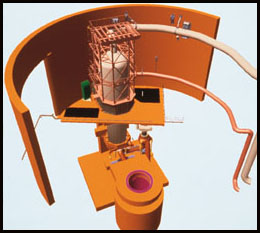
EDF uses virtual reality to model a nuckear reactor
(photo courtesy of EDF and Division).
EDF has built a virtual environment to model the interior of the reactor
building. This model includes all the major reactor components, including
piping and ductwork, multi-level scaffolding, control points, and even the
lifts which move engineers between levels around the reactor itself. Finally,
on top of the physical models in the virtual world, a radiation plan is
overlaid, giving the radiation dosage received per second in any particular
part of the building.
Using this complex model, the maintenance engineer puts on a VR headset,
and "enters" the reactor building. Using the control on a 3-D
mouse, along with natural human motions, the engineer moves around the virtual
building, following the paths and actions proposed for the maintenance activity.
While this happens in the virtual world, the system continuously computes
the theoretical radiation which would have been received had the engineer
performed the actual operation.
With the "virtual radiation dosage" information, operators can
plan safer and more efficient procedures. While still experimental, EDF
sees substantial value in this approach for the development of operating
procedures in a nuclear plant.
Maintenance Operations
Similarly, engineers at the Chalk River Laboratories division of Atomic
Energy of Canada Ltd. (AECL) in Chalk River, Ont., Canada, are prototyping
VR software to improve maintenance operations of reactors during outages,
to minimize radiation exposure to maintenance crews, and as a training/demonstration
tool for new plant designs or procedures. The AECL is using the PC-based
Superscape VRT software from Superscape Ltd. (Aldermaston, U.K.). The AECL
maintains three nuclear reactors throughout Canada, which produce about
20 percent of that nation's electricity.
The AECL is using VR software to simulate outage maintenance activities
inside a reactor vacuum structure. Maintenance operators "walk through"
the facility, making necessary repairs or upgrades. This not only limits
the operators' exposure to radiation during real outages, but also helps
speed them through reactor repair or improvement tasks.
"Working with the VR software is proving to be a much more expedient
process than what is currently used," explains Peter Lirvall, human
factors engineer for the Safety Management and Resource Training Branch
of Chalk River Labs. "For instance, when an outage occurs, operators
typically study paper engineering drawings to familiarize themselves with
the area. For larger maintenance tasks, these drawings can be confusing
to find and use, so operators have to build a mock-up of the equipment.
This full-scale mock-up allows the operators to practice the maintenance
procedure, such as taking a valve apart, prior to entering the reactor facility.
With the VR software, the agency can build situation-specific 3-D images
off of desktop PCs by importing engineering drawings and borrowing from
an object library which includes standard valves, pipes, nuts and bolts."
Lirvall believes that VR can potentially save the nuclear power industry
billions of dollars by minimizing downtime on reactors. Among the other
benefits he cited are:
- Reduced outage and improved safety;
- Cost-effective and safe maintenance of equipment;
- Reduced exposure times and the ability to identify overexposure situations;
- Cost-effective training in a virtual control room simulator;
- Human factors evaluations of design interface;
- Visualization of conceptual and detailed designs of critical nuclear
field environments.
Operators at the AECL have developed a VR model of a typical reactor control
room for training purposes, Lirvall notes. "A virtual control room
can be used to offload the control room simulator, lower maintenance costs
and provide 24-hour unlimited access," he says. "The interactive
instruments in the virtual control room can be used to visualize control
room operation's effects on the reactor and field equipment."
New training programs can also be integrated into the virtual control room,
he continues. "Cross reference skills, for example, can be improved
between layout of control room instrumentation and their layout on engineering
drawings by being able to bring up related drawings next to the instrument
of concern."
According to Lirvall, the VR software may have the most benefit to AECL
engineers and operators in the coming years for a proposed one-month outage
of the four reactors at the Darlington facility. This outage typically costs
the power plant several hundred thousand dollars in lost revenue each day.
It is anticipated that a VR system can significantly shorten the outage
duration.
"The idea is to use VR to train the operators before they get into
the plant since many have not been in reactor facilities for many years,
if ever," Lirvall explains. "The operators can use the VR system
to perform their tasks, assess the potential problem areas, and get a good
feel for the amount of time that will be necessary for each task."
Engineers have developed a virtual prototype of the 80 x 40 meter reactor
structure to demonstrate lighting requirements. Future plans call for a
virtual environment connected to a database containing equipment documentation.
"Design engineers, operators, maintenance personnel and regulators
can use the virtual facility to zoom in on an area of interest, locate the
equipment and select it to retrieve all available documentation about the
equipment," Lirvall points out. "Equipment can be taken apart
by, for example, finding and clicking on nuts and bolts to take a cover
off and then explore the function of the components. Such a facility may
be made available for an operator to communicate with and instruct maintenance
personnel in an efficient manner about the problem at hand. Planners will
be able to identify potential complications in performing the tasks and
reduce both risks and outage delays."
As far as safety, training on a VR system could help improve crane handling
or forklift driving in tight environments. VR training can also help a user
deal with collision surfaces in areas that cannot be accessed with a forklift
or other larger maintenance tools. Such a system could help plant personnel
shorten exposure time by identifying the best access/egress routes for people
and equipment, Lirvall notes.
The virtual environment facility may be applied so that radiation fields
may be visualized to help the planning of access routes. "Colored clouds
surrounding field equipment may visualize radioactive areas and let operators
familiarize themselves with the radioactive environment before entering
it," Lirvall says. "The operator can then choose an access route
and plan task procedures to take advantage of locals areas that are shielded
from the radiation source. Alternative placements of radiation shields may
be explored depending on the access. A mannequin in the virtual environment
that is controlled by an operator's body movements may be used to predict
the exposure of radiation when walking through the task."
Decommission, Decontaminate, Dismantle
A United States-based company, TRW of Redondo Beach, Calif., is using VR
to decontaminate nuclear facilities. The company has developed a system
called CAPS (Characterization Analysis Planning System) that uses VR technology
to generate information needed to decommission, decontaminate and dismantle
old buildings once used for producing radioactive materials for atomic bombs
during the height of the Cold War.
Decontaminating radioactive buildings is a very hazardous process, as the
radioactivity levels can be so high that a person can spend no more than
15-20 minutes in the building before receiving a maximum yearly exposure.
These old facilities present other dangers, too, such as decaying structures.
Many have been shut down, and have no power or lights. One dark site encountered
by TRW engineers had a large hole in the floor. In another, the roof had
rotted away and the bird droppings in the building were highly toxic. Yet
another building was infested with poisonous snakes.
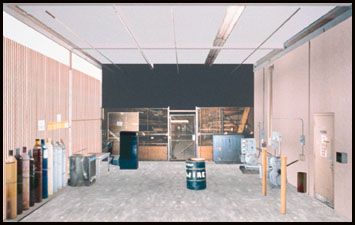
A virtual world simulation by TRW of an actual radioactive site
(photo courtesy of Sense8 Corp.).
Thanks to CAPS, photogrammetry and solid modeling, clean-up personnel now
have a way to create a model of the interior of a facility. VR then allows
workers to "walk through" that model before they are sent in for
the actual clean-up.
TRW's system combines advanced VR features with photography to visualize
facility models. First, information is gathered by taking photos using a
35mm hand-held camera, with only minimal measurements taken for scale. This
method helps reduce the time spent at the actual site gathering data. If
radioactivity is too high for humans, a telerobot can be used to operate
the camera.
The photos and other information are loaded into the computer. Using a process
called photogrammetry, engineers create a model of as-is conditions. A photogrammetric
analysis calculates the camera location and allows the user to obtain 3-D
coordinates. 3-D solid models are built directly on top of the photos using
TRW-developed software and commercially available CAD and plant design packages.
The TRW software automatically adds texturing from the source photos to
the models.
Models are then imported into WorldToolKit, a VR software package from Sense8
Corp. (Mill Valley, Calif.) that can accept information from multiple sources
and formats. Once a virtual environment is created, engineers "walk
through" the site, looking for hazards and planning the actual decontamination
process, including determining what types of tools to use. Since the site
is computer-generated, radioactivity is of course not a concern, allowing
workers to practice the demolition before they ever see the actual site.
"The use of VR can make clean-ups cheaper and faster, and more importantly,
safer," says Jim Cracraft, TRW's associate investigator for CAPS. "Virtual
walkthroughs mean better preparation, both in terms of planning and actual
familiarity with a site, while the phototextures add incredible vibrancy
and accuracy to the virtual world."
TRW works closely with its clients to get the correct level of detail and
make sure that the end product will be as useful as possible. The idea is
to make the process as interactive as the virtual environment.
The future of the nuclear power industry "is dependent on safety and
stringent quality control practices in construction and operation,"
observes AECL's Lirvall. Thanks to the implementation of virtual reality-based
systems, the considerable health risks in operating nuclear facilities are
being minimized, while performance and efficiency are being enhanced.
David Blanchard is an associate editor of CiME and the editor of two
newsletters, Intelligent Systems Report and Intelligent Manufacturing. His
E-mail address is:
Return to the Table
of Contents
Go to the CiME
homepage
Go to the Lionheart Publishing homepage
Go to the Subscription
Form for the print edition of CiME.
CiME is a publication of Lionheart Publishing,
Inc. ©
2555 Cumberland Parkway, Suite 299
Atlanta, GA 30339 USA
Phone: +44 23 8110 3411
e-mail:
URL: http://207.69.204.147