
Spring 1996 € Volume 1 € Number 1
Fighting Obsolescence
Will your applications grow with you?
A new approach to solutions development.
By Julie Fraser
History has a tendency of repeating itself. Software we now call legacy
systems -- because we've considered them obsolete for a few years -- were
the hot ticket 10 or 20 years ago. The information systems you acquire today
will be obsolete one day also, but your job is to make it later rather than
sooner.
Most manufacturers are turning to commercial software products because they
ease the custom developed problems of implementation time, staffing and
maintenance. Unfortunately, packaged software does not necessarily solve
another problem -- systems that are too rigid to change when the business
does. The original justification for custom development has not vanished,
either: packaged systems may not match your business processes. It's critical
to choose systems that support your processes, especially if you have gone
through some re-thinking or business process re-engineering.
The typical checklist for technology, features and functions is clearly
not enough. A checklist type of evaluation may begin to indicate whether
the software system solves your current manufacturing management challenges,
but it usually does not reflect the process. Even to the degree it does,
it's not a good indicator of whether the package will support your operations
five or 10 years down the line when your way of doing business will have
drastically changed with the world around you.
Still, a product's ability to reflect your business processes now and as
they change is something you can examine before buying. It is tightly linked
to the architecture of information systems, to the design of applications,
and at its core, to the development philosophy of the software supplier.
So while the traditional RFP checklist cannot systematically examine tailorability
and ability to change, other questions can. Before we examine those questions,
let's look at software development processes and their results.
The Traditional Development Process
There are several factors that, when judiciously applied to systems development,
ensure that information systems can evolve with the company and its business
issues. But first, let's examine a simplified model of how information systems
are traditionally developed. Figure 1 illustrates the typical evolution
of an information system.
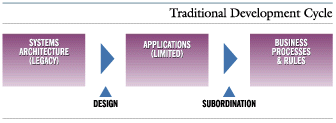
Figure 1
Most manufacturing companies -- and most manufacturing software suppliers
-- have legacy systems and investments in hardware, software and personnel
training. These current capabilities (or sunk costs) are significant, and
are at the root of most traditional development efforts. The basic tenet
is, "We have these systems and this knowledge, we should try to maximize
them." As a result, legacy systems architecture is the primary driver
in many new applications developments.
Now we have an outdated architecture. Unfortunately, the systems' inability
to match business processes is further compounded because the users' input
and requirements are usually not taken into consideration. Software suppliers
certainly can involve customers in their development process, but usually,
the mechanisms are not in place.
This leads to applications that do not support current business processes
and rules. For the end user, the new application becomes just one more system
to feed and maintain. In many cases, users resist or even sabotage these
systems. When this happens, management believes the users are not supporting
their business goals; however, in most cases, users resist because they
do care. Users are the ones who can see how procedures forced to feed an
application keep them from processes that run the business effectively.
Any number of manufacturing companies are still buying systems that force
data-oriented business processes on the users. We have met quite a few managers
who first led successful re-thinking or re-engineering efforts, only to
see the benefits and momentum dwindle when a new information system de-rails
the processes. Re-engineering costs then become essentially wasted.
A New Approach
Looking at this chain of system development and its results, you probably
are thinking, "There must be a better way of developing information
systems." Fortunately, there is. Let's call it the "Customer-Driven,
Business-Process-Oriented Development Cycle." Figure 2 is a representation
of this new paradigm in information systems development. This solution may
seem trivial. It is so simple and natural that you'll wonder why it has
not always been this way. The mark of solutions that work is: They make
sense!
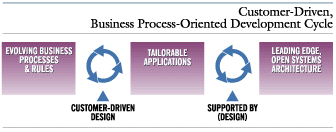
Figure 2
The first consideration in this new way of designing and developing information
systems is to determine what business processes and rules the applications
will support in the manufacturing environment. The questions to ask next
are: Who are the users that need to perform them? How do they accomplish
their tasks? What information -- not data -- do the users need to perform
these activities?
It is only in the context of answering these questions that developers can
start to design and develop applications that will serve as true decision
support systems. It is essential, however, to factor in change. Although
the phrase is becoming old hat, change is the only constant in the new business
environment. As a result, applications must be designed and developed as
tailorable parts of the whole system. Look for standard systems, because
support will always be an issue with custom ones, but also look for configurability
in these standard systems.
To support solid business processes, software must truly aid efficient diffusion
of information. Look for robust implementations of technologies that have
become much more than trendy buzzwords: graphical user interface, open systems,
client/server architecture, object-oriented design, agent-based technology,
optimization algorithms, etc. These leading-edge technologies are fast becoming
recognized as efficient and powerful in real-life, day-to-day decision support
systems. They actually contribute to the system's ability to model real
business processes and change when needed. They also foster an ability to
turn data into answers to questions users must pose to do their jobs.
Where Do We Go From Here?
As the rate of business change accelerates, finding an information system
to help improve productivity and efficiency is not only a major responsibility,
but also a genuine challenge. A few things to look for in choosing systems
are:
- How is the system architecture set?
- How are the applications developed?
- How well do the functions fit my business processes?
- Does it use modern technologies that enable tailoring?
- How will the system accommodate changes to our businesses?
Those of you in manufacturing and not IS are probably thinking, "This
is all well and nice, but how does it help me in manufacturing more intelligently?"
The answer, in and of itself, represents the new paradigm in systems and
manufacturing: To manufacture intelligently, you must manage intelligently
and to do that, you must give the right information to support your decision-making
process at every stage, instantly and in real-time. Only an information
system that is designed to totally support your processes and that is tailorable
can, in the long run, help you keep your competitive edge. As in other aspects
of intelligent manufacturing, it is crucial that you ask the right questions
of your information systems.
Julie Fraser is corporate strategic advisor for Berclain USA Ltd. (Schaumburg,
Ill.), a provider of software and methods for manufacturing synchronization
& scheduling to discrete and batch process manufacturers. Fraser is
based in Cummaquid, Mass.
Return to the Table
of Contents
Go to the CiME
homepage
Go to the Lionheart Publishing homepage
Go to the Subscription
Form for the print edition of CiME.
CiME is a publication of Lionheart Publishing,
Inc. ©
2555 Cumberland Parkway, Suite 299
Atlanta, GA 30339 USA
Phone: +44 23 8110 3411
e-mail:
URL: http://207.69.204.147