
Volume 1, Number 2

The demands of global competition, rapid product changes and technological advances now require manufacturers to be more nimble and able to respond in real-time to changes in demand, capacity and materials.
Theoretically the production and distribution processes are logical and smooth, but in reality, many manufacturers are finding that actual sales do not match sales forecasts, and materials are procured for the forecast rather than the real situation. Each independent individual group within a larger enterprise reacts to manage as best they can -- but without interacting with each other, and with little visibility as to how their responses affect the entire manufacturing or distribution organization. What is needed is a new set of software tools to enable real-time rapid response to changing conditions that can balance, then optimize, multiple manufacturing constraints at the same time.
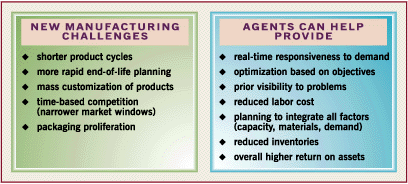
New software technologies such as "intelligent agents" can be deployed in supply chain and planning/scheduling software so manufacturers can become more responsive and cost-efficient.
Intelligent agents can isolate problems or variables to assist manufacturers in generating optimized production solutions when changes in capacity, materials and delivery requirements (or customer demand) arise. These industrial agents are now playing increasingly important roles in planning and scheduling for leading manufacturers of consumer products, computers and electronics, and automobile products and parts.
The agents work within the context of a new business model that focuses the entire manufacturing enterprise on the customer by managing the supply chain effectively. Supply chain management includes the process of controlling the flow of raw materials from the point of purchase by a manufacturer through work-in-process inventory and finished goods distribution, all the way to the delivery of the product to the customer.
The most successful and best-in-class companies are those which best coordinate the time-based activities of each step of the manufacturing process. For example, while materials have to be available for use, no company can afford to stockpile them for long periods of time. Production plans must reflect the capacity limitations of the facility and its staff, while in the distribution process, there must be a cost-effective, intelligent balance between shipping costs and on-time delivery.
This is a complex scheduling and optimization task, which requires that scheduling material and capacity become an "event-driven" process. Real-time responsiveness to changes in the environment, and the application of agents which can independently execute tasks based on user-directed guidelines, is a key.
For example, agents can be instructed to monitor the network for
new customer orders or other changes, then adjust plans and schedules
to meet conditions. The agent also might identify a new and urgent
customer, generate an adjusted production schedule based on
site-specific guidelines, then alert a scheduler to a modification of
status. It is important to note that the agent does not take control
in an autonomous fashion, but works as an assistant (although a very
intelligent one) to planners.
Contributions of the Intelligent Agent
These software agents contribute to the process of becoming real-time
responsive in many ways. First, they combine advanced optimization
technology to the most unpredictable of variables, which is customer
demand. Such demand in a fast-changing marketplace is virtually
impossible to precisely estimate; as a result, planned capacity and
material availability remain ever-changing. Agents in this context
enable management of these variables efficiently, so planning and
scheduling can be changed as required and optimized for as many
conditions as possible.
Agent-based planning/scheduling systems also bring with them the ability to be integrated with proven MRP II, DRP and other legacy manufacturing systems. This can be achieved almost seamlessly; while transactional systems provide effective data storage and transaction management on a permanent basis, agents can be employed to do what they cannot, especially when conditions are changing to provide the real-time planning and optimization ability.
Planning and scheduling agents' establish real-time transaction or
periodic update connections with these transactional systems, then
couple the information with detailed models of an individual plant or
a complete enterprise. Data from the transactional system and the
agent databases become a base of raw data from which agents generate
the optimized plans and schedules.
Agents Work Fast
One of the keys to the agents' work is their ability to optimize
around ALL constraints at the same time. These include materials,
capacity, labor, demand and other variables that are first integrated
into a basic supply chain model, then reviewed and optimized by the
agents. Some of the benefits of this optimization are critical for
manufacturers, such as the minimization of changeovers in production,
and the efficient allocation of resources that are scarce and subject
to competing demands in the manufacturing enterprise. Because agents
can integrate all kinds of information from various legacy DRP, ERP,
MRP and finite scheduling systems, and execute them at the same time
rather than in serial sequence, they can provide results in minutes
rather than days or weeks.
Also important to the user is the ability to provide different weights to different variables or constraints. Thus the agents are enabled to balance between competing constraints and vary those constraints based on up-to-the-minute business conditions.
Agents, in effect, supply a revolutionary approach to planning and scheduling by combining advanced optimization technology with real-time monitoring. So if new orders or change orders come in, the agent is able to identify exceptions created by these events.
If a key material shipment is pushed out into a later point in the schedule, the agent then alerts users, and is able to optimize a new schedule taking the material shipment delay into account. The objective of satisfying customer commitments is satisfied quickly and easily. If all orders cannot be satisfied, the agent recommends trade-offs that reflect user preferences.
This optimization technology and the ability to react to changes is vital to re-planning and re-scheduling. As new customer orders are accepted, for example, users may either manually update production schedules or invoke the agents to resolve exceptions to the new schedules. Agent technology minimizes changes to schedules and quickly generates "executable" schedules.
Another vital capability is "scalability" from single plants to entire manu- facturing enterprises. Agents can start with one production facility or distribution center and leverage proven solutions across the entire company in a highly-integrated manner. For example, an individual agent can optimize a plan or schedule for a particular facility, and then integrate these plans with other agents doing similar work in different facilities. An enterprise-wide agent then balances corporate resources with worldwide demand.
Since agents are fundamentally designed for enterprise-wide integration, they can also integrate all of the different legacy systems, supplying a single planning/scheduling interface for the enterprise with no affect on the core MRP II systems in use at each individual location.
Their flexibility and versatility guarantees that the role of agents in industrial and manufacturing applications, while just beginning, will expand quickly as leading manufacturers put in place real-time responsiveness. Constantly changing customer requirements, product proliferation, global competition and other factors necessitates real-time planning/scheduling changes and optimization of the supply chain management process. Proven now in consumer applications, agents will continue to emerge in manufacturing as a powerful tool in optimizing for the manufacturer.
2555 Cumberland Parkway, Suite 299
Atlanta, GA 30339 USA
Phone: +44 23 8110 3411
e-mail:
URL: http://207.69.204.147