
Volume 1, Number 2

With the gradual development of the global market over the last 25 years, European industry has seen increasing competitive pressure from new developing economies, such as those in Asia and the Far East. It is no secret that advances in information technology are changing the rules of the competitive game to such an extent that industries, regardless of sector, are having to re-define the way they operate and conduct business. Today, success is determined by how quickly a business can define and satisfy the ever-changing patterns in customer demand. Companies must therefore develop ways of reducing time to market while maintaining a high degree of quality, at the lowest possible cost.
More than ever before, survival in today's competitive environment depends on the company's ability to create a sustainable advantage. To this end, companies are questioning every aspect involved in the way they bring their products to market. This includes the pre-production processes as well as the manufacturing process itself. In short, the ability to deliver the product to the market- place faster and at lower cost, while maintaining high standards of quality, provides a competitive advantage for the future.
Traditional product design and development models are often characterized by poor cross-functional communication. This inevitably gives rise to inefficiency in responding to market demand. As a result, many companies are now adopting "concurrent engineering," a term given to include new working practices and tools aimed at resolving these problems by supporting greater integration of people and processes, thereby providing greater control over engineering activities.
The European Commission is supporting the development of concurrent engineering methodologies through a number of projects under the Esprit Programme. This article will consider the work carried out by one such project, SCOPES (Systematic Concurrent Design of Products, Equipments and Control Systems, Esprit Project No. 6562). The SCOPES project was a pan-European initiative conducted over a three-year period, involving 62 man years of effort at a cost of 7 million ECU. The project, completed in July 1995, brought together industrial partners Dassault Systèmes and Groupe Schneider from France and four research organizations -- the CIM Institute at Cranfield University in the U.K.; CRIF, a research institute at the University of Brussels in Belgium; EPFL, the Swiss Federal Institute of Technology of Lausanne, Switzerland; and IAT at the University of Stuttgart in Germany.
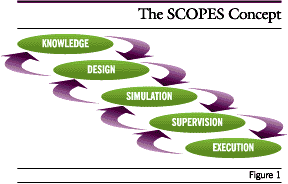
The SCOPES Concept
The information model developed in SCOPES comprises five superimposed
layers corresponding to the most common steps in the design to
manufacturing cycle.
Within each layer a circuit loop creates the communication link between successive activities, as well as facilitating inter-layer communication through the exchange of information regarding problems which may arise at inferior levels. Within the loop, both material and production planning flows are taken into account.
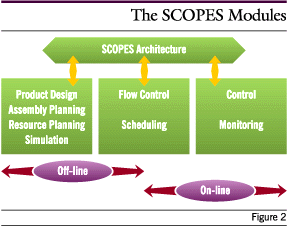
The objective behind SCOPES was to develop a suite of software modules to enable greater integration of engineering and production knowledge, thereby supporting the creation of a concurrent engineering environment for manufacturing.
The SCOPES solution focuses on both "off- and on-line" activities, bridging the gap between product design and the production processes on the shopfloor.
The SCOPES product design module provides an interactive environment for users to use design, manufacture and assembly knowledge to support their work. It extends from the scoring methods used in most design for assembly (DFA) software. The users can build in rules to suggest ways in which the design may be improved, taking account of estimated costs and lead times. With the SCOPES integrated design environment, the user can take assembly plan and resource constraints into consideration. The simultaneous display of solid model, assembly plan and factory layout on a single screen -- and the relationship between the three -- facilitates the communication between design and manufacturing engineers in the design team. The provision of design support knowledge gives the user a clear demonstration of the reasoning behind the advice generated and builds a history of design analysis.
The user input requirement is a considerable advance on existing technology. The design module, as an integrated part of a CAD system, gathers product data from existing CAD databases to generate a product model with a possible assembly sequence. The automatic generation of an assembly plan overcomes some of the problems experienced by existing DFA methodologies. The SCOPES design module has demonstrated the benefit of having a DFA methodology as an integral part of a CAD system.
The SCOPES assembly planning (AP) module creates an optimum assembly sequence drawing on data from the CAD system. Several possibilities are generated and the AP selects the optimum based on product model data, user resource and process constraints. The project successfully demonstrated the implementation of an AP prototype within a CAD system. Assembly plans can be generated and evaluated manually, automatically, or by a combination of the two. The user can modify the suggested sequence by adding constraints or other preferences.
The SCOPES resource planning (RP) module provides a coherent method of equipment selection. The module includes a database of equipment from which the design of logical and physical layout is generated. This involves decisions as to what operation is to be performed on what workstation using what equipment. Best-case scenarios can be generated and analyzed.
Simulation is an essential component of the concurrent engineering environment. Through simulating the system behavior "off-line," possible problems can be anticipated early on. The SCOPES simulation module provides a testbed for verifying solutions generated by "off- and on-line" modules before actual assembly begins.
The integration of design and planning activities "off-line" with activities on the shopfloor is a central feature of the SCOPES solution. The scheduling and flow control modules bridge the gap between "off- and on-line" structure and functionalities, facilitating the direct transfer of "off-line" analysis results to "on-line" production site.
The scheduling model is an important advance over existing methodologies. Traditionally, scheduling has been done manually on the shop floor, but the effect of factors such as decreasing batch sizes complicate the scheduling process and often lead to delay in time to market. Existing automatic systems tend to be very user-specific and inflexible. With SCOPES, these problems have been overcome by integrating the scheduling function into the concurrent engineering methodology.
Work on the SCOPES "on-line" modules resulted in the implementation of a supervision system for flexible assembly lines by project partner Schneider Electric. The supervision system replaces the role of simulation by monitoring events as they occur in real time. Where problems arise (e.g., a machine gets jammed), the supervision system can suggest and implement corrective measures such as re-routing the assembly sequence to avoid the occurrence of bottlenecks.
Successful demonstrations of design and assembly planning modules at the Schneider R&D center have met expectations; and further steps to enhance the SCOPES system have been identified. Demonstration of the resource planning module has highlighted the need for a more comprehensive equipment library as well as the need to integrate cost analysis data. Demonstration of the "on-line" supervision system fulfilled expectations in regard to the man-machine interface.
The response from user groups has been very positive. The demonstrations have succeeded in satisfying user requirements and expectations. The SCOPES solution has, for the first time, linked product, process, resource and simulation in a single CAD system. User groups acknowledge the "added-value" of SCOPES. By facilitating the ability to carry out design and production planning concurrently, potential problems which may occur downstream are anticipated. Time to market is reduced and product quality enhanced. Thus, SCOPES is an important contribution to the development of a concurrent engineering environment.
|
Further Information A complete account of the work carried out on the project is available in "CAD Method for Industrial Assembly," A. Delchambre (Ed), John Wiley 1995, ISBN 0-471-96261-9. Information is also available on the WWW: http://www.zen.co.uk/cim.inst/research/scopes/scopes.html. For details on using SCOPES to enhance particular user
CAD systems, contact the following: European Commission contact -- Erastos Filos, Directorate General III E-mail: [email protected] |