September 1996 € Volume 6 € Number 9


Manufacturing Activity Continues
To Hum in July


By Michael K. Evans


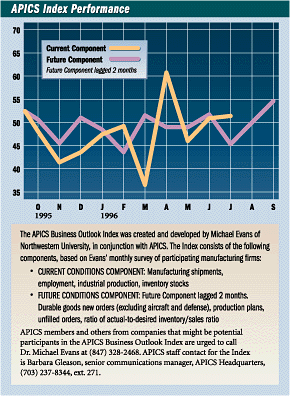
Despite some suggestions that higher interest rates were beginning to take their toll on the economy, there is no sign of a slowdown in the manufacturing sector in July. Indeed, the APICS Business Outlook Index rose to 53.0 from 50.1 in June, with the Current Component increasing to 51.4 from 50.2, and the Future Component rising to 54.7 from 50.1.

There seem to be two factors at work here. First, fewer firms shut down production facilities in July, resulting in a larger than normal gain in production and shipments. That is not the entire story, for if that were the only effect, it would be offset by a decline in production plans over the next three months.

Hence we also find that the continuing robust gains in sales have resulted in a further decline in inventory stocks, leading to stronger production plans in the coming months as well. New orders continue to increase, and with the backlog of orders finally worked off, unfilled orders are also rising, which also tends to boost production over the next few months.

Only two components of the APICS index were below 50 in July: inventory stocks and employment. The decline in inventory stocks, when coupled with a rise in new and unfilled orders, should lead to continued production gains in the near future.

The employment component still remains weak. Even though more plants will be open in July during what had once been vacation or shutdown periods, no new employees will be hired for these positions, so the long-term trend in manufacturing employment continues to decline. On the other hand, we look for only about a 10,000 drop in manufacturing employment for July, compared to the 20,000 monthly average estimated for the first half of the year.


Current Conditions Component
  • Manufacturing Shipments posted robust gains in July, probably due to fewer plant shutdowns than usual this summer. The survey indicates a gain of almost 1 percent. In June, durable goods shipments fell 1 percent, so total manufacturing shipments will probably be down slightly for that month, compared to our estimate of a 0.2 percent gain.

  • Manufacturing Employment fell an estimated 10,000 in July, according to the APICS survey results. That is less than our average estimated drop of 20,000 in the first half of the year, and does represent a significant improvement in the manufacturing picture.

    Except for the surge in employment in April coinciding with the return of striking GM workers, the employment component of the APICS index has remained in a narrow range from 40.9 to 43.5 all year long. Hence the increase in the index to 45.6, even though it is slight and continues to indicate declining employment, is not as negative as the results for the first half of the year.

    Independently of the APICS survey, the steady rise in the length of the manufacturing workweek during the second quarter reported by the Bureau of Labor Statistics would also point to smaller declines, or possibly an actual increase, in manufacturing employment in the next few months.

  • Manufacturing Production probably rose about the same amount in July as it did in June; however, we're still not sure what the June figure was. The preliminary Fed estimate of industrial production in May showed a 0.5 percent rise in the manufacturing sector; this figure was then revised down to 0.3 percent. The 0.6 percent figure reported for June also seems high, and we are looking for a downward revision to the 0.4 to 0.5 percent range, which is also the number expected for July.

  • Manufacturing Inventory Stocks fell in July for the fourth month in a row and, as a result, are back below equilibrium levels. Apparently the expectedly strong gains in shipments over the past few months resulted in inventory stocks being depleted faster than anticipated, which should help boost production over the next few months. For July, the decline in stocks is expected to be 0.1 to 0.2 percent, in line with the average monthly decline during the second quarter.


    Future Conditions Component
  • New Orders, excluding aircraft and defense, continued to rise in July, increasing about 0.7 percent. Some pointed to the 0.8 percent drop in June durable goods new orders as a sign of weakness, but almost all of that drop was due to a plunge in aircraft orders. By comparison, new orders for nondefense capital goods, excluding aircraft, rose 1.3 percent in June after having declined slightly in both April and May. Thus we see the underlying upward trend in new orders continuing in July.

  • The Unfilled Orders index posted its highest reading in a year, rising to 53.3, indicating about 0.5 percent growth for July. Orders were also up slightly in June, making this the first time unfilled orders have risen in consecutive months since mid-1994. That also bodes well for production gains later this year.

  • The index for Production Planning came in at 51.9 for July, virtually unchanged from 51.7 in June. Yet we consider this slight gain significant because actual levels of production were above average in July due to fewer summer shutdowns. Hence if the underlying situation had not improved, the estimate of planned production over the next three months would have declined. Thus it now appears manufacturers are committed to above-average rates of increase in production for the August-October period.

  • The ratio of the actual to desired level of the Inventory/Sales ratio dropped suddenly in July, after being near neutral in May and June. This figure is inverted in the calculations; a lower ratio means a higher index number, because that should lead to bigger gains in production for rebuilding inventory stocks in the future.


    No signs of slowdown yet
    All year long the bond market bulls have been claiming that higher interest rates would "soon" lead to sluggish growth, which in turn would bring interest rates back down to their levels at the beginning of the year. So far, they have been completely off track. Nonetheless, most economists believe that a rise in interest rates will eventually reduce real growth, so for many the game has turned into a question of "patiently" waiting for the first signs of sluggish economic activity.

    The APICS results for July indicate they will have to wait a while longer. Shipments and production both rose sharply, and while part of that reflects fewer summer shutdowns than used to be the case, the underlying data point to continued gains in manufacturing for the next several months. Both new and unfilled orders rose, production plans remain robust, and inventory stocks appear to have dipped below desired levels again, pointing to gains in production during the second half.

    So what's the story-don't interest rates matter any more? Of course they do. However, what the bond market bulls have failed to realize is that a 1 percent rise in interest rates when real disposable income is rising at a 4 percent annual rate and credit is still readily available is simply not enough to make much of a dent in the overall growth rate.

    There have been a few pockets of weakness in the past few months. Sales of mobile homes, trailers and boats are sluggish. Motor vehicle sales have flattened out and are being kept from falling further only by a heavy dose of below-market financing rates and generous rebates. Home improvement construction is down. And while housing sales rose in the second quarter, a slight retraction appears to be in the cards for the second half.

    Nonetheless, the impact of all these negative items is only enough to reduce real growth from its estimated 4 percent rate in the second quarter to about 3 percent in the second half. The key to strong economic performance is the above-average growth in real disposable income, due both to a 2.5 percent growth rate in employment and a continuing rise in the real wage rate, reflecting more "good jobs at good wages."

    The principal threat to continued economic success, then, is not any imminent slowdown, but the possibility that higher inflation will boost interest rates further, curtail credit demand, and cause sluggish or negative growth. Given our scenario of 3 percent growth in the second half, it seems likely that labor market pressures will intensify and wage gains will accelerate.

    If that does occur, the core inflation rate will rise from the 2.6 percent rate recorded in the first half to the 3 to 3.5 percent range, sending interest rates up another half percent to 1 percent and causing very sluggish growth by early 1997. For the rest of this year, though, the APICS survey results and other current economic data point to 3 percent growth.

    All opinions expressed in this report represent the viewpoints of Michael Evans.


    APICS Index Performance


    If you're having trouble reading the text at the bottom of this graph, click here.


    APICS Business Outlook Index

    Maximum feasible value = 100
    CURRENT COMPONENT
     SHIPMENTS EMPLOYMENT PRODUCTION INVENTORY CURRENT COMPONENT TOTAL APICS INDEX*
    1995
    AUG 62.8 44.8 44.2 37.9 47.4 49.1
    SEP 56.9 48.6 58.5 54.8 54.7 50.1
    OCT 57.1 42.8 46.6 46.0 48.1 49.5
    NOV 56.6 34.6 38.9 35.3 41.3 44.8
    DEC 43.4 43.3 44.4 44.1 43.8 43.8
    1996
    JAN 59.7 42.1 50.0 37.9 47.4 49.4
    FEB 58.6 40.9 61.1 37.1 49.4 49.2
    MAR 34.8 43.3 37.0 31.8 36.7 42.9
    APR 73.0 55.6 73.2 43.261.3 56.2
    MAY 53.5 43.3 41.7 45.7 46.1 45.6
    JUN 51.5 43.5 57.1 48.5 50.2 50.1
    JUL 58.7 45.657.7 43.7 51.4 53.0
    FUTURE COMPONENT
     NEW ORDERS UNFILLED ORDERS PRODUCTION PLANNING I/S RATIO FUTURE COMPONENT
    1995
    AUG 47.0 46.9 57.7 51.0 50.7
    SEP 51.5 44.6 43.3 43.1 45.6
    OCT 51.9 48.0 48.3 55.7 51.0
    NOV 45.3 39.6 55.4 53.1 48.3
    DEC 37.1 45.5 50.0 42.6 43.8
    1996
    JAN 48.2 43.1 52.1 61.7 51.3
    FEB 50.2 39.7 45.9 60.0 49.0
    MAR 50.0 51.5 53.6 40.9 49.0
    APR 55.6 36.5 48.4 64.2 51.2
    MAY 40.9 44.8 46.6 48.5 45.2
    JUN 51.6 50.1 51.7 47.0 50.1
    JUL 55.0 53.351.9 58.554.7
    * Current and Future Components with equal weights


    click here if your Web browser is incapable of viewing tables in html.


    Copyright © 2020 by APICS The Educational Society for Resource Management. All rights reserved.


    Click here to return to the table of contents.