September 1996 € Volume 6 € Number 9


Scheduling in a "To Order"
Manufacturing Environment


By John R. Bilas, CPIM

The four different types of "to-order" manufacturing pose their own unique constraints to the business of scheduling.

As the customers of manufacturing and distribution companies become even more demanding and require specialized "to-order" products to fulfill their needs, the "to-order" sector of the manufacturing community has begun to grow at an astounding pace. Not only do customers require more specialized products than ever before, but they require them in shorter periods of time. Gone are the days of the special order that also carried with it a significant lead time above and beyond that of a company's standard product. To react to these changing customer requirements, most manufacturers have had to rethink their manufacturing strategies to remain competitive in the marketplace. Those that fail to respond to these challenges most likely will face the consequences of lost market share, and in some instances, obsolescence.

To discuss the planning and scheduling requirements of the "to-order" manufacturer, it is important to first understand the different types of manufacturing that exist in the "to-order" sector. Most manufacturers will admit to making at least some of their products "to-order," but what does the term "to-order" really mean? It can have very different meanings based on the type of product being manufactured. The term "to-order" is used in almost every industry, but here we will focus our discussion on the four areas of manufacturing most often associated with "to-order": Discrete, assemble-to-order, make-to-order, and engineer-to-order. Each one of these distinct areas has unique planning and scheduling requirements. Each will be discussed in greater detail.


The Discrete Product
In the simplest terms, a company can make a very specific discrete product for one specific customer or many. This could be a very generic "standard" product that the company makes in very large quantities. It could even perhaps be a product that is "branded" for a specific company, which is identical to company's standard product but with different packaging and labeling. Consumer products are a good example of this - identical items sold under different brand names.


Discrete
Since these products typically have already been designed and the necessary production database is in place (bills of materials, routing, etc.), sales order processing is normally a very basic function and very conducive to electronic data interchange (EDI) processing. These items may be stocked in anticipation of customer demand to reduce lead times. They can be forecast and produced according to a master schedule. Production can be to a discrete work order or, as in the case of many repetitive environments, work orderless, flow-based manufacturing. Work centers or cells are scheduled to take advantage of available capacity. To maximize production and minimize setup time, group technology is employed to schedule products in a logical order. Often, many components are common to a number of items. When this occurs, it is not uncommon to have dedicated work centers or lines assigned to the manufacture of these items.


The Assemble-to-order Product
This type of item differs from a make-to-order discrete item in several ways. As implied in the name, assemble-to-order items are just that, items that can be assembled in a variety of combinations and permutations. These items are generally standard in nature, but the unique combinations offer the customer greater latitude in ordering and satisfying specific needs.


Assemble-to-order (ATO)
Generally, these items are constructed with standard components to form a unique end item. The ordering process is quite different from that of a discrete make-to-order item. Rules-based product configurators are an order entry tool of significant importance. Since any given product can be ordered in a number of different combinations, the right questions can be asked at order processing time to configure the product exactly to the customer's requirements. Configuration control ensures that only valid, buildable products can be ordered. As a result of the order configuration process, a unique manufacturing order is created for the item. This order contains the unique bill of material (BOM) and routing needed to build the item. Most rules-based product configurators can construct the routing in many ways. As the term assemble-to-order implies, these items are normally single level items assembled with standard components and subassemblies. Most often the place of assembly differs by product. Ideally the product configurator can choose the most optimum route for assembly, based on quantity. Large amounts can be sent to a regular final assembly work center, whereas small amounts can be routed to small quantity assembly areas. As with discrete items, group technology can play an important part in scheduling to ensure that similar items are scheduled together to minimize setups and maximize production efficiency.

Of equal importance in an ATO environment are the scheduling and procurement of components and subassemblies needed to support the finished, assembled product. It is absolutely critical that all of the necessary components needed to build the end product are available to support the final assemble schedule (FAS). Since these components can be of any size, type, construction, etc., coordination of their availability, when needed, is an even greater task. Even though most items in an ATO environment are most likely stocked, on occasion others must be made special. The manufacture and procurement of these items must be accomplished in a timely manner to support the FAS. Most often the inventory of these items is minimized to reduce cost either via Just-in-Time, kanban, or other inventory management techniques. The scheduling of both purchased and manufactured items to arrive on time is absolutely critical if customer request dates are to be met.


The Make-to-Order Product
This is perhaps the most defined area of "to-order." Most make-to-order items are normally completely made-to-order from scratch. They can, at times, closely resemble an assemble-to-order product in many ways. However, they are almost always more complex.


Make-to-order (MTO)
Where ATO products are just standard components assembled in a unique configuration, MTO items truly have different components and attributes associated with them. Also common in MTO products are dimensions. A customer can order a product in virtually any configuration, size, length, width or other pertinent attribute as long as it is within the allowable range of the product specifications.

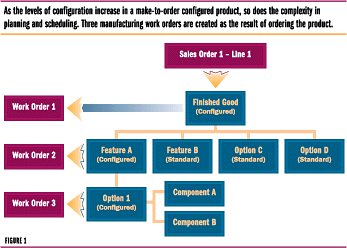
Also, very common to an MTO item is its multilevel characteristics. Most MTO items are built with a variety of components in a bill of material structure that could potentially be many levels deep. As an item is configured at order processing time, the choices that are selected could have an effect on the subassemblies to be made several levels below the finished good. Based on this multilevel configuration, not only will a work order be made for the top level item, but also all the necessary work orders to support the unique lower level assemblies and components will also be created (see Figure 1). This could potentially create a significant number of work orders to be scheduled to manufacture the finished good. Standard components must also be available to support the final configuration. These can be planned via normal policies such as minimum/maximum, MRP, etc. A particular note of difference between ATO and MTO is the number and level of complexities of the work orders. Where ATO has normally only one work order to support the assembly of a finished good utilizing standard components, MTO finished good items carry much more complexity and a greater number of work orders to support the MTO components. Scheduling becomes a greater issue, as the lower level components must arrive at final assembly precisely at the same time. As with ATO items, good product configurators will automatically create the corresponding BOM and routings at each component level. Backward scheduling with the appropriate lead time offsets ensure that the components arrive when needed. Of course at a more detailed level, outstanding work orders at any work center or cell can be grouped together via group technology for efficiency purposes. Both finished good and subassembly levels are difficult to master schedule, mainly because of differences in the individual items. Master scheduling by product group is more appropriate. This enables a wider range of items to be included. The time needed to manufacture a make-to-stock item is predictable. Each variant of an MTO item can contain a different manufacture time based on the configuration. In many instances the work center schedule becomes the informal master schedule.


A good product configurator is the key to success in an MTO environment. The rules-based methodology will schedule the work to the appropriate work centers. The scheduler will then be able to concentrate on managing the schedule with available capacity and materials to meet the sales order date.


The Engineer-to-Order Product
At the extreme end of the continuum is the engineer-to-order company. This type of company is also commonly referred to as a "job shop." Typically, this type of company manufactures one-of-a-kind products. Capital equipment is a good example of an engineer-to-order item - uniquely designed to meet a specific customer need and probably never manufactured before . . . many may never be manufactured identically again.


Engineer-to-order/job shop
Items of this nature are usually manufactured in extremely small quantities, with a lot size of one not being uncommon. Heavy engineering, quotation and estimating are a very important and integral part of the process. Sales order processing is unimportant. Product configurators are of little use as the features, options and characteristics are normally so unique that no amount of product intelligence can be incorporated into the configurator rules to allow for "configurable entry."

Each item ordered is normally assigned a "job" or "project" number. A substantial amount of engineering effort is required up front to estimate the potential cost of the finished good. Since each item is unique (as are a majority of the components that comprise it) BOM and routing are manually constructed for the entire product. In most cases, materials are purchased specifically for the job, and labor skills and standard hours must be approximated. Engineering becomes a critical resource and should be scheduled as such. Often this critical resource can be the difference between on-time and late deliveries. Each and every activity is scheduled to a job or project.

Most ETO jobs are long by nature. Since most of the work orders are manually created, they are also manually scheduled. Project management or job control tools may be employed to track and control the job. Percentage completion, dollars and hours are important information to gauge performance to plan. Since projects are long and capacity is limited, finite scheduling techniques are often used to aid in the management of jobs.


Creativity is key
The "to-order" sector in manufacturing is broad and deep. It can be found in virtually every industry segment in some way, shape or form. The type of scheduling employed can vary from company to company, based on such factors as: products produced, markets, manufacturing methods and constraints, just to name a few. In the "to-order" industries creativity is key. Whereas, in make-to-stock environments, most companies can schedule by a defined set of rules due to the simplicities of the products, the "to-order" business has no such luxury. The highly technical and sophisticated nature of the products, combined with the limitless combination possibilities, creates planning and scheduling opportunities as unique as the products themselves.


John R. Bilas, CPIM, is the Movex product director for Intentia, Rosemont, Ill.

For more information about this article, input the number 1 in the appropriate
place on the September Reader Service Form


Copyright © 2020 by APICS The Educational Society for Resource Management. All rights reserved.

Click here to return to the table of contents.