August 1996 € Volume 6 € Number 8


Simulation-Based Scheduling Software Improves Cycle Time


By Michael Thompson, CPIM


Finite capacity scheduling software that simulates events taking place in a manufacturing process can be used to minimize setups, maximize throughput at bottlenecks and improve a company's ability to meet its delivery commitments.

Compared to most discrete manufacturing industries, semiconductor wafer fabrication poses unique planning and scheduling challenges (some of them are listed in Table 1). These challenges are constraints that planners and schedulers must consider when making crucial business decisions. As semiconductor devices evolve, new process constraints are continually added, making the planning process increasingly complex. The complexity of the process has evolved to the point that the number of constraints, their interrelations, and the need to consider numerous scenarios is more than humans can manage without sophisticated computer-based tools to assist them.

Table 1.
Unique challenges to scheduling semiconductor wafer fabrication
  • Large number of process steps (generally more than 250 per product)
  • High re-entrant process flow (lots visit the same equipment multiple times)
  • An intermixture of single wafer and lot-based process operations
  • Batching of multiple lots that share process recipes and processing times
  • Some process steps that have material life thresholds that predicate when subsequent processes must take place
  • Equipment alignment and calibration issues require some process steps to return to the exact piece of equipment that processed the lot in a previous critical step


  • Within the last five years, the use of simulation-based finite capacity planning and scheduling (FCS) software in semiconductor manufacturing has increased dramatically. FCS software provides a test bed that mimics the constraints and the decision policies of the factory such that the simulated factory performance is highly reflective of the real world factory performance. FCS software adds an important dimension to traditional spreadsheet models. Simulation-based FCS systems add the dynamics of time-based material flow that cannot be properly represented in a spreadsheet model, and allow data to be input to specify the equipment, availability, calendars, products, process routings, process times, support tooling, material handling systems, human operators and certification levels, and numerous other constraints. Properly validated FCS models have been reported to have less than 2 percent error in performance as compared to the actual manufacturing system.

    In a wafer fabrication facility, categorically, there are two main types of policy decisions:
    When to launch
    The "when to launch" decision generally has the greatest impact on the measure of schedule performance. For high-volume facilities with a limited product mix, and where demand is very linear and the factory has sufficient capacity to consistently produce the desired lot release rate, determining when a lot should be released to meet the desired due date is a straightforward calculation.

    For lower volume and higher product mix facilities where demand is not linear, the question of when to launch is much more difficult. Some FCS systems provide features such as backward allocation to assist the human planners in determining when lots should be released to ensure that the lots will meet the desired due date while minimizing inventory and cycle time. Backward allocation is the process of specifying time-phased customer demand for each product and having the planning system allocate existing work-in-process (WIP) inventory to the appropriate customer demand, while at the same time determining when to launch new lots to satisfy the unmet demand. After backward allocation determines the lot start plan and WIP inventory allocation, the FCS system simulates the effect of the start plan with all of the constraints and policy decisions to verify its feasibility. Adjustments are made by the human planners if the demand is not being adequately met.


    Dispatching
    Once the start plan has been established and lots have been released to production, the sequence question of each workstation of the order lots should be chosen. Dispatching rules contain the logic and criteria by which the decision of what to work on next is made.

    Over the last 20 years, numerous studies have investigated which single dispatching rule is the best. These studies have generally attempted to test the performance of a single rule when used for all pieces of equipment in a factory. Most of the studies have tested single-criterion rules such as Shortest Processing Time, Earliest Due Date, Critical Ratio, etc. These studies have shown that only moderate gains can be made using the single-criterion, global rule approach.

    It has been determined the cycle time can be significantly improved by deploying more sophisticated rules that take into account the Theory of Constraints. The Theory of Constraints is a philosophy taught by Dr. Eliyahu Goldratt, who advises that constraints are inherent in every manufacturing system. These constraints are often critical pieces of equipment that, if scheduled effectively and coordinated with the equipment upstream and downstream in the process, can improve the overall throughput of the system. In semiconductor wafer fabrication facilities, the constraints are often not constant over a given time horizon. The moving constraint phenomenon has to do with the effect of batching stations, the combination of single wafer processes and batch lot processes, and re-entrant process flows. In effect, wafer fabrication systems with the constraints discussed here are chaotic systems that exhibit nonlinear behavior. For manufacturers to best manage these kinds of systems, operational policies must be employed to minimize the chaotic effects.


    Coordinated rule-based scheduling
    Leading FCS software provides human planners the option of developing custom, multiple-dimension rules that are tailored to a factory's unique constraint situation. Cycle time is improved by coordinating rules between the critical equipment constraints and the feeding stations; this is called coordinated rule-based scheduling.

    The general strategy of coordinated rule-based scheduling follows:

    1. Identify the critical resources in the factory. The critical resources are those that increase the overall throughput of the facility when their constraints are relaxed. Analyze production loading to determine the resources with the greatest load. Simulation does a great job of providing statistics on resources that have the highest utilization, and the largest number of lots waiting in queue, and the longest average wait in queue.

    2. Keep critical resources busy. Keep manageable levels of work in the resources input queue. Choose tasks that minimize setups, and avoid unnecessary setups. If necessary, critical resources should look upstream attempting to wait a reasonable amount of time for a better choice, rather than taking what is available on the family worklist. In some cases, resources should look downstream, attempting to keep products flowing by choosing jobs that will not get bogged down in a large downstream queue.

    3. Identify server resources. Server resources have low to moderate loads and can be used to aid critical resources. Server resources can ensure that critical resources can look downstream to feed the most productive work to critical resources.

    4. Run the model and analyze the results. Analyze the schedule performance measures established in your scheduling strategy. Pay particular attention to the utilization of critical resources. Were they fully utilized? Were they spending an inordinate amount of time setting up? Also, check to see whether new critical resources have surfaced. If you see a trend that could possibly be improved by making a rule change, enhance the rule and run the model again.

    5. Repeat the previous steps until you are satisfied with the schedule performance.

    6. Employ the selected rules with live data to schedule the facility. There may be some additional modifications to rules due to unforeseen issues that were not encountered in the test data.


    What is a dispatching rule?
    In most simulation-based FCS systems, there are active agents (either human operators or pieces of equipment) making decisions about which lots to process and in which sequence.

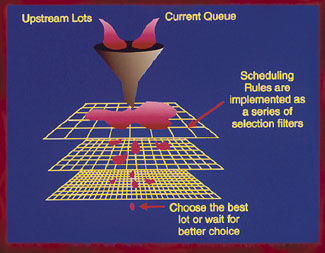
    Conceptually, rules are a series of task lists and filters. The potential tasks that an agent can choose from can be sorted and filtered, and the logic can branch among different lists of tasks, such that virtually any kind of policy decision can be represented using these rules (see Figure 1).

    Figure 1


    Typical Results
    MetricImprovement
  • Increase JIT (Just-in-Time)
  • 2%
  • Decrease cycle time
  • 5%-15%
  • Decrease cycle time deviation
  • 10%
  • Increase throughput
  • 2%-5%
  • Increase equipment utilization
  • 5%-10%
  • Increase output predictability
  • 10%
  • Increase operator efficiency
  • 2%-5%


    For example, SGS-Thomson Microelectronics, a pioneer in FCS systems implementation, has developed rules that give priority to urgent lots (hot lots). Next the rules check for preventative maintenance requirements, then give priority to lots whose recipe is consistent with the recipe that the machine is currently set up for. Conditionally, a maximum wafer count for each recipe is set to balance the selection of different recipes. Once it is determined that a machine must change recipes, the rules check for the availability of support tooling such as masks, then attempt to minimize the change-over time. In addition, the rules check to make sure the chosen recipe is not already being processed by another machine within the same machine family. SGS-Thomson Microelectronics has found that it is critical that the FCS software provide almost unlimited flexibility in rule development.


    Where is technology taking us?
    The following are the most critical issues facing semiconductor manufacturers and FCS software suppliers:

    1. Lowering the cost and level of effort required to integrate FCS software with manufacturing execution system (MES) software (integration standards are needed).

    Current FCS software technology is evolving from a purely stand-alone, isolated simulation environment to a fully integrated component of an MES system. The SEMATECH CIM Framework initiative is providing standards to assist MES and FCS software suppliers with integration. As the CIM Framework evolves and gains acceptance, it will minimize the amount of effort required for different software suppliers to interoperate and will save the end users a significant amount of money in avoiding custom software integration fees.

    2. Increasing the availability of accurate information needed to drive the planning process.

    FCS software is the classic "garbage in/garbage out" technology. The degree of planning error is largely reflective of the quality and accuracy of the input information. In addition, often the level of detail currently specified in MES systems is insufficient for detailed scheduling. Accurate models require that each equipment operation is a unique routing step in the process.

    3. Providing better tools for analyzing, diagnosing and suggesting improved planning and scheduling policy decisions.

    Today's FCS models can be extremely complex. Once a system has produced a plan or schedule predicting unacceptable results, it is often difficult for human planners to determine what policy changes must be made to improve the plan. Most FCS software provides Gantt charts, business graphics, and statistical reports to assist human planners in presenting the results. There is opportunity for the FCS software suppliers to provide better diagnostics that can make suggestions to human planners on possible policy decision changes.

    4. Providing the ability to have the policy decisions react to unforeseen events in real time.

    Most FCS software today is predictive in nature, meaning that it uses input data and policy rules to simulate from the current state forward in time. The result is a plan that predicts what will happen in the real world if all of the real world events happen as planned and specified. Unfortunately, unforeseen events also occur, which cannot be accurately predicted. In these situations, it takes too long to update the FCS model and re-run a simulation to react in a dynamic and timely fashion.

    SGS-Thompson Microelectronics depends on AutoSimulations' finite capacity planning and scheduling software AutoSched to improve its semiconductor manufacturing operations.

    Some FCS suppliers are allowing the policy decisions to be performed in real time. Rather than making decisions in a purely predictive manner, the decisions are made in a reactive manner based on messages from the equipment or the MES systems. The exact dispatching rules conceived and tested in the simulation environment an also be used in real time. The system can better react to unforeseen events and dynamic changes in state.

    The situation, however, does not reduce the need for simulation. Companies still want the ability to run extended simulations for weeks or months into the future to see the long-term effects of decisions that they are making. Additionally, companies need a test bed where scheduling rules can be developed and evaluated in an accurate simulation environment.


    Michael Thompson, CPIM, president and COO of AutoSimulations, Inc., is a member of APICS, the Society of Manufacturing Engineers, and The Society for Computer Simulation. He has been involved with modeling manufacturing systems for over 19 years, and holds BS and MS degrees from Brigham Young University.

    For more information about this article, input the number 6 in the appropriate place on the Reader Service Form


    Copyright © 2020 by APICS The Educational Society for Resource Management. All rights reserved.

    Click here to return to the table of contents.