August 1996 € Volume 6 € Number 8


Manufacturing Activity On Even Keel In June


By Michael K. Evans


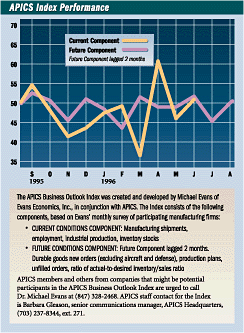
The APICS Business Outlook Index rebounded to 50.1 in June from 45.6 in May, up slightly from the 48.7 average for the first five months of 1996. The March-May numbers were somewhat distorted by the GM strike and its aftermath. The current component rose to 50.2 from 46.1 in May and its previous five-month average of 48.2, while the future component rose to 50.1 from 45.2 and a five-month average of 49.1.

Thus the APICS index indicates that manufacturing activity remains on an even keel. The June figures do not yet provide any signal that higher interest rates have reduced the growth rate in manufacturing.

The individual components also indicate little change in the manufacturing sector. New orders and shipments both increased slightly in June, with unfilled orders showing virtually no change. However, if the strike-depressed level of shipments in March is excluded, the June figure for shipments is the lowest this year, even though it still shows a slight gain.

Manufacturing employment remained sluggish, with an estimated decline of about 20,000, thus continuing the steady downward trend this year. Excluding the April blip following the GM strike, the APICS manufacturing employment index has indicated a decline in every month since April 1995.

Production rebounded again in June, and production plans indicate a slight deceleration in growth over the next three months. Inventory stocks remain well under control, with no sign that firms are planning to increase their stocks this summer. In fact, inventory stocks fell slightly in June, but the desired inventory/sales ratio fell a little more, leading to a slight uptick in the comparison of the actual to desired inventory/sales ratio.


Current Conditions Component
  • Manufacturing Shipments are expected to rise about 0.2 percent in June. In May, the Commerce Department reported that durable goods shipments rose a larger than expected 1.9 percent, due to a surge in aircraft shipments. Except for that one sector, though, gains in shipments remain at subdued levels.

  • Manufacturing Employment continues its steady decline, with another 20,000 drop in June. As we have discussed before in these pages, the APICS figures are often not comparable with the monthly changes in the Bureau of Labor Statistics (BLS) data. The survey data indicate that manufacturing employment has continued to decline about 20,000 per month in the second quarter.

    The BLS figures showed a big drop in April manufacturing employment, excluding the returning GM workers, followed by a slight increase in May; in our view, the gain in employment actually occurred in April, followed by another decline in May. The glitch in the BLS data was caused by several factors, including the five-week sample period for May. Since no additional glitches are expected for June, the BLS data are more likely to agree with the APICS figures showing a 20,000 decline in manufacturing employment for the month.

  • Manufacturing Production continued to post fairly robust gains in June, rising an estimated 0.3 to 0.4 percent. The gains are likely to be less than the 0.5 percent increase reported by the Federal Reserve for May, since there probably will be no further acceleration in production of motor vehicles.

  • Manufacturing Inventory Stocks probably fell slightly in June, down about 0.1 percent. Commerce Department figures are not yet available for May but the survey estimates indicated a drop of 0.1 to 0.2 percent in inventory stocks last month.


    Future Conditions Component
  • New Orders, excluding aircraft and defense, probably continued their modest gain in June; this category of orders rose 0.7 percent in May.

  • With both shipments and new orders showing slight gains, Unfilled Orders were probably flat in June. However, given that they had been declining for almost an entire year, this indicates that backlogs have now been worked off to the point where they have stabilized, a bullish sign for the economy.

  • The Index of Production Planning continues to point to modest gains in production over the next three months, probably 0.2 to 0.5 percent per month. The level of growth is likely to be lower than in the first half of the year, as inventory ratios should remain stable and motor vehicle production probably will not increase from current levels.

  • The ratio of the actual to desired level of the Inventory/Sales ratio is very close to neutral, indicating no desire to shift inventory stocks in either direction.


    Three percent growth likely to continue in second half
    Based on the June survey results, we are not only looking for 4 percent growth this quarter, but now see real growth averaging about 3 percent in the second half as well. The two areas where higher interest rates invariably have their initial effect, namely motor vehicles and housing, have not yet shown any signs of weakness. Although housing starts fell in May, permits did not, so the drop in starts was not a meaningful sign of weakness.

    Looking at the future component of the index, new orders are still rising, albeit at modest rates. Perhaps more important, it appears that the backlog of orders has been worked down to the point where it is no longer diminishing, which means any further uptick in orders would boost production.

    Along the same lines, the index for production planning suggests modest gains of 0.2 to 0.3 percent per month for the next three months, consistent with a 3 percent growth rate. Finally, inventory stocks are now well under control, so there should be no further cutbacks from that source, while any unexpected gains in sales would soon translate into a rise in desired inventory stocks and in industrial production.

    The June results thus describe a manufacturing sector with no apparent minuses -- no overcapacity, excess inventory stocks, or order imbalances -- and hence one that could benefit from continued growth in the rest of the economy. But what factors might provide that spark of growth?

    In our view, it would have to come from consumer spending. Housing may well hold its own but is certainly not going to improve further in the face of higher interest rates. Capital spending has already slowed down, and export growth remains moderate. On the other hand, consumer spending continues to rise at above-average rates.

    We are entirely unimpressed by the argument that consumers have "too much" debt. Consumers "always" have too much debt, and it is easy enough to prepare graphs that show the debt/income ratio, or some similar variable, rising to "dangerous" levels.

    Yet the actual history of the effect of debt is somewhat more prosaic. When credit is easily available, interest rates are at relatively low levels, and the yield spread is fairly wide, that encourages lenders to continue to make more loans to the private sector. Thus the fact that debt continues to rise faster than income is of little or no account. What is important is that additional credit is readily available at a reasonable rate.

    Admittedly the gravy train has to stop sometime. When the Fed tightens to the point where the yield spread is minuscule or negative, lenders will reduce the amount of funds available for borrowing, and all of a sudden consumer spending will plunge. Clearly the economy is not yet at this point.

    Eventually, Fed tightening could lead to a significant slowdown in growth, but the evidence of the past 25 years suggests that it takes at least two quarters, and often as much as four quarters, before tighter monetary policy begins to have a significant negative impact on real growth.

    Of course, the Fed decision on whether -- and how much -- to tighten will be tied to what happens to the inflation rate. The APICS survey does not measure prices paid or received, but it does show that the underlying factors that often accompany higher inflation -- excessive inventory purchases, growth in production above the rate of increase in capacity, and rising backlogs of orders that encourage some firms to raise prices as a tradeoff for faster delivery -- are all absent.

    On balance, then, the continuation of readily available credit and robust employment gains outside the manufacturing sector are likely to lead to continued above-average gains in consumer spending for the second half of the year. Those gains will translate into further increases in orders, production and shipments in the manufacturing sector.


    All opinions that are expressed in this report represent the viewpoints of Evans Economics, Inc., and are not necessarily those of APICS.


    APICS Index Performance


    If you're having trouble reading the text at the bottom of this graph, click here.


    APICS Business Outlook Index

    Maximum feasible value = 100
    CURRENT COMPONENT
     SHIPMENTS EMPLOYMENT PRODUCTION INVENTORY CURRENT COMPONENT TOTAL APICS INDEX*
    1995
    JUL 54.7 46.6 45.8 45.3 48.1 50.3
    AUG 62.8 44.8 44.2 37.9 47.4 49.1
    SEP 56.9 48.6 58.5 54.8 54.7 50.1
    OCT 57.1 42.8 46.6 46.0 48.1 49.5
    NOV 56.6 34.6 38.9 35.3 41.3 44.8
    DEC 43.4 43.3 44.4 44.1 43.8 43.8
    1996
    JAN 59.7 42.1 50.0 37.9 47.4 49.4
    FEB 58.6 40.9 61.1 37.1 49.4 49.2
    MAR 34.8 43.3 37.0 31.8 36.7 42.9
    APR 73.0 55.6 73.2 43.261.3 56.2
    MAY 53.5 43.3 41.7 45.7 46.1 45.6
    JUN 51.5 43.5 57.1 48.5 50.2 50.1
    FUTURE COMPONENT
     NEW ORDERS UNFILLED ORDERS PRODUCTION PLANNING I/S RATIO FUTURE COMPONENT
    1995
    JUL 60.0 53.2 50.0 46.9 52.5
    AUG 47.0 46.9 57.7 51.0 50.7
    SEP 51.5 44.6 43.3 43.1 45.6
    OCT 51.9 48.0 48.3 55.7 51.0
    NOV 45.3 39.6 55.4 53.1 48.3
    DEC 37.1 45.5 50.0 42.6 43.8
    1996
    JAN 48.2 43.1 52.1 61.7 51.3
    FEB 50.2 39.7 45.9 60.0 49.0
    MAR 50.0 51.5 53.6 40.9 49.0
    APR 55.6 36.5 48.4 64.2 51.2
    MAY 40.9 44.8 46.6 48.5 45.2
    JUN 51.6 50.1 51.7 47.0 50.1
    * Current and Future Components with equal weights


    click here if your Web browser is incapable of viewing tables in html.


    Copyright © 2020 by APICS The Educational Society for Resource Management. All rights reserved.


    Click here to return to the table of contents.