
August 1996 € Volume 6 € Number 8
Supply Chain 2000:
Integrated Sales Manufacturing and Logistics
By Richard L. Burdett and Gerard W. Cleaves
One of the most significant challenges facing businesses is the integration
of work along their supply chains -- from customer to supplier and from
order acceptance to product delivery. Those who shorten the overall cycle
and become more responsive to customer needs will fare best.
The future will belong to those who understand data, can arrange it to form
meaningful information and then utilize the knowledge they gain to satisfy
new market needs. During the 1970s and 1980s, manufacturing companies tried
Just-in-Time (JIT), total quality management (TQM), and other well-intended
programs to improve manufacturing processes. In the 1990s, those incremental
approaches gave way to more radical ones-business process reengineering.
Questions that companies have grappled with as they reengineered include:
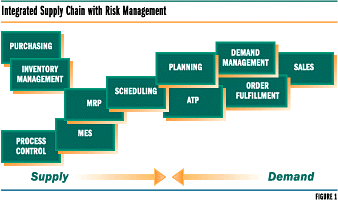
- How do we tighten the sales, manufacturing, and logistics supply chain?
Can we make direct connections between customers, inventories, and manufacturing
while preserving rational economic planning and scheduling? How do we manage
risk (see Figure 1)?
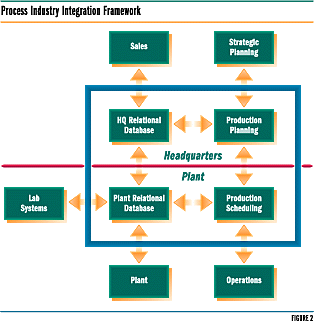
- In process environments, how can we link a relational database management
system with the real-time data capture system? How do we structure the plant
database in order to integrate planning, scheduling, and process control
(see Figure 2)?
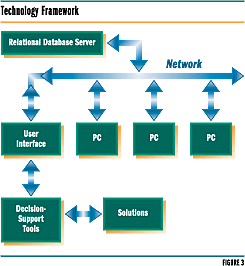
- How should we position ourselves to take advantage of emerging technologies
including local area networks (LANs), wide area networks (WANs), graphics,
object orientation and improved communications capabilities available via
the Internet? Is the client/server model still valid for the year 2000 and
beyond (see Figure 3)?
Creating a competitive advantage
Traditionally, the manufacturing industry has turned to MRP-based systems
to solve supply chain problems, primarily for their database capabilities.
Over the years, numerous attempts have been made to broaden the scope of
these systems to include scheduling functions such as finite capacity scheduling,
multi-facility allocation, sequencing and lot sizing; and to extend the
use of these discrete manufacturing tools to the process industries. In
some cases, additional modules have been added to existing systems, in other
cases, data links were developed to external packages. At best, the result
is a cumbersome collection of tools that require considerable manual intervention
to produce usable information. At worst, the schedules generated from these
systems are "thrown over the fence" for resolution by manufacturing
personnel on the plant floor, where they exist only as pieces of data and
add nothing to a company's greater knowledge.
To improve its competitiveness, a company must get beyond the mere collection
of data and harness decision-support technology to expand its knowledge.
The business issues for many companies revolve around improving customer
service by reducing the span of time between taking an order and making
a shipping commitment. The objective is to turn weeks, days, or hours into
hours, minutes, or seconds -- and to do so at the lowest possible cost.
A natural corollary is to determine whether an order should be met: Is it
profitable? Is it consistent with business objectives? Combining the two
factors gives a more systematic view of the supply chain and thereby transforms
data into information.
The technology issues revolve around relational databases and 4GL templates
or objects, client/server architecture, object linking and embedding (OLE)
standards, graphical user interfaces, optimization, expert systems and communications.
Adding additional research and development to address risk management or
decision-making under risk and uncertainty creates a form of knowledge that
can be applied to many aspects of work from strategic to operational.
Introducing new technology often requires cultural change in addition to
organizational change. The downsizing trend now appears to have run its
course. Rapid innovation and frequent product introductions will become
the norm for successful companies. Regardless of the organizational approach
taken, the introduction of advanced methods will require additional training
and retraining of personnel in order to improve the ability of the organization
to turn information into knowledge.
Implementation issues include a need to clearly define business objectives
and priorities and to use these to reinforce and manage expectations throughout
an entire organization. Companies must identify benefits from tightening
the overall supply chain (i.e., improved customer service through better
and faster response, increased throughput, and reduced manufacturing and
logistics costs) and growing their markets and then compare the costs associated
with delivering these benefits to alternative investments such as new plants
and equipment, full computerization, aggressive use of the Internet, or
carrying excess inventory.
The benefits to be gained from integrated operations -- notably planning,
scheduling, selling and buying -- include greatly improved customer service
and lower manufacturing costs, all of which lead a company to do what it
says it can do. Use of highly integrated decision support technology serves
as a catalyst for effective communications and teamwork between sales and
operations personnel, and as a foundation for cost reduction and reengineering
initiatives. Benefits can be realized at all levels of the planning and
scheduling hierarchy. However, overall gains will be limited unless sales,
strategic and operations planning, and scheduling processes are approached
as an integrated whole. Companies that succeed in integrating these business
processes will have a significant competitive advantage and will be in better
position than their competitors to grow into new areas. Rather than chasing,
they will be chased.
Filling in the context: a more detailed look
Current MRP systems are second-generation products that have improved upon
early versions. Yet they are still inadequate for capacity balancing and
scheduling or complete integration of activities. Advances in manufacturing
techniques in the 1980s -- JIT, work cells, and continuous-flow processes
-- removed some of the differences between discrete and process manufacturing,
and made manufacturing organizations more responsive to their customers.
MRP vendors have struggled to support these new technologies because their
systems are based on discrete lots and batches. They provide few tools to
manage capacities, orders and inventories in a continually changing environment.
MRP systems originated within the assembly manufacturing industries to make
sure the right materials are in the right place at the right time to meet
production targets. Modern manufacturing philosophy holds that the organization
of the shop floor and floor-based systems should bring materials to the
manufacturing process as automatically as possible, pulling the materials
into the process instead of using MRP systems to push the process from the
storeroom. Consequently, MRP works best when it is part of a shop floor
system. When firms need help with planning, capacity balancing, or scheduling,
they are not well served by MRP systems.
MRP-based systems are best suited to order entry, inventory control, forecasting,
plant and laboratory data management, and job/process control. Typically,
these systems have master production scheduling modules. However, process
industry and manufacturing companies with complex operations (i.e., companies
with multiple plants, products or stages of production or those having complex
recipes or routings) find them inadequate.
Since these systems cannot meet all of the planning and scheduling requirements
of any single company, the natural question arises, are the database capabilities
of MRP systems appropriate for the supply chain needs of the future? Specifically,
companies need to address:
- 1. What data is needed to generate the information that tighten
the supply chain and integrate the different applications that manufacturing
companies use to control their operations?
- 2. What costs need to be considered when multiplecriteria optimization
is desired?
- 3. How often does this data need to be updated? Where are real-time
systems needed? Where can batch-based systems be utilized?
- 4. How must the data be processed? What are the desired controls,
feedback, and outputs? What technologies are critical to this decision support
framework?
Most of the data management functions required for computer integrated manufacturing
(CIM) can be provided by a good relational database management system used
in tandem with tools for data reconciliation to improve data quality, and
risk management tools to improve decision quality. Current inventory control,
order entry, forecasting, and/or process information systems already perform
many of these functions and would only need to be converted to database
templates or objects. These templates could serve as starting points for
different planning and scheduling applications ranging from supply chain
management to strategic planning.
How would these templates fit on a relational database? By building a simple
template for each of the key applications (such as order management, inventory
management, forecasting, distribution planning, scheduling, process/job
control) using commercially available tools linked to sources of data to
translate this data into information and supply chain optimization models
to further translate the information to knowledge.
Current scheduling tools are designed to assist companies in developing
realistic production plans and schedules -- ones that can be handed directly
to a production superintendent -- at lower than customary cost (that is,
with significant reductions in inventory and manufacturing costs). Since
these products bring together information that is required to support production
planning and scheduling (forecast, order entry, inventory, process -- all
of which might come from MRP-based or current in-house systems), the tool
serves as a catalyst to promote better communication between marketing and
manufacturing personnel.
Planning and scheduling problems are complex, and the these products must
integrate techniques from databases, operations research, expert systems
and graphics to address different parts of the overall scheduling universe.
Fundamentally sound, technically robust solutions, when combined with good
relational database systems, can provide companies unprecedented capabilities
across the entire sales, manufacturing and logistics supply chain to reconcile
data, balance facilities, optimize operations, and deal with sequencing
and dispatching. We can now truly integrate planning and scheduling with
process data, MRP systems, and inventory management systems. Many of the
technologies required for firms to become knowledge-based companies exist
and are in use at leading corporations.
Electronically empowered
Now, with efficient relational database systems and fourth generation language
development tools, specialized manufacturing and shop floor control packages
are becoming less useful tools as technologies overlap. Many of the features
that once distinguished MRP systems are now available in good relational
database managers. Moreover, non-database functions can generally be found
in good planning and scheduling products.
The recent explosion of computational power, the emergence of efficient
relational database technology and improved telecommunications have made
possible the integration of manufacturing planning, scheduling, and control.
Now that we have the potential for doing whatever decision-support calculations
are required, wherever we want, supported by whatever information is required,
we are left with some key design questions: How do we establish an integrated
sales, manufacturing, and logistics framework to pull all the data and information
together to generate knowledge a business can then utilize?
Industry needs new tools to integrate optimization, simulation, and graphics
interfaces -- using "best of breed" technology as a starting point.
With new capabilities at their disposal, companies will be able to distribute
computational capabilities across entire enterprises to reconcile data,
balance facilities, optimize operations, deal with sequencing and dispatching,
address risk and uncertainty and maintain stringent quality controls.
It is desirable to think in terms of many different models arrayed across
different levels of the planning, scheduling and control hierarchy. An integrated
system can move select plant information to a higher level in the hierarchy,
so that the system can respond quickly to inquiries and opportunities. Higher
level functions such as production planning can support lower level scheduling
and inventory control functions. Such a system can combine or uncouple scheduling
functions as required. For process industry applications, an integrated
system must be able to support process optimization at the supervisory process
control level and generate targets, marginal economics, and constraints
for process control algorithms.
Strategic planning requires a revolutionary approach to risk management.
Decision support technologies require an infusion of old-fashioned common
sense for finding strategies and making strategic decisions. The goal is
to find strategies that are: optimal, or close to optimal, under favorable
conditions; good under a wide range of conditions; and acceptable under
the most adverse conditions.
The state of the art
In current business practice and economic theory, most planning models optimize
either the financial results of an enterprise or its market share. Such
shortsighted goals may, in the long run, harm both a company and its major
stakeholders. New modeling capabilities must be developed for "value-added"
costs and profits subject to acceptable risks. They must combine various
goals of different weights, which is especially useful for finding compromises
among the opposing opinions of different decision-makers within an organization.
In addition to these system elements, there are other critical components
of change to manage. These include:
- The processes of the supply chain
- The skill level of the people involved in the supply chain
- The organizational set-up to manage the supply chain
Further study must focus on processes, people, and organizations as well
as decision support tools and information systems of the future supply chains
of leading corporations to enable them to learn to generate useful information
and turn it into knowledge.
The integrated supply chain framework
It is increasingly important for multinational companies to improve the
global integration of their supply chains. But to do this they have to reexamine
the basic relationship of supply and demand and redefine their work according
to extended geographic and cultural boundaries. They must understand clearly
their strengths and weaknesses in local, regional and global markets, how
best to use expensive assets worldwide and, finally, how to leverage their
strengths as a valuable extension of their physical products. In some cases,
organizational capacity and knowledge become the product. All this activity
requires superior information and tools that allow quick response to complex
dynamics.
What is required to implement an integrated supply chain framework? Implementation
with 4GL languages such as SQL relational databases, OLE oriented products
minimize initial development efforts and allows an evolutionary development
path. We envision database templates for different business functions that
provide a starting point for initiating a variety of supply chain applications.
With an integrated supply chain framework, implementation projects would
not require traditional code development. Implementations involve creating
databases and defining data in higher level systems-models, database structures,
expert system rules, menus, user interfaces, and so forth. They require
high level consulting expertise, especially in the areas of database design,
modeling, expert systems, and manufacturing economics. This expertise comes
from systems integrators, software vendors, or the client organization itself.
The bulk of the actual implementation work, however, can be done by analysts
with less programming or consulting expertise. The leverage achieved by
only a few experts in such projects can be phenomenal.
The database orientation of the integrated supply chain framework helps
the user of such systems integrate other specialized external systems such
as order entry, purchasing, and accounting. It further enables reasonable
migration paths for implementation based on existing legacy systems where
appropriate. Instead of needing interfaces between different systems and
modules, modules can be plugged into a common database. When a module becomes
obsolete, unplug it and plug in its replacement.
Most planning and scheduling applications until now have been primarily
in the forward planning and scheduling areas. Expert systems can be applied
to real-time job control and process control environments too. Thus, we
must ask if, given an integrated supply chain framework closely linked to
these two functions, can we establish a planning/scheduling/control environment
that can mix push vs. pull, JIT, kanban, MRP, and other elements as required
by the business problem at hand. Once again, the major design issue is how
to construct the underlying database to support such a general manufacturing
control system.
Leading, not following
Companies that consistently develop good production plans and adapt their
schedules as conditions change to meet the growing needs of their customers
will be superior competitors. Those that can integrate this information
along the supply chain and make good decisions will have the knowledge to
be leaders, not followers.
Planning and scheduling are difficult even in a stable environment since
they involve the assimilation of vast amounts of information. When the unexpected
occurs -- last minute order changes, interruption of material flow, or equipment
failure -- the task becomes more difficult. Even the most knowledgeable
employees may find the job overwhelming unless they have access to the appropriate
current information and decision support tools.
Richard L. Burdett has held assignments in procurement, manufacturing,
production planning and distribution in his 20-year career at Du Pont. He
has recently been named a director of AtlanTec Inc. Gerard W. Cleaves is
the president and founder of AtlanTec Inc., a Westfield, NJ-based company
specializing in supply chain and risk management.
For more information about this article, input the number
7 in the appropriate place on the Reader
Service Form
Copyright © 2020 by APICS The Educational Society for Resource
Management. All rights reserved.
Click here
to return to the table of contents.