July 1996 € Volume 6 € Number 7


Manufacturing Activity Turns Sluggish Again


By Michael K. Evans


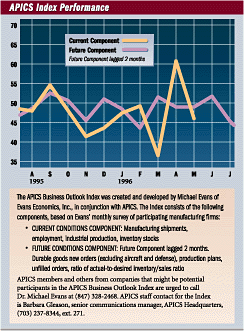
The APICS Business Outlook Index declined significantly in May, falling to 45.6 from 56.2 in April. The Current Component of the index dropped to 46.1 from 61.3, while the Future Component declined to 45.2 from 51.2. The April result was artificially boosted by the increase in production following the GM strike. However, the May figure of 45.7 is also below the 49.6 average of the past two months, indicating that even after adjusting for the impact of the strike, the trend in manufacturing activity slowed substantially in May.

The Employment Index, which had indicated a gain in employment, even excluding the returning strikers in April, indicates a return to recent trends, with a decline in manufacturing sector employment of approximately 20,000 for May. Industrial production is expected to be little changed, although current-dollar shipments will continue to rise because of higher prices in some industries.

A reading of 46 for the overall index generally indicates no change in overall manufacturing activity. Furthermore, since both the current and future components of the index are near this level, the results indicate there is not likely to be much change in manufacturing activity over the next three months.

New and unfilled orders both declined in May, and production plans indicate little or no pickup in manufacturing over the next three months. Inventory stocks appear to be in balance, so production schedules should not be influenced by any attempt to alter the inventory/sales ratio.

For the first four months of 1996, the APICS index averaged 49.4, indicating that manufacturing activity was advancing at a 2 to 3 percent annual rate. The decline in May suggests more sluggish growth in the manufacturing sector.


Current Conditions Component
  • Manufacturing Shipments are expected to rise about 0.3 percent in May; however, the gain will be due to higher prices, with constant-dollar shipments showing a slight decline.

  • Manufacturing Employment declined an estimated 20,000 in May. For January and February, the APICS index for manufacturing was 42.1 and 40.9, respectively, indicating about a 30,000 decline in manufacturing employment in each month. However, the Bureau of Labor Statistics (BLS) figures showed a 72,000 drop in January, followed by a 30,000 rise in February, for an average decline of 21,000. In March, the APICS index predicted a drop of about 20,000 in manufacturing employment, excluding GM strikers; the BLS figure, excluding the strikers, was 30,000. Over the quarter, the results were similar.

    In April, though, the APICS index looked for about a 20,000 gain plus the returning strikers, whereas the BLS figure showed a 50,000 drop excluding strikers. That 70,000 difference is even bigger than the 42,000 gap in January. Since we believe the BLS seasonals are flawed, particularly for the first month in each quarter, most of that 70,000 difference should be made up in May. As a result, the BLS report could show a gain in manufacturing employment of anywhere from 30,000 to 50,000 because of the error in reporting April data. Averaging April and May, excluding returning strikers, the APICS figures show no change; we think the two-month average for the BLS figures will show approximately the same result, which means a big gain in the government employment figures for May.

  • Manufacturing Production probably was unchanged in May. Last month, the index predicted that the April gain would be 1.0 percent; in fact, the Fed reported a 1.3 percent gain, or a 0.3 percent rise excluding motor vehicles.

  • Manufacturing Inventory Stocks probably showed very little change in May, continuing the pattern of the past three months.


    Future Conditions Component
  • New Orders, excluding aircraft and defense, rose in April-a fact confirmed for the durable goods sector by the Commerce Department -- but slipped again in May, falling about 1 percent, according to the APICS survey results.

  • Unfilled Orders continued to decline, although they fell less than in April, when shipments surged following the GM strike. In general, though, firms continue to work down their backlogs, indicating that most of them do not expect a surge in economic activity in the next few months.

  • The Index of Production Planning shows no change in production over the next three months. Since the Fed gives more weight to high-tech equipment and components than does the APICS survey, that would probably translate into a 0.1 percent to 0.2 percent increase in the Fed index of industrial production -- still below the 0.4 percent monthly average for manufacturing production during the first four months of the year.

  • Most survey participants indicated that the Inventory/Sales ratio was fairly close to desired levels in May. The decline in inventories stemming from sluggish growth in 1995, the effects of the severe winter weather, and the GM strike caused this index to jump around over the past several months, but with no distorting effects; the May data indicate firms are not likely to adjust their inventory stocks.


    Factors leading to slower growth ahead
    The APICS index was reported at 49.6 or higher from its inception in September 1993 through the end of 1994. Over that period, real growth remained at above-average rates. The index fell below 50 from February through June 1995, rebounded in the July-October period, and then dropped in November and December, reflecting the improvement in third quarter growth followed by the fourth quarter slowdown. Through April 1996, the index remained near 50 (adjusted for the strike), but the May figure indicates the slowdown has returned. What economic factors are responsible for the slowdown?

    The first, and most likely, cause of more sluggish growth has been the 1 percent increase in interest rates over the past three months. In spite of the uptick in housing starts and building permits in April, the survey results indicate that higher interest rates are beginning to reduce growth in industries associated with housing and consumer durables.

    Also, we think that export growth is slowing down, and net exports are starting to decline again. The three-month moving average figures show that the net export deficit rose steadily from $9.2 billion in January 1995 to $11.1 billion in May 1995-due mainly to the collapse of the Mexican economy -- but then narrowed steadily to $7.3 billion in November. Since, then, however, the deficit has widened to $8.6 billion. The recession in Germany and sluggish growth in Latin America, coupled with the strengthening of the dollar, appear to be the major reasons-and those factors are likely to continue for the rest of this year.

    A third factor is inventory investment itself. According to the APICS survey results, the inventory/sales ratio was at unusually low levels late last year, so when sales showed modest strength early in 1996, some firms rebuilt their inventory stocks. Hence inventory investment (excluding retail auto dealers) rose in the first quarter. However, the latest survey results suggest there will be no further rebuilding of stocks in the next few months.

    The rise in interest rates in 1994 caused purchases of motor vehicles and residential construction to flatten out by midyear. However, the economy continued to rise at a robust 3.4 percent rate in the second half because capital spending rose at a 13 percent annual rate. Yet the recent drop in the new orders component of the index to 40.9 means that index has averaged 47.0 over the past six months. When compared to 53.8 for the comparable period two years ago, this strongly suggests that second-half gains in capital spending will be sluggish.

    The lack of "pricing power" in the market, as noted by the excess capacity in manufacturing and the steady decline in the "core" intermediate and crude materials components of the PPI, is yet another reason why inventory investment will not increase in the second half.

    The improvement in economic activity in the first four months of this year was aided by a rebound in non-auto inventories, a boost in construction stemming from the decline in interest rates last year, and an improvement in consumer spending due to the spurt in mortgage refinancing and earlier-than-usual income tax refunds. Now that these factors have faded, the May APICS Index indicates slower growth in the months ahead.


    All the opinions expressed in this report represent the viewpoints of Evans Economics, Inc., and are not necessarily those of APICS.


    APICS Index Performance

    If you're having trouble reading the text at the bottom of this graph, click here.

    APICS Business Outlook Index

    Maximum feasible value = 100
    CURRENT COMPONENT
     SHIPMENTS EMPLOYMENT PRODUCTION INVENTORY CURRENT COMPONENT TOTAL APICS INDEX*
    1995
    JUN 53.1 46.8 41.7 35.9 44.4 46.5
    JUL 54.7 46.6 45.8 45.3 48.1 50.3
    AUG 62.8 44.8 44.2 37.9 47.4 49.1
    SEP 56.9 48.6 58.5 54.8 54.7 50.1
    OCT 57.1 42.8 46.6 46.0 48.1 49.5
    NOV 56.6 34.6 38.9 35.3 41.3 44.8
    DEC 43.4 43.3 44.4 44.1 43.8 43.8
    1996
    JAN 59.7 42.1 50.0 37.9 47.4 49.4
    FEB 58.6 40.9 61.1 37.1 49.4 49.2
    MAR 34.8 43.3 37.0 31.8 36.7 42.9
    APR 73.0 55.6 73.2 43.261.3 56.2
    MAY 53.5 43.3 41.7 45.7 46.1 45.6
    FUTURE COMPONENT
     NEW ORDERS UNFILLED ORDERS PRODUCTION PLANNING I/S RATIO FUTURE COMPONENT
    1995
    JUN 41.7 33.3 68.0 51.6 48.6
    JUL 60.0 53.2 50.0 46.9 52.5
    AUG 47.0 46.9 57.7 51.0 50.7
    SEP 51.5 44.6 43.3 43.1 45.6
    OCT 51.9 48.0 48.3 55.7 51.0
    NOV 45.3 39.6 55.4 53.1 48.3
    DEC 37.1 45.5 50.0 42.6 43.8
    1996
    JAN 48.2 43.1 52.1 61.7 51.3
    FEB 50.2 39.7 45.9 60.0 49.0
    MAR 50.0 51.5 53.6 40.9 49.0
    APR 55.6 36.5 48.4 64.2 51.2
    MAY 40.9 44.8 46.6 48.5 45.2
    * Current and Future Components with equal weights
    click here if your Web browser is incapable of viewing tables in html.
    Copyright © 2020 by the American Production and Inventory Control Society Inc. All rights reserved.

    Click here to return to the table of contents.