
June 1996 € Volume 6 € Number 6
Implementing ERP in a Big Way
By Bill Goodwin, Margie Seegert, CPIM; John Cardillo, CPIM; & Eric
Bergmann, eds
When Detroit Diesel realized its legacy system had grown too slow and cumbersome
to meet modern competitive challenges, it sought out a new solution, and
then implemented it without missing a beat.
By mid-1992, managers at the Detroit Diesel Corp., a subsidiary of Penske
Corp., recognized that changing business requirements were testing the limits
of the firm's information systems. Outdated technology precluded further
enhancement of legacy systems that had been in place for years. A new solution
was in order, one that could accommodate advanced production styles, increasing
numbers of new product introductions and, most importantly, ever-growing
order volumes.
By the close of 1995, when the solution to Detroit Diesel's information
system problems was largely in place, revenue had grown to almost $2.1 billion
dollars per year. Production lines were running on three shifts per day
and into weekends, with average revenue approaching $40 million a week.
Any disruption in production was out of the question. Thus, the development
process and eventual cutover that led to the implementation of the new system
had to be virtually seamless.
Yet, the scale of the enterprise precluded a clean break with the old system.
A methodology sufficient to manage the transition would need to accommodate
an extremely rapid cutover on one hand, while maintaining links with the
legacy system in some functional areas. Underlying the whole initiative,
a reliable planning process that would bring a technically advanced enterprise
resource planning (ERP) system online was required.
The end result of this activity would be a widely implemented ERP system
running from "book to bill." Included in the system are order
configuration and entry, work orders, inventory and shop floor control,
on-line engineering change orders, accounts receivable/accounts payable,
advance shipping notice via electronic data interchange to and from customers
and many other functions.
Choosing an implementation partner
To achieve these ambitious goals, Detroit Diesel chose EDS (Electronic Data
Systems) of Plano, Texas, to plan and facilitate the implementation of what
eventually came to be called the Diesel Integrated Business Solution (DIBS).
Long experience in large-scale system development for industry and a proven
approach to project management were the resources EDS brought to the assignment.
Facing the project team, however, were unique requirements.
Detroit Diesel's five main production lines manufacture a wide variety of
two- and four-cycle diesel engines. A major factor in the firm's success
is its ability to deliver configure-to-order, customized products on an
engine-by-engine basis. This has led to significant share in on-highway,
construction, mining, industrial, coach and bus, marine, military and power
generation markets. But "continuous customization" and volume
production do not necessarily go hand in hand. In an operation in which
virtually every finished assembly is unique, a management system must be
robust, highly integrated and subject to easy modification.
Noting such conditions, an absolute requirement was that Detroit Diesel's
production lines be left uninterrupted except for one week in August when
lines are traditionally brought down to accommodate vacation schedules.
Given the sheer volume of anticipated system users (thousands), application
programs (more than 1,200) and rapid implementation, the DIBS team elected
to pursue an "all at once" or "big bang" strategy to
factor out any possibility of a production slow-down or stoppage.
The planning agenda
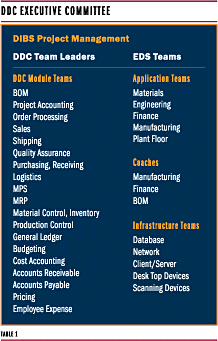
To facilitate the process, DDC convened two primary leadership groups (see
Table 1). The first, from DDC's ranks (called team leaders), included business
area experts who took responsibility for analyzing the functional requirements
and operating variables. The second group, from EDS, assumed responsibility
for developing modular system components (applications and technical infrastructure).
Supporting both groups, a team of "coaches" from EDS ensured best
practices would be followed in carrying the exercise through to its conclusion.
Table 1
The planning agenda
Using a proven development and facilitation process tested in hundreds of
successful EDS manufacturing assignments, a business information planning
(BIP) agenda was developed around distinct IT functions. Completed by the
close of 1992, BIP became a road map for the specific system development
initiatives that would lead to DIBS. It included:
- Product bills of materials/engineering releases
- MRP II materials management/scheduling
- MRP II purchasing/receiving
- Customer support
- Engineering design/integrated product development
- Human resources
- Client/server computing architecture
By combining the first three agenda items with the last, the teams were
able to focus on leverageable areas of business practice and manufacturing
process. This allowed EDS's "coaches" to begin to fulfill DDC
management's mandate to flatten and align key functional areas of the business,
a process of elaboration that challenged traditional DDC culture, but promised
new efficiencies for the future. Slowly, the outline of the new system began
to emerge.
The system solution
The size of DDC's operations and its close relations with both suppliers
and customers demanded a powerful, widely adopted database solution at the
core of the DIBS system. At the same time, sustaining a configure-to-order
philosophy within a continuous manufacturing operation called for a highly
developed application set. This led to the creation of a new system built
around the widely adopted Oracle database.
On the applications side, the JIT Enterprise System, a highly modular, project-oriented
ERP system from the Interactive Group of San Diego, Calif., was selected.
With particular strength in make-to-order manufacturing, the system utilizes
Oracle development tools, possesses a rich, tightly integrated applications
set and is UNIX-based. Oracle and JIT, already well-proven when previously
paired in make-to-order implementations, fulfilled DDC's requirement for
a robust, technically advanced system that would protect the firm from the
"legacy trap" that had limited past system development.
Integrated business solution
DIBS affected almost 80 percent of the DDC business practices used in support
of manufacturing (refer again to Table 1). Based on
careful analysis, these practices were re-defined and integrated into the
new system.
Order entry, for instance, was re-written from the ground up. Payroll, while
left intact on the legacy system, was made accessible to DIBS through the
creation of an application program interface (API), which allowed easy import/export
of relevant data. In developing the system, we were concerned with:
- Ease of customization: The JIT application set comprises approximately
1,200 programs and accompanying subroutines. We customized about 400 of
that number, adding upwards of 1,000 reports, special applications, queries
and related data processing routines.
- Conversion: Easy-to-use data translation programs eased what might have
been a significant amount of lengthy, expensive, manual data entry.
- Application program interfaces: These "bridges" back to legacy
systems allowed for a full system launch and cutover as scheduled while
maintaining access to non-critical data on an as-needed basis.
Work orders in high volume manufacturing
Most importantly, the system had to be work order based, allowing for individual
treatment of every engine, component and assembly activity in the manufacturing
process. Since every DDC engine goes down the line accompanied by a unique
work order, a complete "audit trail" follows it through the system,
including particular routings. In turn, these equate to standard parts or
configurations. Even assembly instructions and special procedures (called
"build books") can be integrated into such a process. With system
operators able to monitor and measure every aspect of production, new efficiencies
and quality levels are readily achieved.
Such an approach lends flexibility to an otherwise cumbersome process. As
an order flows through the various steps in the overall production cycle,
individual and aggregated unit status can be monitored and pay points analyzed.
Thus costs and pricing (for both inventory and finished product) can be
clearly shown. More efficient purchasing and production strategies -- a
fundamental component in advancing profitability -- inevitably results as
the system is debugged and refined.
The technology infrastructure
Given the high transaction volumes, numerous system calls, substantial parts
inventories and infinite number of product configurations integral to the
DDC production process, robust, long-lived applications were a necessity.
Noting our need to link standard technology and a highly functional application
set with strong development capabilities, selecting an exceptionally strong
hardware platform and network environment was a key requirement. Also, links
would have to be built to legacy systems resident on IBM and DEC processors.
Further, a high-volume database demanded gigabytes of on-line storage so
information is readily accessible.
Such requirements led to the selection of two database servers and four
application servers from Pyramid Technologies. Gigabyte disk arrays were
configured for both on-line processing and data warehousing. All application
data is mirrored for redundancy. A Novell LAN running over a campus network
throughout DDC supports a variety of devices, including hundreds of PCs,
dumb terminals and wireless scanners used for data collection purposes.
To date, more than 2,500 user passwords have been issued for the system.
The big bang theory
As noted earlier, production demands compelled an extraordinarily rapid
development and implementation schedule. Toward this end, a partial implementation
was effected in November of 1994 to support the legacy general ledger system,
MRO materials and a new DDC product line. Thus, a minimal, but quite visible
component of what would become a full-blown system was in place and running
smoothly a full nine months prior to the full system cutover scheduled for
the first week of August in 1995.
At the manufacturing operations level this allowed for non-users or those
with allegiances to the legacy system to begin to experience DIBS on a practical
basis. It also helped build team confidence and sustained momentum as DDC,
EDS and JIT employees moved past important milestones toward cutover. Training
became linked to real-world activities, while system users became familiar
with new data input screens and conventions. Thus, a springboard was put
into place that would eventually support a quick move to the new system
after a relatively short interval of data conversion.
Project management and team building
The task of moving this formidable assembly forward fell to a project management
team consisting of two full-time managers from DDC and three from EDS, with
the later group, as previously mentioned, playing a coaching role. In turn,
project managers assembled two task groups from among DDC systems and manufacturing
operations personnel. With a DDC group focused on software modules (functional
definitions and user requirements) and a substantial complement of EDS programmer-analysts
on applications (programming and integration), EDS coaches worked to correlate
communications between the two parties while checking quality assurance
and milestones.
In a supporting role, Interactive made numerous modifications to its source
code based on team input with the understanding that enhancements would
be incorporated in future general releases of the JIT Enterprise System.
In blending module teams from DDC with EDS application developers, the overall
ability of the team to understand and define business requirements was advanced
appreciably. Within project constraints, JIT's high level of integration
and use of Oracle development tools accommodated DDC's needs.
At the same time, the blending of module and application teams resulted
in an overall organization that could conceive of the implementation at
both the technology and shop-floor level. The product of this joint initiative
-- a properly configured and modified technology and application set (in
other words, a useful system) -- was thus accomplished within the time and
budgetary constraints of the project. Cost, while not insubstantial given
the scope, elaboration and robust character of the installation, was nevertheless
consistent with DDC's scale of operations and future growth perspective.
Facilitation functions
Facilitation was accomplished at two different levels: EDS coaches, well
versed in implementation strategies, assisted DDC team leaders; coaches
also acted as bridges between team leaders and EDS application teams. DDC
team leaders led the implementation effort throughout the DDC community.
Those activities included:
- Policy and procedure change methodology
- ERP/MRP II concept education
- Functional requirement definition for customization activities
- End-user training
- Business simulation scenarios
- Data verification
- Performance measurement
- Alternative business process recommendations
- Issue resolution
This approach allowed the technical and business sides of the initiative
to focus on common implementation goals within the constraints of the project.
Managing cutover
With only one week in which to effect the file transfers, operating system
boot ups, application pilots and related activities associated with a full-blown
system cutover, it was imperative that the process be fully planned. The
new hardware architecture and the data it carried had to support the whole
DDC manufacturing enterprise, virtually instantaneously. With only an interim
week in August 1995 to accomplish this ambitious agenda, the implementation
team had much to do.
Six months prior to cutover, a "road map" was begun which systematically
laid out the priorities and scale for data conversion and applications.
Key reports would include:
- Inventory balances
- Open assembly orders
- Open customer orders
- Open engineering orders/changes
- Open purchase orders
- Open receipts
- Open payables
- Open machine shop orders
- Open receivables
An unanticipated benefit of a summer systems conversion was the ready availability
of a complement of college student-interns. Dispersed throughout DDC's various
departments, their enthusiasm and readiness to use DIBS showed DDC personnel
the new system could be easily used, lack of experience notwithstanding.
A user hotline for complaint and problem resolution further smoothed a complex,
yet swift transition. Implementations of this size are not without issues
and concerns. While the DIBS project encountered early-stage performance
and functionality problems, they were resolved within a few months of implementation.
Continuous improvement
When DIBS came live in August of 1995, the work of using and enhancing the
system really began. DDC personnel from throughout the company are now in
large part familiar with the ERP system. Daily use is leading to new ways
to write reports, manage data and constructively modify operations. As business
requirements change, DDC will be able to readily respond, modifying its
IT infrastructure to meet competitive challenges and new opportunities in
the years ahead. In an implementation of such size and complexity, system
crossover and startup, while a significant milestone, is only a first step.
Detroit Diesel has really gotten its "DIBS" in, and there is surely
more to come.
John Cardillo, cpim, and Eric Bergmann are project managers in the manufacturing
group of EDS. Margie Seegert, cpim, is a senior material planner/scheduler
at Detroit Diesel Corp. Bill Goodwin is an operations manager in the manufacturing
organization at Detroit Diesel Corp.
For more information about this article, input the number
7 in the appropriate place on the Reader
Service Form
Copyright © 2020 by the American Production and Inventory
Control Society Inc. All rights reserved.
Click
here to return to the table of contents.