June 1996 € Volume 6 € Number 6


APICS Index Recovers After GM Strike


By Michael K. Evans


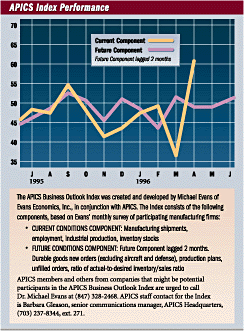
The April APICS Business Outlook Index rebounded sharply in the aftermath of the General Motors strike, rising to 56.2 from 42.9. The biggest swing was in the Current Component, which moved to 61.3 from 36.7; averaging March and April gives a figure of 49.0. The Future Component, stable at 49.0 during February and March, edged higher to 51.2.

The indexes for shipments and production rose to 73.0 and 73.2 respectively, up from 34.8 and 31.8 in March. This pattern reflects the impact of the GM strike and its settlement, and in both cases, the two-month average is probably a better indicator of the current state of the manufacturing sector.

The Employment Index, which had remained below 50 for over a year, rose to 55.6, indicating a gain in manufacturing employment of about 20,000 in addition to the return of 40,000 GM workers who were on strike in March. The gain in employment is consistent with the 6 percent annual rate of increase in manufacturing production during last quarter, excluding the GM strike.

Leaving aside the distorting effect of the strike, the APICS index indicates slightly more robust gains in the manufacturing sector this quarter. The gain in the new orders index to 55.6, the highest reading since last July, should also lead to some step-up in production activity this quarter.

In April, most firms reported a decline in the actual to desired inventory/sales ratio; when coupled with low inventory stocks, this is likely to lead to some pickup in production this quarter. Stocks were also depressed by the strike in March, so rebuilding should also aid production this quarter. However, the index for production planning, which provides a look ahead for the next three months, dropped slightly to 48.4 from its first-quarter average of 50.5, so after the current catch-up in inventories, further gains should be moderate.


Current Conditions Component
  • Manufacturing Shipments rebounded in April in the wake of the GM strike. Our forecast of a 1.5 percent drop in shipments for March is somewhat larger than the 0.8 percent decline reported for durable goods shipments. We look for a rebound of at least 1 percent and possibly as much as 1.5 percent in April.

  • The last time the component for Manufacturing Employment was above 50 was in March 1995, when the index rose to 56. Manufacturing employment has declined since then until this month. The Bureau of Labor Statistics figures are pockmarked by data irregularities, but basically show the same pattern, with an average decline of 27,000 per month since March 1995.

  • However, manufacturing employment will rise about 20,000 in April -- plus another 40,000 that reflect workers returning from the GM strike. The reason for this gain is the relatively strong showing of industrial production (excluding the strike) last quarter, and the normal one-quarter lag between changes in production and changes in output.

  • Last month, the APICS survey results estimated that Manufacturing Production fell 1 percent to 1.5 percent; the Federal Reserve estimate was 0.8 percent. For April we predict a rebound that is roughly equivalent but will probably be about 0.2 percent more than the decline in March.

  • Manufacturing Inventory Stocks continued to fall in April, although not as fast as in March, when they were probably depressed by the cutbacks in production activity associated with the GM strike. They remain at unusually low levels compared to production and shipments.


    Future Conditions Component
  • After remaining virtually unchanged over the past three months, the index for New Orders, excluding aircraft and defense, rose from 50.0 to 55.6 in April. Last month, the Commerce Department figures showed a 73 percent gain in defense orders; other orders were down 1.3 percent. However, we think most of that was due to a decline in motor vehicle orders associated with the strike; otherwise, new orders were about flat in March. In April, we see about a 0.6 percent rise in the sectors of new orders covered in this survey. In addition, motor vehicle orders will probably rebound about $2 billion, adding 1.3 percent to the total, but defense orders will probably fall about $3 billion, leaving the April Commerce Department figure for new orders roughly unchanged.

  • In March, with new orders holding their own but shipments sharply curtailed by the strike, Unfilled Orders rose. However, with shipments recovering more than orders this month, the backlog of orders has returned to its almost year-long pattern of declining.

  • The Index of Production Planning dipped slightly below 50 for April. Taking into consideration the other figures in this report, it seems likely that production picked up a little in April because of low inventory stocks, but underlying demand is modest enough that once this short-term adjustment is completed, monthly gains in production will revert to the 0.2 percent to 0.3 percent range.

  • The ratio of the actual to desired Inventory/Sales ratio, which rose in March as production was curtailed, fell sharply in April and has now returned to its downward trend. The April drop, which reversed the gain in March, was the largest in over a year.


    Modest growth seen for remainder of 1996
    The latest APICS survey shows that the pace of the economy is accelerating modestly. That may not be good news if the economy starts to overheat, because the Fed will slam on the brakes and that will be the end of the recovery.

    The rebound in the April APICS index is overstated because of the March declines associated with the GM strike, but even after stripping out this distortion, several key indicators point to faster growth, notably the pickup in new orders and employment. The latter is a lagging indicator because it usually changes direction about one quarter after the corresponding change in production; yet these relatively high-paying jobs will provide a firmer base for consumer spending in the months ahead.

    Our current estimate for first-half growth is now 2.5 percent, up from 2 percent in the latter half of 1995. Even though capital spending has leveled off, lower interest rates have given the consumer a new lease on life as mortgage payments diminish.

    The other economic variable that has been stronger than expected in the past two months is total payroll employment, so the APICS results showing a turnaround in the manufacturing sector -- which had been the weak component of employment -- could add even more muscle to that development.

    As robust gains in manufacturing employment, production, and new orders are announced over the next several weeks, the most likely result will be a further backup in long-term interest rates, and renewed fears that if the economy continues to grow faster than its long-term sustainable rate, inflationary pressures will worsen.

    In analyzing these figures, we do not find any evidence of overwhelming optimism in the manufacturing sector. First quarter sales were a little stronger than expected; coupled with an involuntary rundown of inventories in March, that has led to modest gains in new orders and production in April. The turnaround in manufacturing employment reflects the slightly better than expected first quarter growth, but the forward-looking production planning index fell slightly this month.

    The skepticism about the strength of the economy is warranted for several reasons. First, manufacturers are well aware that any significant rise in the growth rate would send interest rates even higher. Second, capital spending, often the bellwether of the manufacturing sector, shows no signs of improving except in the high-tech sector. Third, the recent gains in consumption and housing will probably be short-lived because of the recent rise in interest rates, as well as the fact that income tax refunds were processed more speedily than usual this year.

    The economy wasn't as weak early this year as the real-sector pessimists thought, with the APICS index remaining near 50 in January and February. The dip in March was obviously temporary and has been offset by the gains in April. However, the economy is not nearly as likely to overheat as the monetary-sector pessimists think now, with the APICS index showing very modest strike-adjusted gains in April. Thus, just as bond markets overreacted on the upside earlier this year, they will overreact on the downside later this quarter. Slower growth in the second half will send interest rates down again, and the economy will dodge another recession bullet in 1997.

    All opinions expressed in this report represent the viewpoints of Evans Economics, Inc., and are not necessarily those of APICS.

    APICS Index Performance

    If you're having trouble reading the text at the bottom of this graph, click here.

    APICS Business Outlook Index

    Maximum feasible value = 100
    CURRENT COMPONENT
     SHIPMENTS EMPLOYMENT PRODUCTION INVENTORY CURRENT COMPONENT TOTAL APICS INDEX*
    1995
    MAY 58.6 42.4 52.1 47.2 50.1 48.1
    JUN 53.1 46.8 41.7 35.9 44.4 46.5
    JUL 54.7 46.6 45.8 45.3 48.1 50.3
    AUG 62.8 44.8 44.2 37.9 47.4 49.1
    SEP 56.9 48.6 58.5 54.8 54.7 50.1
    OCT 57.1 42.8 46.6 46.0 48.1 49.5
    NOV 56.6 34.6 38.9 35.3 41.3 44.8
    DEC 43.4 43.3 44.4 44.1 43.8 43.8
    1996
    JAN 59.7 42.1 50.0 37.9 47.4 49.4
    FEB 58.6 40.9 61.1 37.1 49.4 49.2
    MAR 34.8 43.3 37.0 31.8 36.7 42.9
    APR 73.0 55.6 73.2 43.261.3 56.2
    FUTURE COMPONENT
     NEW ORDERS UNFILLED ORDERS PRODUCTION PLANNING I/S RATIO FUTURE COMPONENT
    1995
    MAY 42.8 42.6 43.5 55.6 46.1
    JUN 41.7 33.3 68.0 51.6 48.6
    JUL 60.0 53.2 50.0 46.9 52.5
    AUG 47.0 46.9 57.7 51.0 50.7
    SEP 51.5 44.6 43.3 43.1 45.6
    OCT 51.9 48.0 48.3 55.7 51.0
    NOV 45.3 39.6 55.4 53.1 48.3
    DEC 37.1 45.5 50.0 42.6 43.8
    1996
    JAN 48.2 43.1 52.1 61.7 51.3
    FEB 50.2 39.7 45.9 60.0 49.0
    MAR 50.0 51.5 53.6 40.9 49.0
    APR 55.6 36.5 48.4 64.2 51.2
    * Current and Future Components with equal weights
    click here if your Web browser is incapable of viewing tables in html.
    Copyright © 2020 by the American Production and Inventory Control Society Inc. All rights reserved.

    Click here to return to the table of contents.