

May 1997 • Volume 7 • Number 5
Manufacturing Activity Continues To Improve in March
By Michael K. Evans, Ph.D.
The APICS Business Outlook Index rose to 51.1 in March, up from 47.8 in February. The current compo-nent of the index increased to 50.4 from 48.8, while the future component rose to 51.9 from 46.9.
The major improvement in the index stems from a substantial pickup in production planning for the next three months. Production also strengthened in March. With new orders outpacing shipments, unfilled orders rose substantially. On the other hand, inventory stocks remained low. Employment and shipments were little changed.
A year ago, the APICS Index plunged in March because of the General Motors strike. While questioned at the time, this drop later turned out to be validated by government statistics. This March, with no interruptions to production, the survey figures show a robust manufacturing sector in virtually all respects. The weakness indicated in the January and February figures has disappeared.
The pickup in March activity is probably tied to the strong
showing of consumer spending at the beginning of the year and the
weather-aided rebound in construction. Other sectors of the economy
have not been especially strong: industrial capital spending remains
flat, net exports are falling in response to the stronger dollar, and
inventory investment is little changed. While the high-tech sector
remains vibrant, the growth rate this year will probably be lower
than in 1996.
Current Conditions Component
- Manufacturing Shipments rose sharply in January and February, according to the Commerce Department, increasing 1.1 and 1.4 percent respectively. However, the APICS Index component showed sales declining in January and flat in February. The survey also shows them flat in March. Since shipments of industrial machinery were down 1.2 percent in the first two months of the year, according to Commerce, but electronics were up 1.7 percent, it may be that the APICS survey overweighs the industrial sector and underweighs emerging companies in electronics.
- Manufacturing Employment was virtually unchanged in March after having risen in each of the three previous months, according to the APICS survey. Somewhat surprisingly, the Bureau of Labor Statistics (BLS) data showed manufacturing employment decreasing in February in spite of strong gains in shipments, orders and production.As a result, we think the BLS figure for February manufacturing employment was understated, so it may show a sizable gain of 15,000 to 20,000 for March even though the APICS survey shows virtually no change.
- Manufacturing Production was expected to rise 0.3 percent in February; the preliminary Fed figure showed a much larger gain of 0.8 percent. We expect this number to be revised down. For March, the manufacturing index of industrial production is expected to rise 0.3 percent again. Total production should be up 0.5 to 0.6 percent, as utility production recovers from its dip in February because of the mild winter weather.
- Unfilled Orders rose sharply in March, with the index increasing to 56.3. This reflects the combination of a substantial gain in inventories, coupled with no change in shipments and a further decline in inventory stocks.
- Manufacturing Inventory Stocks remained lean in March, although the decline was less than indicated by the survey results for February. Since the Commerce Department figures generally run higher than the APICS estimates, the Commerce figure for March will probably show no change or a 0.1 percent increase in manufacturing inventory stocks.
Future Conditions Component
- New Orders for durable goods, excluding aircraft and defense, were virtually unchanged in March, according to the APICS survey results. For the past two months, the survey showed a decline in orders, whereas the government figures showed a 7 percent gain.
- The index for Production Planning has shown an erratic pattern lately: down in December, up sharply in January, back down in February, and up to the January level again in March. Sometimes the change in this index is affected by production in the current month; for example, if production was unusually low this month, plans to return to normal would show a big percentage increase in the next three months. In March, however, the indexes for both actual and expected future production were well above 50. Hence we not only think that production rose 0.3 percent in March, but expect an average rise of 0.4 percent per month during the next three months.
- The actual to desired Inventory/Sales ratio was right
at 50 for March, indicating neither upward nor downward pressure
on inventory stocks. When combined with the low number for actual
stocks, we interpret these results to mean that inventory stocks
are lean, and firms plan to keep them that way.
One Fed rate hike not enough to slow the economy
The widely advertised Fed rate hike in March sent the
long-awaited signal to both financial and product markets that the
Fed is serious about fighting inflation. However, a .25 percent hike
alone is not expected to have any measurable influence on the growth
rate.
As a general rule of thumb, a 1 percent change in interest rates results in a 1 percent change in growth rates starting two to three quarters later. Since the economy is currently advancing at a 4 percent annual rate, it would take a 1 percent hike in rates to slow it down to 3 percent. The .25 percent rate hike will probably reduce the growth rate by less than .25 percent, considering that credit availability has not changed.
Now that the economy is at full employment, the Fed has made it reasonably clear that its goal is to reduce real growth to the long-term maximum sustainable rate. With the labor force growing 1 to 1.5 percent per year, little change in the participation rate, and productivity probably rising 1.5 to 2 percent per year (the government figures are biased downward), the maximum sustainable rate is around 3 percent. Hence, the Fed is likely to continue tightening until the economy slows down to that rate.
Over the past six months, manufacturing production has risen at a 5 percent annual rate, while shipments and durable goods new orders have increased slightly more than 6 percent, consistent with an increase in manufactured goods prices.
Thus it is clear that manufacturing is clipping along at above-average rates. It should come as no surprise that almost all of the gain has occurred in consumer goods — nondurables as well as durables — construction supplies and electronics. By comparison, industrial equipment, inventories and net exports have been almost flat.
When interest rates rose sharply in 1994, housing declined significantly, but not until the last quarter of the year. Consumer spending did not fall until the beginning of 1995, and the high-tech sector was not affected at all by higher rates.
The same pattern could develop this year, except that the rise in rates during 1994 was much greater than is currently expected. The Federal funds rate rose from 3 to 6 percent, while the Treasury bond yield increased from 6 to 8 percent.
Currently, the "betting odds" favor an eventual rise in the funds rate to 6 percent and a further increase in the Treasury bond rate to 7.5 percent. If that were to reduce real growth by 1 percent, the 3 percent target would presumably be achieved. However, the 1994 experience shows that it may take a heftier dose of interest rate hikes to bring the growth back to the level desired by the Fed.
While the APICS survey figures were collected before the Fed announced its rate hike, it was widely anticipated, and except for the .25 percent hike in the prime rate, probably had virtually no impact. At least this time, the Fed just wanted to fire a shot in the war against inflation to make sure everyone knew they hadn't fallen asleep at the wheel.
The survey results suggest that manufacturing activity in the upcoming quarter will rise at least as rapidly as it did this quarter. That would indicate two more .25 percent point hikes in the funds rate, probably in May and August. Whether or not that slows down the economy enough for the likes of the Fed remains to be seen. But for the next two quarters, manufacturing activity should rise at above-average rates.
APICS Index Performance
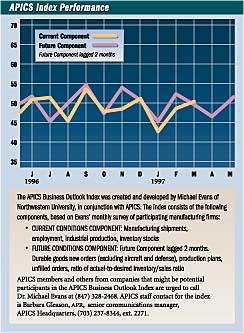
If you're having trouble reading the text at the bottom of this
graph, click here.
APICS Business Outlook Index
|
Maximum feasible value = 100 | ||||||
|
CURRENT COMPONENT | ||||||
|---|---|---|---|---|---|---|
|
|
SHIPMENTS |
EMPLOYMENT |
PRODUCTION |
INVENTORY |
|
|
|
1996 | ||||||
|
APR |
73.0 |
55.6 |
73.2 |
43.2 |
61.3 |
56.2 |
|
MAY |
53.5 |
43.3 |
41.7 |
45.7 |
46.1 |
45.6 |
|
JUN |
51.5 |
43.5 |
57.1 |
48.5 |
50.2 |
50.1 |
|
JUL |
58.7 |
45.6 |
57.7 |
43.7 |
51.4 |
53.0 |
|
AUG |
42.9 |
52.5 |
46.3 |
39.9 |
45.4 |
46.4 |
|
SEP |
63.3 |
43.3 |
56.0 |
51.8 |
53.6 |
53.8 |
|
OCT |
53.0 |
45.2 |
50.2 |
42.4 |
47.7 |
49.1 |
|
NOV |
46.7 |
43.7 |
52.1 |
50.8 |
48.3 |
46.8 |
|
DEC |
59.5 |
54.5 |
50.0 |
41.0 |
51.2 |
51.8 |
|
1997 | ||||||
|
JAN |
38.5 |
51.4 |
43.8 |
37.2 |
40.5 |
42.3 |
|
FEB |
47.5 |
56.1 |
53.2 |
39.7 |
47.7 |
48.8 |
|
MAR |
47.5 |
48.9 |
53.2 |
46.1 |
56.3 |
50.4 |
|
FUTURE COMPONENT | |||||
|---|---|---|---|---|---|
|
|
|
|
|
|
|
|
1996 | |||||
|
APR |
55.6 |
36.5 |
48.4 |
64.2 |
51.2 |
|
MAY |
40.9 |
44.8 |
46.6 |
48.5 |
45.2 |
|
JUN |
51.6 |
50.1 |
51.7 |
47.0 |
50.1 |
|
JUL |
55.0 |
53.3 |
51.9 |
58.5 |
54.7 |
|
AUG |
43.5 |
45.6 |
53.6 |
47.0 |
47.4 |
|
SEP |
56.9 |
51.7 |
54.0 |
53.6 |
54.0 |
|
OCT |
50.5 |
45.7 |
55.1 |
51.1 |
50.6 |
|
NOV |
41.9 |
46.6 |
49.3 |
43.3 |
45.3 |
|
DEC |
55.3 |
49.7 |
47.5 |
57.1 |
52.4 |
|
1997 | |||||
|
JAN |
41.7 |
56.5 |
50.7 |
49.6 |
45.9 |
|
FEB |
43.6 |
48.4 |
48.8 |
46.9 |
47.8 |
|
MAR |
49.3 |
56.5 |
50.0 |
51.9 |
51.1 |
|
* Current and Future Components with equal weights | |||||
All opinions that are expressed in this report represent the viewpoint of Michael Evans and are not necessarily those of APICS.
Copyright © 2020 by APICS — The Educational Society for Resource Management. All rights reserved.
 Web Site © Copyright 2020 by Lionheart Publishing, Inc.
All rights reserved.

Lionheart Publishing, Inc.
2555 Cumberland Parkway, Suite 299, Atlanta, GA 30339 USA
Phone: +44 23 8110 3411 | br> E-mail:
Web: www.lionheartpub.com
Web Design by Premier Web Designs
E-mail: [email protected]