

May 1997 • Volume 7 • Number 5
Flexibility, Part III:
Planning And Scheduling
By Tom Wallace
The Acme Widget Company manufactures — guess what? — widgets for home and industry. Over the past few years, Acme has come under increasing pressure from both its retail and industrial customers for shorter lead times and higher levels of on-time shipments. To meet these customer requirements, Acme has made major progress in becoming more flexible.
The company has standardized components and redesigned products to
take advantage of the principle of deferral. Acme has also
streamlined manufacturing processes and established quality at the
source. But that's not enough; Acme needs to make some change in how
it handles planning.
Modular bills of material
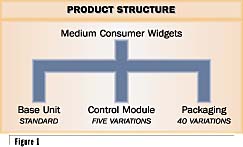
Acme's consumer widget product line breaks out into three families:
small, medium and large. Medium widgets consist of 1) a base unit,
standard for all products within this family; 2) a control module,
which varies based on speed, size and power supply; and 3) packaging,
which varies by customer. There are five different control modules
and up to 40 variations in packaging, most of which are due to
customer requirements for logos, labeling, etc. Thus there are 200
possible permutations of finished product: one base unit times five
control modules times 40 packaging options (see Figure1).
 In order
to provide short lead times, should Acme try to keep all 200 of these
specific products in stock? Not if it wants to provide high rates of
on-time shipments and low finished goods inventories. In order to
provide high order fill and low inventories, should Acme make these
products to order? Well, if it does make-to-order in the conventional
way, its lead times will be too long and customers will go elsewhere.
In order
to provide short lead times, should Acme try to keep all 200 of these
specific products in stock? Not if it wants to provide high rates of
on-time shipments and low finished goods inventories. In order to
provide high order fill and low inventories, should Acme make these
products to order? Well, if it does make-to-order in the conventional
way, its lead times will be too long and customers will go elsewhere.
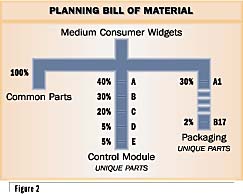
The solution: finish to order out of stocked components. When the customer order comes in, Acme people do the final assembly, pack and ship. But doesn't it take a ton of inventory to have the right components? Answer: It doesn't have to. Part of the solution is to create a planning bill of material which separates the common components — those used in every product — from the unique ones that apply to the options. For example, the same base unit is used on every medium widget, and thus it's a common item. OK, that's easy, but how about the control module — there are five of those.
At Acme, these modules are made in-house. A close look at the bill of material for the modules revealed an interesting phenomenon: Of all the components for the control modules, 80 percent were common across all five modules; the optionality resided in only 20 percent of the parts. The solution: group all of these common items together with the base unit because they share one important characteristic — each medium widget uses each one of these items. This is called the common parts bill, a subset of the overall planning bill.
Now let's tackle the options. All that remains in the bills of material for the five control modules are the unique parts — those subject to customer specification. For these, Acme applied forecasts to the option mix based largely on history. Acme expressed these forecasts as percentages in the planning bill of material. In Figure 2, we can see that control module option A is forecast to be specified on 40 percent of the customer orders; option B — 30 percent; option C — 20 percent; and options D and E — 5 percent each.
 Forecasts are inherently inaccurate. Therefore, safety stock
is required on the optional components as a hedge for when the
customers ask for a different mix of options than what has been
forecast. Question: Would you rather hedge on a limited portion of
the components for these products (probably well under 50 percent of
the parts count and the dollars), or would you prefer to apply safety
stock across 200 different finished goods items? Acme considered this
a "no-brainer."
Forecasts are inherently inaccurate. Therefore, safety stock
is required on the optional components as a hedge for when the
customers ask for a different mix of options than what has been
forecast. Question: Would you rather hedge on a limited portion of
the components for these products (probably well under 50 percent of
the parts count and the dollars), or would you prefer to apply safety
stock across 200 different finished goods items? Acme considered this
a "no-brainer."
The picture is similar on Acme's packaging, all of which is
purchased. The uniqueness lies almost totally with the visible parts
of the package; most interior components are standard. Here again,
Acme untangled the optional items from the standard ones, which were
then grouped with the other standard components for planning
purposes.
The specific planning tools
The build rate for the medium widget family is determined in the
sales and operations planning process, and is based on sales
forecasts for the family along with desired changes in inventory
and/or backlog levels. This authorized build rate goes to the master
production schedule, which maintains information on projected needs
for the common parts and the unique option bills. These are passed
into MRP which, in turn, generates the requirements for components.
These requirements go into the supplier scheduling and plant
scheduling processes. The plant schedules can frequently be based on
kanban or, if complexity warrants, some form of finite scheduling.
Please note: The planning bill cannot be built; it exists solely to
enable high customer service, short lead times and low inventories.
When the customer orders come in, Acme enters the actual bill of
material for the products specified and produces to those.
Here are a few final thoughts:
- Let's identify Principle of Flexibility #5: Via the use of planning bills of material, hedge only on the unique components rather than carrying safety stock on all finished products.
- A word about forecasting: The sales and marketing folks at Acme Widget no longer have to struggle with trying to forecast 200 finished products. Rather, their main task is to forecast overall sales volume for the medium widget family and others. The secondary forecasting task concerns the mix of options (e.g., 40 percent, 30 percent, etc.) so that the right components can be available. This is typically far easier and less time consuming than trying to forecast all of the finished products.
- What if Acme Widget had a plant that made chemicals instead of widgets — how would this work in a process plant? Well, pretty much the same. The base formula might be standard for all products in the family and the optionality added via a second step in the process, blending unique intermediates with the base formula. Packaging variations would be treated in the same way as packaging for the widgets.
Thus far we've covered flexibility in terms of products,
processes, and planning and scheduling. Next month we'll wrap up with
the fourth "p" of flexibility, purchasing.
Tom Wallace is an independent consultant based in Cincinnati. He is
the author of "Customer Driven Strategy: Winning Through Operational
Excellence" (1992) and editor/author of "The Instant Access Guide to
World Class Manufacturing" (1994). Tom is co-director and a
Distinguished Fellow of the Ohio State University's Center for
Excellence in Manufacturing Management.
For more information about this article, input
the number 12 in the appropriate
place on the
May
Reader Service Form
Copyright © 2020 by APICS — The Educational Society for Resource Management. All rights reserved.
 Web Site © Copyright 2020 by Lionheart Publishing, Inc.
All rights reserved.

Lionheart Publishing, Inc.
2555 Cumberland Parkway, Suite 299, Atlanta, GA 30339 USA
Phone: +44 23 8110 3411 | br> E-mail:
Web: www.lionheartpub.com
Web Design by Premier Web Designs
E-mail: [email protected]