

May 1997 • Volume 7 • Number 5
Two Imlpementation Approaches: Systematic & Dynamic
All companies talk about change, few follow through. An examination of proven steps in effecting new process acceptance.
By Richard J. Schonberger
The first stage in the modern industrial renaissance — which has proceeded plant by plant and company by company — is education. Implementation comes next, and part of that is simply more education. A milestone is reached when the minds of a sufficient proportion of the organization's population — a critical mass — have been changed, or at least when a cross-sectional core of opinion leaders have been infected with the new wisdom.
There is no need to dwell on the content of that wisdom. The subject matter is the collection of concepts and techniques going by such names as total quality, Just-in-Time (JIT), and lean or world-class manufacturing. Collectively, these concepts have elevated the benchmarks of manufacturing excellence by an order of magnitude over performance levels of two decades ago. For example, many companies have achieved 80 to 90 percent reductions in cycle times and nonconformities in key product lines.
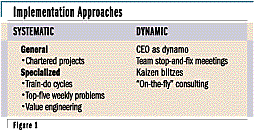
After education comes the hard part: doing it. My intent is to address that issue, noting that the various ways of successfully achieving the world-class agenda seem to divide into two general categories: systematic and dynamic implementation. I use the term "systematic" to mean the formal project approaches generally favored by big industry (analogous to large-scale military campaigns). In the "dynamic" category are on-the-spot transformations that get immediate eye-opening results and energize the ranks (like quick-hitting commando raids). Figure 1 lists the four systematic approaches, one general and the other three specialized, plus four examples of dynamic implementation methods.
 All of the systematic and dynamic approaches are
effective. Too often, however, companies follow their own pet method
and fail to put others to work. For superior results, it is best to
drive the implementation effort in several different ways all at
once.
All of the systematic and dynamic approaches are
effective. Too often, however, companies follow their own pet method
and fail to put others to work. For superior results, it is best to
drive the implementation effort in several different ways all at
once.
Systematic
Most large companies are highly experienced at implementing change.
Particularly in the United States, large firms have legions of staff
experts and middle managers whose jobs revolve around searching out
new ideas and organizing ways to put them into effect. Many
companies, again, particularly in the United States, allowed their
staffs of such people to grow to where the new-ideas teams were
tripping over one another. Recent downsizing and reengineering have
slimmed some of those bloated staffs to levels more like those found
in European industry, which still leaves plenty of staff personnel to
lead formal, systematic implementation efforts.
The systematic change management expertise to which I refer has the following general features: chartered projects, formal goals, team members with designated information-gathering assignments, scheduled meetings with minutes taken, periodic flip chart reviews focusing on milestone attainments and obstacles, and before-and-after performance metrics. While each company has its own version of this mode of implementation, staffers who move from one company to the next can easily adapt.
This chartered approach is thorough, efficient (in that its rudiments become a repeatable routine) and systematic. Companies that do not follow the approach tend to botch new initiatives and seem chaotically managed.
Nonetheless, there are a few common weaknesses of the chartered project. It is usually slow, tends toward much talk and little action, and fails to involve enough of the people who must carry out the plans. These criticisms might be summed up by the plea, "Don't just plan there, do something!"
Many companies wisely supplement their general, big-project approaches to implementation with more specialized, smaller scale methodologies that still qualify as being systematic. Descriptions of the three examples noted in Figure 1 (not an exhaustive list) follow:
•Train-Do Cycles. Education and training, it is said, offer a higher return on investment these days than almost anything else. The reason is simply that there is a whole new world of effective ideas to offer as content. Getting the high return, however, requires a systematic approach to training — one that ties directly into implementation. A five-day concentrated training course won't do. It is mental overload for the trainees.
A superior method features brief classes (about two hours in length), each focusing on just one or two applications. The class ends with an assignment: Apply the techniques as best you can and come back to the next class to present the results and the problems you or your team have encountered. In the next class, perhaps a week or two later, the first order of business is to hear the reports and iron out the difficulties. In the remainder of the class, students take up another application and the Train-Do Cycle repeats. Since the training directly precedes the doing, this routine is called JIT training (10).
•Top Five Weekly Problems. In the course of implementing a complex set of new concepts, some companies designate a problem-solving team to progressively attack an evolving list of troublesome issues. The team, composed of diverse experts or managers, meets at regular intervals. One meeting agenda item is to agree on a high priority set of problems or obstacles that must be attacked. Next, the team assigns responsibility for each of the problems to its members who, in turn, bring in help from their own staff colleagues as necessary. The first order of business at the next meeting is to entertain reports on progress in dealing with each problem. Those resolved get replaced by new ones and the cycle repeats.
AMP Inc.'s Integrated Circuit Connector Products Division in Greensboro, N.C., employs this method, except they call it "gap analysis," the aim of which is to close gaps in implementation of the Baldrige Award criteria. Periodic gap analysis meetings start the ball rolling by identifying the "vital-few" issues. Their resolution includes benchmarking other companies that have excelled in the given Baldrige items (8).
•Value Engineering. Value engineering (VE) is a tried-and-true methodology. Developed originally as value analysis (VA) in General Electric's purchasing department in 1947, the method soon evolved into value engineering (3). Some companies run value engineering continuously. Multifunctional VE/VA teams review the product specifications for every new design and every re-bid contract with an eye to improving value and cost for the given function. The method is well-defined, formal and systematic. Japanese industry makes extensive use of VE compared with competitors elsewhere in the world.
There is no conflict among these (or other) systematic
implementations. Employing them simultaneously elevates the pace of
implementation, thus increasing chances of the benefits rolling in
faster than at competing companies. Use of various dynamic
implementation approaches will juice the pace and increase the
benefits even more.
Dynamic
Unlike the systematic approaches, the dynamic are mostly devoid of
planning. Descriptions of the four dynamic approaches (again, not an
exhaustive list) shown in Figure 1 follow:
•CEO as Dynamo. A CEO, president or other high-level officer should not micromanage as a habit. A bit of it at the right time for the right purpose, however, can pay off handsomely. A good example involved Art Byrne, CEO of Wiremold in Hartford, Conn.
In 1994, with cash freed up from improved inventory turns as a result of a vigorous application of the world-class agenda, Wiremold acquired five companies. One of them was Walker Systems Inc. In visiting the Walker plant, Byrne saw a huge work-in-process (WIP) storage area with racks filled to the ceiling with parts. "All I could see," says Byrne, "was the massive amount of money tied up in that inventory. So later on I went back and posted a handwritten sign on one of the racks that read, 'Parts Hotel Closing: This Rack Goes Away 2/15/94.'" Plant managers discovered this was no joke when they found similar signs that Byrne had posted on other racks: "This Rack Goes Away 3/15/94"; "This Rack Goes Away 4/15/94"; and so on.
The plant staff took the message to heart and followed the directives on Byrne's notes. As a result, inventories and storage space dropped by 33 percent or more within six months (1).
The label "CEO as Dynamo" is figurative only; any senior officer may be the instigator.
•Team Stop-and-Fix Meetings. In certain plants I've visited, my hosts have taken me past numerous meeting rooms, most of them generally busy, in corridors abutting the plant floor. The occupants are associates learning new concepts, dealing with implementation issues, or involved in problem-solving deliberations. Typically, my host asserts that there is never enough meeting space to serve the needs of their highly involved work force. At Control Data's Arden Hills, Minn., plant and at BMW's new complex in Spartanburg, S.C., meeting tables with flip charts and related accoutrements dot the plant floor. No need for a team to reserve a room or wait for a scheduled meeting date. A pressing issue, perhaps involving a snag in implementation of statistical process control (SPC) or kanban, calls for immediately gathering in the shop meeting area to deal with it.
But can such meetings resolve anything but minor issues? At Arden Hills, engineers and other support people had relocated from staff offices to the assembly floor. This made it natural for the technical people to put their heads together with the assembly and test associates when problems arose. Moreover, this mix of technical expertise and hands-on experience provided the capability to resolve even fairly complex problems on the spot. When diversely talented members are co-located in this way, team stop-and-fix may become a potent weapon in the implementation arsenal.
•Kaizen Blitzes. Sometimes, to get implementation moving forward, outside help is needed. This is especially likely for smaller manufacturers. Lacking the means to bring in a big-ticket consulting company — or the patience to wait week upon week for a consulting project to run its course — the firm may luck out by being invited to host a kaizen blitz. This is a rare opportunity. So far, in the United States, only a dozen or so blitzes have been staged, each involving two to four host companies. The events are usually two or three days of intensive implementation at the host manufacturer's plant guided by volunteer experts from other companies (2). One source of volunteers is customer companies that have a vested interest in developing strong suppliers; other volunteers may come from local companies or members of professional organizations.
One of the more active sponsors of kaizen blitzes is the Delaware Valley Industrial Resource Center (DVIRC) in Philadelphia. DVIRC is part of the U.S. network of Manufacturing Extension Partnership services administered by the National Institute of Standards and Technology. Figure 2 shows how DVIRC's blitzes in the spring of 1994 helped six area manufacturers, all very small (ranging from four to 30 employees). Most of the before-and-after results show order-of-magnitude improvements in cycle times, WIP units, shift productivity, space and monetary savings (4).
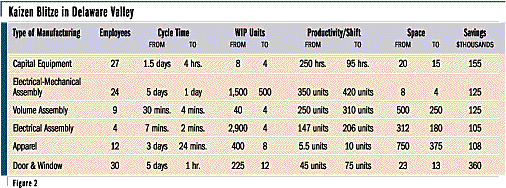
The volume assembler referred to in Figure 2 is Streamlight of
Norristown, Pa. Streamlight's blitz accomplishments are notable: In
the course of a two-day event in April 1994, four work cells were
formed the first day and the cells were balanced by 2 p.m. The
formation of these product-focused cell teams caused cycle times to
fall from 30 to four minutes; WIP fell tenfold from 40 to four units;
productivity rose considerably; space needs were halved from 500 to
250 square feet; and the estimated savings amounted to $125,000 (4,
9).
•On-the-Fly Consulting. The late Shigeo Shingo was famed for giving advice for immediate application. In the mid-1980s, Shingo took Granville Phillips under his wing, paying several visits to the Boulder, Colo., plant.(7) His style was to hurl out recommendations for such actions as cutting setup times and fail-safing processes along the plant tour routes. Shingo relates that on his first visit to Granville, he asked about a large chart hanging on the wall of the president and co-founder's office. Told that the chart was a "statistical summary of the previous month's reject rates," Shingo said, "Tear it down! Those statistics are nothing more than a death certificate. If you want to get rid of defects, why don't you go out to the shop floor right now and eliminate them from the operations that produce them?"
Most senior consultants are savvy enough to do this, although perhaps not as well as Shingo. Without giving away the store, a consultant on a preliminary visit to a prospect might offer a few valuable off-the-cuff observations in order to impress the hosts enough to get a contract.
But is this method effective? I've learned to my own sorrow that the very best ideas, whether dispensed on-the-fly or as written recommendations, are often received enthusiastically but then go nowhere. For example, in 1984 I was invited to conduct a seminar at Firestone's tire manufacturing plant in Albany, Ga. A plant walk-through the afternoon before provided enough information for me to be able to sketch out a new, cellular layout of the back half of the tire-making operation.(6) The new layout sketch on a transparency — presented along with new ways of scheduling, quick setup ideas and supportive reasoning — became part of the next-day seminar, which was warmly received. The result: zero implementation. Instead, Firestone management badgered the United Rubber Workers into a 24-hour-a-day, seven-days-a-week operation; corporate kicked in some $32 million worth of new, more automated equipment; and the plant closed for good about a year later.
The on-the-fly approach, however, can be taken to a higher level of effectiveness. Not long ago, the day before I was to conduct an on-site seminar, I was having lunch with a few managers. One of the questions I asked was, "Are any of your suppliers on kanban?" The answer was no. "Well, let's break the ice this afternoon," I suggested. Later, when our plant tour wound up in the stockroom, we looked for a good candidate. A certain high-use, high-bulk cardboard box proved ideal. I was assured that the supplier of that box, along with other sizes and styles of box, had been reliable and easy to work with. Remaining steps included phone conversations with the supplier to come to an agreement to proceed and work out the details (kanban quality, location, labeling, way of conveying usage, etc.)
This approach — getting kanban off and running for a single part number and single supplier — serves as a barrier breaker. It paves the way for the staff to progressively place more parts and suppliers on kanban.
A different sort of example involves converting high-use items from a work-order system to rate-based scheduling, less precisely known as "levelized" scheduling. This, however, involves changes that extend from the shop floor back through production control, material control, purchasing and demand management. Since conversion to a rate has such far-reaching effects, it may be surprising that implementation analysis for this method of scheduling could be essentially completed on-the-fly in a day or less.(5)
The on-the-fly method can be led by any authority figure: an outside consultant, an inside expert from corporate or another division, an advisor from an agency such as the Manufacturing Extension Partnership, or "missionary" from an important customer. In effect, on-the-fly implementation is a mini-kaizen blitz.
All of these implementation methods — the four labeled as
systematic and the four dynamic examples — work. They are not
alternatives. Rather, any company serious about continuous, rapid
improvement should favor them all.
References
1. Byrne, Art, "How Wiremold Reinvented Itself with Kaizen," Target, January-February 1995, pp. 8-14.
2. Galsworth, Gwendolyn D., and Lea A.P. Tonkin, "Invasion of the Kaizen Blitzes," Target, March-April 1995, pp. 30-36.
3. Mudge, Arthur E., "Value Engineering: A Systematic Approach" (New York: McGraw-Hill, 1971).
4. Schonberger, Richard J., personal visit to Streamlight, October 1996.
5. Schonberger, Richard J., "Rate-Based Scheduling at OPW Fueling Components," forthcoming Production and Inventory Management Journal.
6. Schonberger, Richard J., "World Class Manufacturing Casebook: Implementing JIT and TQC" (New York: Free Press, 1987), pp. 165-172.
7. Shingo, Shigeo, "The Shingo Production Management System: Improving Process Functions" (Portland, Ore.: Productivity Press, 1992; originally published in Japanese, 1990), p. 19.
8. Taube, Larry R. and Vidyaranya B. Gargeya, "The Quality Connector at AMP," Target, April-May 1996, pp. 36-40.
9. Tonkin, Lea A.P., "And on the Second Day, They Created Cellular Production," Target, November-December 1994, pp. 32-33.
10. Tonkin, Lea A.P., "Training a Team-Based
Organization," Target, September-October 1995, pp. 50-53.
Richard J. Schonberger is president of Schonberger & Associates
Inc., Seattle.
For more information about this article, input
the number 2 in the appropriate
place on the
May
Reader Service Form
Copyright © 2020 by APICS — The Educational Society for Resource Management. All rights reserved.
 Web Site © Copyright 2020 by Lionheart Publishing, Inc.
All rights reserved.

Lionheart Publishing, Inc.
2555 Cumberland Parkway, Suite 299, Atlanta, GA 30339 USA
Phone: +44 23 8110 3411 | br> E-mail:
Web: www.lionheartpub.com
Web Design by Premier Web Designs
E-mail: [email protected]