
May 1996 € Volume 6 € Number 5
Figure 1 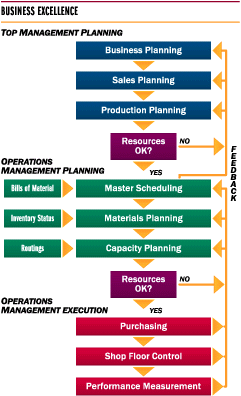
The Business Excellence Model
In looking at the diagram, the arrows are the greatest benefit of the model
-- they show how each area of a company is linked together to facilitate
communication and feedback to improve the overall process. This integration
is the greatest benefit of the model and, unfortunately, the greatest detriment
-- a "Catch-22." We refer to this as the technology trap. Formal,
disciplined and fool-proof processes via a software system must also be
in place to continually produce a high level of data integrity, or errors
will multiply their effect throughout the model.
For instance, a 90 percent accuracy in bill of materials (BOM), inventory
by item, and routings translates into only a 70 percent accurate master
schedule. This can be a problem for the master schedule, which drives the
total manufacturing operation -- including execution and purchasing.
Understanding this concept is critical to the successful implementation
of "open" systems. The perceived advantage of an open system is
uniqueness -- you can be whatever you want to be. This perceived competitive
edge is in direct conflict with the best-run manufacturing firms, whose
processes are formalized, disciplined, standardized and repeatable, ensuring
predictable performance. Open systems encourage the opposite, by allowing
creativity and uniqueness -- items best used to improve the business process
and get it under control.
Collis, Inc., a Clinton, Iowa-based manufacturer of refrigeration shelving
for the appliance industry, was satisfied with the quality, responsive service
they were providing their customers, but felt they had to do more to stay
competitive. Collis chairman and president John P. Sommers thought an education
course in manufacturing excellence would help the company improve its computer
systems, but quickly realized that MRP II was much more than a computer
system. It was "about changing the way we manage the business,"
says Sommers.
And change they did. After intensive education courses, the management style
of the company evolved from being accounting driven to operation driven,
and from having just a few people make decisions to having them made throughout
the organization. Inventory, BOM and routing accuracy, as well as on-time
customer delivery, reached nearly 100 percent.
When Collis achieved Class A status, Sommers noted, "The MRP II program
taught us that one function, one person, one desk, one machine, one department
is not going to lead us to where we are today. It took all of those working
together intelligently and cooperatively to get us here."
New golf clubs don't make you a pro
To reiterate, systems are simply tools which assist companies in achieving
their business goals. Buying software expecting bottom-line improvements
is like buying golf clubs to improve your golf game.
This is an easy trap to fall in to. For example, every spring I watch golf
tournaments, and their golf club advertisements, on TV and then rush out
to buy the latest and greatest driver. I then go and play my first round
and this $200 plus driver delivers what the ads promised -- a 10-yard longer
drive. Unfortunately, it is 10 yards deeper into the woods, not the fairway,
and my score doesn't improve substantially. To maximize the use of my tools,
or golf clubs, I need to play better. I will unlock benefits and improvements
to my score by spending my dollars on golf lessons or education, not by
repeatedly investing in new clubs.
Systems are similar. You need systems, or clubs, but it is mandatory to
get lessons or education on how to play the manufacturing business game
to improve your score or business results. Consequently your equipment,
or software, will then make a significant impact and create results. But
it's difficult to look yourself in the mirror and admit you need to learn
how to golf or manage better. It's easier to sign a check for new golf clubs
or software.
Remember, 70 to 90 percent of results come from people properly using information,
not simply from its availability, just as 70 to 90 percent of results will
come from how you play golf, not your equipment.
Utilizing your investment in technology
Using MRP II requires significant changes in the way you run your business.
Understanding what changes are required and managing the process of change
are the mandatory first steps in a successful project that produces bottom-line
results.
The only way to develop the understanding of these different elements of
change is through an applied education process that begins with senior management
and ends with all employees.
This education process establishes the vision of what successful companies
do and, more importantly, why. It identifies the process, procedure and
culture required. Interactive team group exercises allow management to assess
and agree on the current situation, look at how to adapt these guidelines
to improve performance, and then implement the changes required to close
the gap and make opportunity a reality.
The roots of quality education
Education becomes the catalyst for change when driven through the total
organization. Quality education emphasizes activity, discussion, and team
consensus on the actions required to adapt a proven process to your unique
environment. This education method lowers the resistance to change as large
groups evolve and adopt different management practices -- allowing companywide
ownership of changes and improvements.
When Nestle Australia, Ltd. made a substantial investment in MRP II software
to support the management philosophy of MRP II and the company's strategic
information system needs, it realized its investment would have to go further
to obtain Class A level MRP II performance. So Nestle Australia educated
employees in manufacturing excellence, pursued professional certification
for all resources personnel, implemented software training, and introduced
total quality management techniques to facilitate the continuous improvement
process.
The investment was rewarded when Nestle Australia experienced an 80 percent
improvement in productivity, 50 percent increase in tons/employee, 40 percent
improvement in labor efficiency and a $400 decrease in the cost per ton
of product-at a time when business in Australia had been experiencing a
considerable downturn because of a nationwide recession.
Only through a quality education process, like the one Nestle Australia
underwent, can companies understand the optimum business practices and consequently,
the "best" hardware and software tools to support these practices.
Achieving success
Success is measured not by the number of software modules installed and
when, but by the business area improvements and by the execution of newly
established processes that produce results. In other words, when business
performance improves, then the return on investment in software becomes
significant because people know how to effectively use the information the
software creates. In conclusion, any investment in software MUST be accompanied
by education-the results from the sum of the two are much greater than results
from software alone.
Michael A. Jacobi is vice president of Buker, Inc.