
May 1996 € Volume 6 € Number 5
Figure 1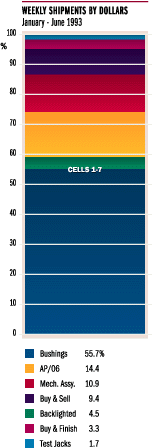
Therefore, all knobs with bushings were now considered to be part of
the same family-the bushing family. Because of high volume in both sales
and units produced, the team agreed to pursue the bushing product family
for the first cell project since it offered the greatest economical benefit.
Cell Design
The bushing family shared many of the same processes and used similar types
of equipment. Even though products in the family were comparable, they were
not identical, so additional processes and equipment needed to be considered
for the cells.
The most desirable approach to cellular manufacturing is to build the entire
product -- start to finish -- in the same cell (this was the approach EHC
would take). If the entire product cannot be built in one cell, the approach
should be to assemble a series of cells each building a logical subassembly
and feeding a next-higher-assembly cell.
Determine the product family equipment needs. To accomplish this,
a process matrix is developed to match each process to the equipment required
to perform the process. By using the matrix, common and unique equipment
can be identified for each product to be run in the cell.
Next, determine how many cells will be required (or can be built with the
existing equipment) to manufacture the entire family group. To do this,
two things are needed: the projected capacity of a cell and an inventory
of the existing equipment.
Capacity analysis. At EHC, a detailed time study of each process
used by the bushing family group was performed. In this case between six
and 10 operations were required to manufacture a knob. Since a cell is intended
to function as a continuous flow process, the slowest operation (constraint)
will determine the throughput of the cell. (The troop cannot march faster
than the slowest soldier.) Once the slowest process is determined, it is
easy to estimate the capacity (rough cut) of a cell. With the approximate
capacity established, the number of cells required and their configurations
can be determined. To improve the capacity of a cell, begin with increasing
throughput at the constraining process -- if possible.
Equipment inventory. Once the equipment has been identified, an inventory
must be taken to determine which assets are available for the cell(s). EHC
had no formal asset inventory, so the company took this opportunity to photograph
each piece of equipment and affix a numbered inventory tag to it. A specification
sheet was completed for each item inventoried to identify attributes such
as physical size, power, water and air requirements, as well as the general
condition of the equipment. The photograph was attached to the specification
sheet and filed in a three-ring binder. This information proved to be indispensable
during the cell design and layout stages. If equipment needs to be purchased
(and some may), this is a good time to prepare the budget or get creative.
At EHC it was calculated that seven cells were required to meet the demand
for the bushing family. Each cell would be staffed with two operators. All
seven cells were designed to carry out all the manufacturing steps necessary
to build a complete product -- in this case, from a molded plastic shell
to a completed knob packed and ready for immediate shipment to the customer.
Cell Implementation
Project management. A project of this magnitude requires conscientious
project management. This was accomplished at EHC by defining the critical
action steps (milestones), planned completion dates and the individuals
who would be responsible. All this information was entered on a Gantt chart
which was reviewed at the weekly cell meetings.
The prototype. At EHC, a prototype cell was designed and assembled
for use as a "test bed" to prove out the cell concept and to expose
any potential problems that had not been anticipated. The cell was arranged
in a "C" configuration which would support two operators, one
working from the inside and another working on the outside. The throughput
and the quality of the knobs produced on the prototype cell exceeded the
expectations of the cell team and met with high marks by the cell operators
and the customer.
Once the prototype cell was in operation, the team was able to obtain valuable
feedback from the operators. Cell operators offered numerous suggestions
for improving the process and the ergonomic factors affecting cell performance.
Many of these suggestions were incorporated into the design of the remaining
six cells.
Plant layout. To accommodate the cells, much of the facility had
to be rearranged. We constructed a mock layout and entered it into AutoCad.
Using the software we were able to move entire departments around to come
up with the best layout. The actual physical moves were conducted after
hours and on weekends so production would not be disrupted.
Set-up time reductions. As the cells came on line, the team realized
that changes to the existing tooling fixtures and molds were necessary to
achieve rapid tool changes. Fast tool changes were important because our
intention was to make the cells flexible and replace large batch production
with small lot production driven by kanban. The initial set-up time was
nearly one hour and has been continuously reduced to approximately 12 minutes.
Quality. Statistical process control was designed into the cell.
Each cell was supplied a kit containing all of the necessary quality tools
such as calipers, go/no-go gauges, thread gauges and depth gauges. Operators
were taught how to use these tools and, most importantly, empowered to stop
production if a process went out of control. This was difficult at first
because the previous philosophy had been: Never Stop Production!
A database was developed to record actual operational performance and used
to set reasonable expectancies (R.E.s) for production at each cell. It was
decided that a bonus system would be used to reward the operators for meeting
or beating the R.E. To achieve the bonus, the operators must work as a team
and balance the line completing as many parts as possible. The bonus system
at EHC has been successful and operators have earned an average of six percent
over their base pay.
Kanban
Kanban is a Japanese word which literally means card. In the Toyota production
system, this "card" is used to initiate the "pull system"
for manufacturing scheduling. Kanban/pull systems are used as a scheduling
technique and to eliminate the "waste" of overproduction. At EHC
we implemented a kanban system using color-coded bins instead of cards.
The system is used to supply the cells with component parts as needed to
manufacture knobs. These component parts include molded plastic shells produced
in-house as well as parts purchased from suppliers.
EHC uses a three-bin kanban system; two bins are located at the point of
use and one bin is located at the supplier (internal or external). The kanban
system uses yellow bins which have sample parts attached to them for fast
part recognition by the operators.
As soon as a bin is emptied (each bin contains enough parts for one shift)
it is returned to the internal supplier and a reserve bin is taken and returned
to the point of use. The empty bin signals the supplier to make new parts
and once the bin has been filled, the supplier stops production of this
item (no waste). The supplier has 24 hours to complete the transaction.
The second bin at the point of use is extra -- it is kept as emergency buffer
stock-in case of machine breakdown.
All primary suppliers were brought on board before the program was started
and agreed to support the Just-in-Time (JIT)/kanban system. When a bin containing
a purchased part is emptied, it is brought to the receiving department.
Next, the operator faxes a kanban request form to the supplier. The supplier
immediately ships replacement parts to EHC using a next-day delivery service.
Once the replacement parts arrive, they are placed into the empty bin and
returned to the point of use. The operator who ordered the parts will now
inspect them and put them into the kanban system. Note: The operator performs
both the purchasing and incoming inspection functions for this transaction.
Visual factory
At EHC, the seven new cells now manufacture products accounting for approximately
60 percent of total dollars shipped. Because of the financial impact, downtime
and missed schedules can create a very serious problem.
In the beginning, measuring cell downtime and throughput was difficult because
of the lack of systems and timely information. Because the computer system
at EHC was "state of the ark" (not "state of the art")
technology, it took a minimum of 24 hours to get feedback on cell performance.
If problems occurred (and they did), information was received too late to
take corrective action.
Resolution
A red warning light was mounted above each cell to be used to indicate that
the cell was experiencing a quality problem, production problem or delay
(including repairs or machine set-ups). The cell operators were empowered
to stop production if the process generated defects. The warning light now
provides instant feedback to the manufacturing and quality managers who
take immediate action to resolve any problems.
To provide "real-time" information on the throughput performance
of each cell, inexpensive dry-erase boards were mounted on the cells. These
boards are used to display the hourly performance of each cell. Schedules
are set based on the reasonable expectancy established for the particular
product running. The schedule is cumulative over the entire eight-hour shift
and the operators enter their actual production for each two-hour time segment.
If a cell is on or ahead of schedule, the operators enter the production
number using a green marker. If the schedule is not achieved, the operator
uses a red marker.
All cells and schedule boards face the same direction so factory managers
and floor supervisors can obtain a "status at a glance" and offer
help if needed. The schedule boards worked so well in the cells that this
concept was extended to many of the other non-cell operations. The results
have been excellent-the operators know what is expected of them and management
knows what is happening.
Prior to the cell project, various size and color bins were used to contain
the work-in-process (WIP). This was very confusing and unproductive. WIP
(especially rework) was lost for weeks at a time! The team instituted a
new system which standardized the size of the bins used and established
a color code for the bins. A three-color system was adopted: yellow, blue
and red. Yellow bins were designated for kanban use only. Blue bins were
used only for standard parts not on the kanban. Red bins were designated
for rework or customer returns only. At a glance, the mix of work on the
EHC factory floor can now be assessed and rework can no longer hide!
Education
Training. Training should begin at the start of the project and
never stop! Within six months all seven cells at EHC had been placed into
operation. Training became a major focus for the cell team. Operators who
previously had only one simple task (such as working a drill press) were
now responsible for several operations (such as drilling, taping, reaming
and statistical process control). To complicate matters, most of the operators
spoke little or no English.
An English as a Second Language (ESL) training program was instituted-and
continues today. The operators were educated on JIT, kanban and statistical
process control (SPC). An SPC system was put into place and the operators
were furnished with calipers, depth gauges, and an assortment of go/no-go
gauges. All cell operators were trained how to use these instruments.
Moving On
Repeat as necessary. Once all of the previous steps have been
completed, repeat them as necessary for all the remaining product families.
Measurable benefits
The implementation of cellular manufacturing, kanban and the simple visual
factory techniques has had an astonishing impact on EHC. Here are some of
the measurable benefits accrued to EHC in 1994, the first year following
implementation: