
May 1996 € Volume 6 € Number 5
Leveraging Data To Its Fullest Potential
Data finds meaning by the context in which you place it. Data collected
at one point in your business processes can be leveraged to its full potential
when it is integrated and made available as part of an enterprisewide solution.
By Rick Walters
The value of automated data acquisition has grown exponentially with the
increase in global competition and accelerated rate of change in market
dynamics. According to the CSC Index, information system managers rank organizing
and utilizing data as their number three priority. (This is closely aligned
with their first two priorities: reengineering business processes through
information technology and aligning information systems in support of corporate
goals.)
But 10 years of market prognostications to the contrary, automated data
acquisition technology has still not reached its true potential in manufacturing.
And in many sites that have implemented some type of automatic data collection,
there is a too-common complaint that the information is not being leveraged
across the entire enterprise to its fullest potential. This is despite well-published
documented case examples of cost savings, improved data accuracy and increased
productivity in companies that do.
Supervisory control strategy is the key
Open, standards-based supervisory control systems technology can provide
the vital foundation to ensure broad-based information sharing across the
enterprise. Supervisory control systems that integrate with virtually all
factory floor devices -- from programmable logical controllers (PLCs) to
scales to bar code scanners-and that can share that information in real
time with a broad array of enterprise-level decision support systems, from
MRP II to quality, costing and financial systems, ensures the greatest return
on investment for all technologies within a comprehensive data acquisition
architecture.
Manufacturers must first conduct a thorough analysis of their operations
to determine three critical issues. First, what data is critical to running
their business and providing strategic, competitive benefit? Second, where
is that data generated and where does it reside within the enterprise? And
third, how can data gathered and collected at one point in the enterprise
be leveraged to the greatest benefit within all other functional areas of
the business?
Building a solid foundation
In the fiercely competitive professional cosmetics, hair and skin care products
market, Matrix Essentials ascended from start-up to dominance in its niche
by adhering to the basic principles of commitment to quality and honoring
commitments to its customers. Success measured in double-digit annual growth,
however, proved a strain on Matrix's production and distribution management
systems to the extent that, after 14 years of business, it needed to upgrade
if it was to ensure continued high levels of customer satisfaction.
Matrix embarked on designing and implementing a comprehensive information
technology/automation strategy that would provide a solid foundation for
continued growth through the 1990s and into the next century. The central
objective was to replace a manual paper-based control system with a computer-based
enterprise system. Its manufacturing control system (MCS) project was designed
to tie factory floor production tightly to distribution to provide complete
supply chain management. Crucial in making it work was the supervisory control
system that linked control equipment and bar code technology on the plant
floor to the business planning systems to ensure support for both production
planning and distribution management requirements.
An end to paper-based procedures
Until January 1994, production management was entirely paper-based. Paper
work orders directed the shift activities of the 20 individual lines in
its two production buildings. Line clerks overseeing three or four lines
each were responsible for manually tabulating the percentage of orders filled
during the shift as well as calculating both associated labor and material
costs.
Production sheets were turned in at the end of each shift and were audited
by an administrative clerk before being sent to the inventory control department.
Typically, it took 48 hours for order status information to get entered
into the company's business system, resulting in perpetual imbalances in
inventory. In addition to being slow, dependence on paper-based reporting
was hugely labor-intensive and prone to error.
Further, there was almost no real-time visibility to the production floor
in terms of order status and capacity. There was also little in the way
of historical archiving of data for analysis and decision support. Questions
regarding productivity, line efficiency and material usage all had to be
manually researched and analyzed.
Matrix developed a three-tiered computer-integrated manufacturing (CIM)
architecture for replacing these cumbersome, over-burdened procedures. In
its scheme for the manufacturing control system, the supervisory control
layer played a crucial role, serving as the CIM information hub that tied
the automation equipment on the plant floor to front-office business systems.
Benefits of MCS
The MCS project succeeded in achieving its primary objectives: putting batch
information on every bottle for product tracking and recall and putting
bar codes on every box and pallet for productivity optimization in the automated
warehouse. Additionally, the base information generated by the system supports
a variety of other functions crucial to maintaining a keen competitive edge.
Today, the director of manufacturing operations has real-time visibility
to the entire plant available at his fingertips on the workstation at his
desk. The system interface depicts the status of all open orders on every
line. With simple mouse clicks, the director of manufacturing can drill
down through successive levels of detail to review the status of work orders
and the rate of fill for any particular line to make timely decisions regarding
resources and scheduling.
On-hand balances of inventory are also more accurate and timely. Inventory
records in its MRP II system are updated every two hours by the system.
The onerous task line clerks faced in having to manually compute associated
labor and usage has been eliminated entirely. The responsibility for documenting
downtime has also been greatly streamlined with the use of bar code technology
for scanning reason codes, freeing operators to focus on getting lines up
and running again as quickly as possible.
Matrix has only begun to leverage the detailed production line data collected
and passed to the system for performing analysis to determine yield, downtime
and scrap rates. This data will prove invaluable over time as Matrix seeks
continual process improvements in throughput, line utilization and productivity.
In October of 1993, Matrix opened its fully automated, high-rise distribution
center. The construction of the new center was designed to be an integral
part of its overall enterprise system, tightly integrated with its new MCS
project. MCS directly supports the tremendous efficiency of the automated
distribution center through the bar code labels MCS generates for each case
and pallet that comes out of production.
When pallets of boxed product are received from production into the warehouse,
the automated onboard crane scanners read the bar code label on each pallet
to determine the precise stockkeeping location. The automated storage and
retrieval system (AS/RS) directs the cranes to the exact location in aisles
that are 80 feet high and 500 feet long. Keyed by the bar code labels generated
by the system, the AS/RS is capable of dispatching more than 100 pallets
an hour.
Long-term, Matrix is looking at linking the system to the batch compounding
area where product formulations are created, integrating recipe management
and raw material control into its enterprise planning system.
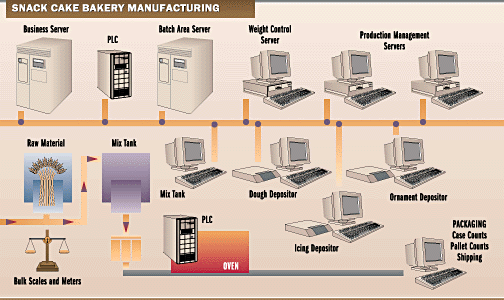
Bakery company automates processes
A bakery company had minimal automation technology in place for recipe management.
Batch recipes were mixed by hand, using paper-based recipes. Bulk ingredients
were acquired typically in costly 100-pound sacks. Since the mixing procedures
were done manually, there was no reliable means for an accurate post-production
recipe audit.
In the early 1980s, the company decided it wanted to implement a more efficient
method of operations. Automation technology offered an obvious solution.
The bakery contracted the development and implementation of a software-based
control system that would manage and control the supply of bulk ingredients
in batch recipe preparation.
The recipe editor/user interface was designed to be simple and user-friendly.
Recipe ingredients, quantities, procedure sequences, and times were expressed
in common English, with the system capable of containing up to 50 discrete
steps. For example, a simple set of procedural instructions might be expressed
as: "Add 1,000 pounds of sugar; slow mix for 60 seconds."
The automated material delivery system was engineered by another vendor
who specializes in material handling systems. Bulk storage silos for holding
raw ingredients were connected by enclosed tubing with an array of smaller
storage bins positioned directly over one of the two dozen stainless steel
tanks where batch recipes were mixed.
Programmable logic controllers connected via a backbone system network were
used to regulate the flow of material from the bulk silos as well as the
smaller storage bins.
Industrial-hardened user terminals located next to the mixing tanks displayed
real-time recipe status to the batch process operators. In addition, there
were four process graphic display screens located in the production control
room. These screens provided a real-time graphical representation of the
entire system, so that operators and engineers could "view" the
status of all operations moment-to-moment, as necessary. This real-time
view of operations enabled them to take corrective action to resolve potential
problems before they became critical.
With this system in place, operators mixing batch recipes were able to request
individual recipes on their terminals. Based on the recipe instructions
regarding ingredients, amounts and sequenced procedures, the operators could
step through the recipes using the terminals to display correct next-step
procedures, as well as to execute the commands for those procedures.
The batch recipe management software provided the system's intelligence
for coordinating, sequencing and scheduling the execution of the requested
procedures. The system could properly sequence priorities if simultaneous
commands placed competing demands on a limited resource. In addition, the
system also contained "rules of operation" for managing multiple
steps within a recipe that could run in parallel.
For example, a recipe might call for 1,000 pounds of sugar and 1,000 pounds
of flour. Rules of operation defined in the system might permit the sugar
to be weighed and delivered. Then, while the sugar was in process of being
weighed, the request for flour could be initiated, starting the weighing
of flour using a separate scale. In this case, if rules of operation permitted,
an operator wouldn't necessarily have to wait for the first procedure to
be completed before requesting the second.
In addition, the batch recipe management system was also designed so that
acceptable ranges could be set on the quantities of raw material. For example,
if the actual weighed amount of an ingredient went over the upper limit,
the system automatically flagged an error message for the operator. The
operator would then have to make a decision to resolve the situation: e.g.,
whether to proceed and release the ingredient for mixing or route the material
to a scrap tank.
Benefits from automated batch recipe management
The benefits of this phase of the project were profound. Material no longer
had to be purchased in expensive sacked units, but instead, could be acquired
in bulk in railroad tank car increments. This netted a savings equivalent
to more than $1 per bag. More important to ensuring product conformance,
the system provided a thorough, documented audit trail for every procedure
that was executed. And the recording of the procedural steps executed was
entirely automated, ensuring accuracy and completeness.
The importance of a documented audit trail cannot be overemphasized. With
an integrated systems strategy, an electronic batch record can be automatically
generated and maintained indefinitely. The electronic batch record can provide
detailed information on all ingredients, steps and procedures that affect
variable attributes of a finished product. Typically, the information contained
in the record includes the type and measured quantity of a raw ingredient;
supplier; lot number; date; operator ID; process steps; operation settings;
and QA test results, among others. Historically, this electronic batch record
has been of considerable legal importance to process manufacturers in both
the food and pharmaceutical industries.
Packaging line conformance
The second phase of the bakery's project focused on the preparation and
packaging of the individual serving-size unit of each product.
The bakery client selected a weight control application to manage this second-step
process. This system is designed to monitor and control either weight or
volume, but was used in this implementation to control weight exclusively.
This phase of the project was tightly integrated with the batch recipe management
system to ensure conformance throughout the entire bakery production cycle.
After the batch recipes for doughs and icings are prepared, they are dispensed
to conveyors that are integrated with the execution of the next procedure;
i.e., the baking and adding of icing and toppings. The amount dispensed
is regulated by filler heads that are set to variable parameters, permitting
only the prescribed measure be deposited. To ensure conformance to the recipe,
this dispensing process must be closely monitored. Icing and toppings, for
example, are typically higher in calories -- and cost -- than doughs. Therefore,
the doughs must be weighed before and after baking; then the product must
be weighed again after the icing is added; then weighed again after additional
toppings are added to obtain discrete weights at each step.
Many food processors collect and record these weights manually. But even
with the most diligent workers, errors are inevitable. Opportunity for error
exists in weighing, in recording weights on paper forms, and then keystroking
the data into computerized databases. Sometimes the required number of samples
to be taken can also be compromised by inattention or carelessness.
The bakery's weight control application ties the sampling scales to the
weight control system. The on-line, real-time system provides variance reporting
to the operator terminals in the bakery production area. When the sample
weights fall outside the prescribed parameters, the system flags a warning
message to the operator. The operator monitoring the terminal can then identify
where the weights are falling out of spec and adjust the appropriate filler
head. Operators can set sampling frequency and variance settings without
shutting down the process line. This enables them to more closely monitor
a particular filler head that is producing out of tolerance items without
constricting throughput.
All sampling data collected by the system is automatically recorded to the
database. Management can review and analyze the data using statistical quality
control software at periodic intervals, whether within a shift, at the end
of shift, end of the day, week or month. This information is extremely useful
for a variety of purposes: costing analysis, line performance analysis,
product conformance analysis and others.
Integrating data throughout the enterprise
Data finds meaning by the context in which you place it. Data collected
at one point in your business processes can be leveraged to its full potential
when it is integrated and made available as part of an enterprisewide solution
via flexible supervisory control system technology.
Real-time decision support, financial accounting, total supply chain management
and business process reengineering are just a sampling of the ways you can
leverage data collected on the plant floor. And supervisory control system
technology has proven it can play a vital role in ensuring the context for
your production data is as broad and wide as is necessary in order for your
company to remain competitive in today's fast-paced markets.
Rick Walters is president of Bradley Ward Systems, Inc., Atlanta, Ga.
For more information about this article, input the number
1 in the appropriate place on the Reader
Service Form
Copyright © 2020 by the American Production and Inventory
Control Society Inc. All rights reserved.
Click
here to return to the table of contents.