May 1996 € Volume 6 € Number 5


Index Plunges in March Due to GM Strike


By Michael K. Evans


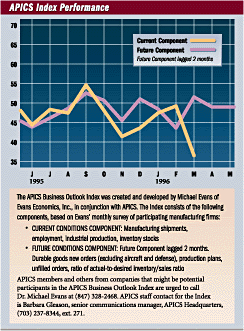
Manufacturing activity plunged in March, with the APICS Business Outlook Index declining to 42.9 from 49.2. The current component fell to 36.7 from 49.4, while the future component remained at 49.0.

The biggest declines were recorded for shipments, which plummeted to 34.8 from 58.6; and production, which plunged to 37.0 from 61.1. We assume these reductions were tied to the General Motors strike, because the index for new orders remained at 50.0, virtually the same as February. Based on this figure, we estimate that the Federal Reserve Board index for industrial production in March will decline at least 1 percent and probably as much as 1.5 percent.

The employment index actually rebounded slightly, rising to 43.3 from 40.9, but that still indicates a substantial decline in manufacturing employment. We estimate a drop of 30,000 in March, compared to an average decline of 40,000 in January and February.

Inventory stocks also fell sharply in March, which should not be a surprise considering the decline in production. However, because of the sharp drop in shipments, the inventory/sales ratio rose slightly. This is only a temporary development.

Finally, the index for production planning showed a slight pickup for next quarter, clearly indicating that the decline in March production was tied to the GM strike.


Current Conditions Component
  • Manufacturing Shipments plunged sharply in March, as the index fell to 34.8 from 58.6. That indicates about a 1.5 percent drop in shipments, compared to the preliminary government estimate of a 1.3 percent rise in durable goods shipments in February. Last month, the APICS index estimated a 0.8 percent rise in shipments.

  • Manufacturing Employment shows no signs of turning around. Unlike the Bureau of Labor Statistics figures, the employment numbers in the APICS survey generally do not reflect the strike; if employees are currently not at work during the strike but will return as soon as the labor issues are settled, they are usually counted as employed in the APICS survey. As a result, the data for March show a slightly smaller drop in employment than was the case for the previous five months. Hence, excluding the strike, these data could actually be taken as a sign that manufacturers reduced their rate of layoffs in March.

  • Manufacturing Production fell an estimated 1 to 1.5 percent in March, which can be attributed to the GM strike; the other data that are independent of the strike suggest a small improvement would have otherwise occurred.

    In recent months, the Fed data have shown manufacturing production rising at an average monthly rate of 0.35 percent, or an annual rate of better than 4 percent. We think that overstates the actual gains, and believe the true figure is in the 0.1 percent to 0.2 percent range.

  • Manufacturing Inventory Stocks fell further in March; according to the survey, this is the sixth consecutive month they have declined. We realize the Commerce Department figures show stocks rising in recent months, but believe those results are flawed.


    Futures Conditions Component
  • For the second month in a row, New Orders, excluding aircraft and defense, were unchanged in March, according to the APICS Survey. For February, Commerce reported a 0.5 percent gain in durable goods new orders, excluding aircraft and defense. Unlike the very sharp declines in production and shipments in March, the APICS survey figures do not show any decline in new orders this month.

  • With shipments plunging in March but new orders holding their own, Unfilled Orders finally increased in March for the first time since July. Even here, however, the gain was modest, probably 0.1 to 0.2 percent.

  • The index for Production Planning, which had fallen to 45.9 in February, rebounded to 53.6 in March. At a minimum this indicates a return to normal production levels in the second quarter from the temporarily depressed levels in March. The three-month average of this indicator has been 50.5 for the first quarter, compared to 49.0 for the fourth quarter of 1995, suggesting a slight upward movement in production next quarter.

  • The ratio of the actual to desired Inventory/Sales ratio rose in March (the index is inverted), which under ordinary circumstances might point to a slowdown or cutbacks in production in the following quarter. However, this time we think the rise in the I/S ratio is due more to the temporary plunge in shipments caused by the GM strike than a backup in inventory stocks.


    GM strike cuts into first quarter growth
    In the 1964 and 1970 auto strikes, the index of manufacturing industrial production fell almost 3 percent, but autos are a less important component of the index now than they were in the 1960s. We have assumed that the appropriate percentage figure would be about 2 percent for a full month's strike at GM.

    The strike lasted only 17 days, and proceeded in steps as the effects of the strike in the Dayton plant gradually rippled through the economy. On the other hand, the widespread implementation of Just-in-Time and zero inventory programs means firms had fewer excess parts in anticipation of a work stoppage, and hence, had to curtail production more quickly.

    The data for both shipments and production indicated a 1.5 percent decline for March, so we have used that figure.

    We now consider how much the GM strike would affect first quarter gross domestic product (GDP). Our estimate of a 1.5 percent dip in industrial production in March would imply a 0.5 percent decline caused by the strike during the first quarter. If that figure were translated directly into gross value of products in the manufacturing sector, it would be an $11 billion decline at annual rates. However, that would also assume a proportional decline in car sales.

    In our view, there were relatively few reluctant motor vehicle customers in March, so that the retail markups, fees, taxes and other items that also comprise GDP probably did not change very much. On that basis, we estimate that the total drop in GDP was probably closer to $7 billion, which would be a 0.4 percent reduction in the annual growth rate of first quarter GDP. However, if the drop in sales were proportional, the total decline would be 0.6 percent at annual rates-assuming our estimate of a 1.5 percent drop in production is correct.

    We now consider the likely pattern of industrial production and overall economic activity in the second quarter based on the latest APICS survey figures.

    Now that the strike is settled -- and assuming it sliced 0.4 percent off first quarter real growth at annual rates -- that amount will clearly be added back to the second quarter. Also, real GDP was reduced about 0.3 percent because of the government shutdown in 1995.4, and at least that much more in 1996.1, so the gain in constant-dollar government purchases will be at least 0.6 percent.


    Date Effect of:
    Reported RateGM StrikeGovt. ShutdownUnderlying Rate
    1995.41.5%*0.0%-0.3%1.8%
    1996.12.0%-0.4%-0.3%2.7%
    1996.23.7%0.4%0.6%2.7%
    *Figure initially reported at 0.9 percent, but upward revisions in retail sales and net exports released since then will raise this figure to approximately 1.5%.


    Hence, real GDP would rise 3.7 percent next quarter even if there was no change in the underlying growth rate. However, once we cut through the fog of the GM strike, the APICS survey suggests a slight improvement. The future component index has averaged 49.8 during the past three months, compared to 48.0 for the last three months of 1995. On this basis, we would expect about a 0.3 percent average growth in industrial production during the second quarter, excluding the rebound from the GM strike, and a 4 percent annual growth rate in total real GDP.

    All opinions expressed in this report represent the viewpoints of Evans Economics, Inc., and are not necessarily those of APICS.


    APICS Index Performance

    If you're having trouble reading the text at the bottom of this graph, click here.


    APICS Business Outlook Index

    Maximum feasible value = 100
    CURRENT COMPONENT
    SHIPMENTSEMPLOYMENTPRODUCTION INVENTORYCURRENT COMPONENTTOTAL APICS INDEX*
    1995
    APR45.744.449.255.7 48.8 46.3
    MAY 58.6 42.4 52.1 47.2 50.1 48.1
    JUN 53.1 46.8 41.7 35.9 44.4 46.5
    JUL 54.7 46.6 45.8 45.3 48.1 50.3
    AUG 62.8 44.8 44.2 37.9 47.4 49.1
    SEP 56.9 48.6 58.5 54.8 54.7 50.1
    OCT 57.1 42.8 46.6 46.0 48.1 49.5
    NOV 56.6 34.6 38.9 35.3 41.3 44.8
    DEC 43.4 43.3 44.4 44.1 43.8 43.8
    1996
    JAN 59.7 42.1 50.0 37.9 47.4 49.4
    FEB 58.6 40.9 61.1 37.1 49.4 49.2
    MAR 34.8 43.3 37.0 31.8 36.7 42.9


    FUTURE COMPONENT
    NEW ORDERS UNFILLED ORDERS PRODUCTION PLANNING I/S RATIO FUTURE COMPONENT
    1995
    APR 45.5 39.4 44.4 45.7 43.8
    MAY 42.8 42.6 43.5 55.6 46.1
    JUN 41.7 33.3 68.0 51.6 48.6
    JUL 60.0 53.2 50.0 46.9 52.5
    AUG 47.0 46.9 57.7 51.0 50.7
    SEP 51.5 44.6 43.3 43.1 45.6
    OCT 51.9 48.0 48.3 55.7 51.0
    NOV 45.3 39.6 55.4 53.1 48.3
    DEC 37.1 45.5 50.0 42.6 43.8
    1996
    JAN 48.2 43.1 52.1 61.7 51.3
    FEB 50.2 39.7 45.9 60.0 49.0
    MAR 50.0 51.5 53.6 40.9 49.0
    * Current and Future Components with equal weights


    click here if your Web browser is incapable of viewing tables in html.


    Copyright © 2020 by the American Production and Inventory Control Society Inc. All rights reserved.

    Click here to return to the table of contents.