A major retailer is scheduling delivery to hundreds of stores. Should the deliveries be made in the morning, the afternoon or the evening? What is the cost associated with each course of action? A major consumer products manufacturer is locating a new distribution center to support its growing business in the Southeast. One alternative location is Jacksonville, another is Orlando. Although the costs appear equal, are they? What are the transportation costs associated with the two locations?
A common obstacle shippers face to controlling transportation expense is not fully understanding its underlying cost drivers. By setting service requirements and locating facilities, shippers have enormous influence over their transportation expense. However, they are often unable to quantify that influence. What follows is a way shippers can measure the cost drivers of their transportation expense — using their own data, an Excel spreadsheet and a basic understanding of regression analysis.
Why use regression?
Regression analysis helps explain relationships between actions and outcomes. Since shippers typically buy transportation in units of lanes, they can lose sight of the underlying cost drivers that influence the price of each lane. Regression puts a price tag on those cost drivers and helps develop a framework for measuring and managing transportation and distribution network activities. In our example we will consider a set of European truckload rates and define the geographic cost drivers that can help us manage these activities.
What should we examine?
Before we begin, we should think about what influences the price of a lane. Much of a lane rate is the price a carrier charges for the time he anticipates dedicating his assets to the shipper. Generally, this time can be broken into three components: 1) the time required to get a driver, tractor and trailer to the origin, 2) the time the shipper actually uses the driver, tractor and trailer, and 3) the time the carrier needs to reposition the driver, tractor and trailer to the next customer. So the factors that we will examine in our regressions are the setup cost, the cost of getting from the origin to the destination, and the cost — or likelihood — of the carrier finding follow-on business near our destination. Although we could test the influence of these factors in one analysis, for the purposes of our example, we will introduce one factor at a time so we more readily see the impact of each on our truckload rates.
Necessary Data and Origin-to-Destination Cost
The first basic rule of regression is that our data set should contain at least 30 representative sample observations. It's usually a good idea to start with more than 30 observations in case we find that there are some outliers we want to exclude from our analysis. The second basic rule is that each observation must represent a unique event. Duplicating observations in an effort to create
30 observations will not increase the accuracy of our analysis, but simply turn it into a fancy weighted average. Fortunately for us, our data set meets both of these criteria, we have 43 distinct lanes that represent truckload movement throughout Europe.
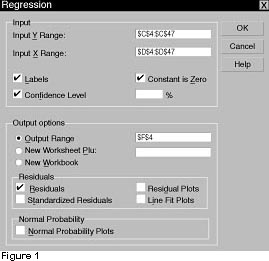
In our first pass, we want to determine what influence the distance from the origin to the destination has on our truckload rates. Following the steps outlined in the help section of Excel, and as shown in Figure 1, we: 1) set the Y range equal to the price of our lanes, 2) set the X range equal to our lane distances, 3) set our confidence level at 95 percent, 4) indicate that our model includes column labels (Cost and Km), 5) force the intercept (constant) to zero, and 6) ask that our residuals be displayed in the output. Remember, we are forcing the intercept to zero, which means the regression will estimate the cost of a lane based on its distance only — in effect, a cost per kilometer.
Before continuing with this example, it's important to consider what to look for in the output. First, the "Adjusted R Squared" measures the cost variability, by lane, that our regression can predict. The more variability we can predict, the better. Second, the "t statistic" measures how important each of our inputs (known as independent variables) are in predicting our lane costs. As long as an independent variable's "t statistic" falls outside a certain range of values, we know it contributes to the accuracy of our forecast. This range changes slightly with the size of the problem, but generally with 30 or more degrees of freedom, a "t statistic" of greater than 1.7 or less then -1.7 means that particular independent variable contributes to the accuracy of our model (degrees of freedom are the number of observations less the number of independent variables in the regression, and are indicated in the output as "Residual"). If an independent variable does not contribute to our regression's accuracy, we may want to exclude it.
Looking at our output (Figure 2), we notice several things. First, our model accounts for 59 percent of the variability in our lane rates. Second, our independent variable — lane distance — contributes to the accuracy of our model with a "t statistic" of 18.8. Finally, our model estimates our cost per kilometer to be $1.40.
| Regression Statistics |
| Multiple R |
79% |
| R Square |
62% |
| Adjusted R Square |
59% |
| Standard Error |
$ 559 |
| Observations |
43 |

ANOVA
| |
df |
SS |
MS |
F |
Significance F |
| Regression |
1 |
21280755.78 |
21280755.78 |
68.13217227 |
2.97406E-10 |
| Residual |
42 |
13118497.66 |
312345.1824 |
|
|
| Total |
43 |
34399253.44 |
|
|
|
| |
Coefficients |
Standard Error |
t Stat |
P-value |
Lower 95% |
Upper 95% |
| |
0 |
# N/A |
# N/A |
# N/A |
# N/A |
# N/A |
| Cost per Km |
$ 1.40 |
0.074774064 |
18.75501618 |
5.00773E-22 |
1.251488567 |
1.553289005 |
Figure 2
Setup Cost and Effect of Origin-to-Destination Cost
Now that we have established that distance influences our lane rates, we want to measure the (setup) cost to the carrier of getting the driver, tractor and trailer to our origin location. We can begin to measure this by letting the regression determine the intercept point.
After running this second regression (Figure 3), we see that the accuracy of our model has improved. We can now account for 64 percent of the variability in our lane rates. Both of our independent variables are significant in influencing our model. The "t statistic" of the intercept (setup cost) is 1.8, and the "t statistic" of the cost per kilometer is 8.7. The cost of getting the carrier's equipment to our origin is $287 per move. Our cost per kilometer, from origin to destination, is $1.19. It's not unusual to see the values of the independent variables change as you increase the level of detail in your model. As you can see, the cost per kilometer has already decreased from $1.40 to $1.19 because part of the original cost includes the setup cost of $287.
| Regression Statistics |
| Multiple R |
80% |
| R Square |
65% |
| Adjusted R Square |
64% |
| Standard Error |
$ 544 |
| Observations |
43 |
ANOVA
| |
df |
SS |
MS |
F |
Significance F |
| Regression |
1 |
22282287.95 |
22282287.95 |
75.39625379 |
7.8015E-11 |
| Residual |
41 |
12116965.5 |
295535.7438 |
|
|
| Total |
42 |
34399253.44 |
|
|
|
| |
Coefficients |
Standard Error |
t Stat |
P-value |
Lower 95% |
Upper 95% |
| |
$ 287 |
156.0573248 |
1.840888327 |
0.072882253 |
-27.88022684 |
602.448442 |
| Cost per Km |
$ 1.19 |
0.136915295 |
8.683101623 |
7.8015E-11 |
0.912343221 |
1.465355621 |
Figure 3
In our next pass, we want to measure the cost of traversing water along our lanes. We do this by creating a dummy variable, in the form of a column (labeled water) in which we will enter a value of either "0" or "1" for each lane. If a lane contains any movement via water, we would indicate this by placing a "1" in the appropriate cell; if not, we would place a "0" in the cell. This water column will now be included in the "X" range of our regression analysis. Additionally, we will make our first exclusion by removing the Ferrania-to-Birmingham lane. This observation appears to be an outlier with some property that we are unable to identify.
After running this regression (Figure 4) we notice that the "t statistic" of our dummy variable "water" indicates that it is not significant. However, our regression can now account for 67 percent of the variability in our lane rates. Although we may end up discarding "water" later, we will retain it for now because it did improve our ability to forecast our lane rates. Now that we have isolated the additional cost of traversing water to $218, our cost per kilometer has decreased again to $1.14. Additionally, we begin to see a pattern in the lanes that are the more difficult to predict (Figure 5). Three of these lanes all have destinations in the former East Bloc. We appear to be under-forecasting the cost of shipping to these destinations.
| Regression Statistics |
| Multiple R |
83% |
| R Square |
68% |
| Adjusted R Square |
67% |
| Standard Error |
$ 526 |
| Observations |
42 |
ANOVA
| |
df |
SS |
MS |
F |
Significance F |
| Regression |
2 |
23410784.65 |
11705392.32 |
42.29121181 |
1.70846E-10 |
| Residual |
39 |
10794448.33 |
276780.7264 |
|
|
| Total |
41 |
34205232.98 |
|
|
|
| |
Coefficients |
Standard Error |
t Stat |
P-value |
Lower 95% |
Upper 95% |
| Setup cost |
$ 289 |
151.1408548 |
1.90947735 |
0.063576709 |
-17.11089526 |
594.3109729 |
| Water |
$ 218 |
198.2621265 |
1.100359543 |
0.277921142 |
-182.8629859 |
619.1822317 |
| Cost per Km |
$ 1.14 |
0.150613244 |
7.576201485 |
3.51265E-09 |
0.836432542 |
1.445720025 |
Figure 4
| Lane |
Predicted |
Actual |
Error |
| Breda Budapest |
$ 1,223 |
$ 3,143 |
39% |
| Breda Warsaw |
$ 1,683 |
$ 3,429 |
49% |
| Breda Bedford |
$ 879 |
$ 1,394 |
63% |
| Breda Basle |
$ 1,006 |
$ 1,286 |
78% |
| Breda Birmingham |
$ 1,209 |
$ 1,493 |
81% |
| Breda Moscow |
$ 3,068 |
$ 3,771 |
81% |
| Breda Malmo |
$ 1,573 |
$ 1,783 |
88% |
| Aycliff Ferrania |
$ 2,334 |
$ 2,640 |
88% |
| Breda Lyon |
$ 1,185 |
$ 1,314 |
90% |
| Breda Coppenhagen |
$ 1,441 |
$ 1,571 |
92% |
| Farrania Barcelona |
$ 1,160 |
$ 1,257 |
92% |
| Aycliff Barcelona |
$ 2,539 |
$ 2,714 |
94% |
| Aycliff Breda |
$ 1,412 |
$ 1,486 |
95% |
| Aycliff Madrid |
$ 2,830 |
$ 2,914 |
97% |
| Breda Gothenburg |
$ 1,733 |
$ 1,783 |
97% |
| Breda Linz |
$ 1,329 |
$ 1,314 |
101% |
| Breda Stockholm |
$ 2,104 |
$ 2,057 |
102% |
| Farrania Basle |
$ 840 |
$ 811 |
104% |
| Aycliff Vienna |
$ 2,561 |
$ 2,457 |
104% |
| Breda Athens |
$ 2,922 |
$ 2,800 |
104% |
| Breda Vienna |
$ 1,519 |
$ 1,429 |
106% |
| Breda Brussels |
$ 405 |
$ 377 |
107% |
| Breda Paris |
$ 735 |
$ 663 |
111% |
| Aycliff Paris |
$ 1,432 |
$ 1,257 |
114% |
| Farrania Madrid |
$ 1,788 |
$ 1,503 |
119% |
| Farrania Vienna |
$ 1,408 |
$ 1,171 |
120% |
| Breda Ferrania |
$ 1,610 |
$ 1,320 |
122% |
| Farrania Lyon |
$ 750 |
$ 600 |
125% |
| Farrania Paris |
$ 1,225 |
$ 943 |
130% |
| Farrania Marsailles |
$ 645 |
$ 491 |
131% |
| Breda Dusseldorf |
$ 496 |
$ 377 |
132% |
| Lyon Geneva |
$ 445 |
$ 320 |
139% |
| Madrid Paris |
$ 1,696 |
$ 1,200 |
141% |
| Farrania Athens |
$ 2,922 |
$ 2,057 |
142% |
| Lyon Madrid |
$ 1,595 |
$ 1,114 |
143% |
| Breda Barcelona |
$ 1,872 |
$ 1,257 |
149% |
| Breda Rotterdam |
$ 346 |
$ 229 |
151% |
| Lyon Brussels |
$ 1,081 |
$ 714 |
151% |
| Breda Madrid |
$ 2,133 |
$ 1,400 |
152% |
| Lyon Paris |
$ 796 |
$ 491 |
162% |
| Farrania Genoa |
$ 357 |
$ 183 |
195% |
| Farrania Turin |
$ 432 |
$ 206 |
210% |
Figure 5
Next we will measure the impact of shipping to eastern Europe by again creating a dummy variable column. If the destination of a lane lies within eastern Europe, we will indicate this by placing a "1" in the appropriate cell. If not, we will place a "0" in the cell.
As you can see in the regression output (Figure 6), the accuracy of our model has increased. We can now account for 92 percent of the variability of the price of a lane. Additionally, the "t statistics" of our independent variables (setup cost, water, eastern Europe, and cost per kilometer) indicate that they all contribute to the accuracy of our model. Finally, we can now see that there is a cost penalty of $1,899 for shipping to eastern Europe. The reason for this is probably due to the number of days the carrier spends clearing the border and the inability of the carrier to find a back haul out of eastern Europe.
| Regression Statistics |
| Multiple R |
96% |
| R Square |
93% |
| Adjusted R Square |
92% |
| Standard Error |
$ 256 |
| Observations |
42 |
ANOVA
| |
df |
SS |
MS |
F |
Significance F |
| Regression |
3 |
31707809.09 |
10569269.7 |
160.8186139 |
1.22812E-21 |
| Residual |
38 |
2497423.89 |
65721.68132 |
|
|
| Total |
41 |
34205232.98 |
|
|
|
| |
Coefficients |
Standard Error |
t Stat |
P-value |
Lower 95% |
Upper 95% |
| Setup costs |
$ 352 |
73.86469374 |
4.764697657 |
2.76118E-05 |
202.4116731 |
501.4741934 |
| Water |
$ 622 |
103.0804391 |
6.034240662 |
5.10919E-07 |
413.3367307 |
830.6876241 |
| Eastern Europe |
$ 1,899 |
169.0336231 |
11.23587379 |
1.21524E-13 |
1557.049763 |
2241.431147 |
| Cost per Km |
$ 0.80 |
0.079362738 |
10.10239047 |
2.57031E-12 |
0.6410919 |
0.962414839 |
Figure 6
In our last regression we will look at the impact of an improved back haul opportunity on our lane cost. We can create an additional dummy variable ("Low Cost Zone") and include the areas where we appear to be over-forecasting the cost of a lane. An examination of our last output shows that we are over-forecasting cost when the destination is Paris, northern Italy, the Low Countries/Ruhr industrial region. In all three regions, carriers probably have an improved chance of finding follow-on business at the conclusion of our move. So we should reduce our lane rates to reflect those opportunities.
Once we run this regression (Figure 7), we can see that our accuracy has increased slightly to 93 percent, and that all the independent variables, including our newly created low cost zone, are still significant. Additionally, we can see that there is an incentive of $262 to ship into these three "Low Cost Zone" destinations. Now, using the coefficients from our model, we can make lane-to-lane cost comparisons by multiplying the same distance by our forecasted cost drivers.
| Regression Statistics |
| Multiple R |
97% |
| R Square |
94% |
| Adjusted R Square |
93% |
| Standard Error |
$ 240 |
| Observations |
42 |
ANOVA
| |
df |
SS |
MS |
F |
Significance F |
| Regression |
4 |
32081513.3 |
8020378.326 |
139.7331305 |
8.59517E-22 |
| Residual |
37 |
2123719.673 |
57397.82899 |
|
|
| Total |
41 |
34205232.98 |
|
|
|
| |
Coefficients |
Standard Error |
t Stat |
P-value |
Lower 95% |
Upper 95% |
| Setup Costs |
$ 499 |
89.95916731 |
5.548470984 |
2.56728E-06 |
316.8614206 |
681.4102 |
| Low Cost Zone |
$ (262) |
102.6457502 |
-2.551621581 |
0.014987325 |
-469.8929541 |
53.93326885 |
| Water |
$ 569 |
98.57739959 |
5.768357448 |
1.29314E-06 |
368.8930879 |
768.3662663 |
| Eastern Europe |
$ 1,854 |
158.9709248 |
11.66079012 |
5.93296E-14 |
1531.621213 |
2175.831964 |
| Cost per Km |
$ 0.73 |
0.078827291 |
9.306663964 |
3.13318E-11 |
0.573900001 |
0.893338215 |
Figure 7
Additional opportunities
Although our example is a simple one, the same technique can be used to gain insight into the cost drivers of your transportation activity. In addition to quantifying geographic and market cost drivers, we have used the same process to measure other cost drivers, such as the cost of a live unload versus a drop trailer, and the cost of a morning delivery versus an afternoon delivery. Finally, we have used this process to identify distribution cost drivers in support of a larger distribution network analysis. In each case we were able to quantify our underlying cost drivers and increase the accuracy and power of our decision support tools.
Jeff Zoroya is a product manager with InterTrans, an i2 company.

 Web Site © Copyright 2020 by Lionheart Publishing, Inc.