

April 1998 • Volume 8 • Number 4
Supply Chain Management:
Building Effective Processes
By Dennis Brewer
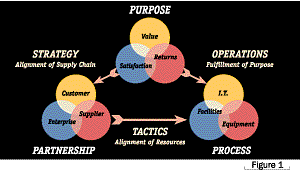
Last month in this column we described the Partnership segment of the 3-P Supply Chain Model, the elements of which include Purpose, Partnership and Process. In the 3-P Model, Purpose defines the selection of Partners, while the needs of those Partners in the marketplace drive the Processes used to integrate the supply chain (see Figure 1). This month we'll discuss how to build effective processes and develop operating practices to support those processes.
Processes
Most of you are already familiar with reengineering to improve processes. Basic process improvement strategy, in turn, involves:
• Eliminating redundancies, internally and among supply chain partners
• Ensuring product availability in appropriate locations
• Eliminating functions which add costs but don't add value
• Adding value with breakthrough processes
This last point, adding value through process innovation, is usually most productive as a collaboration between all of the supply chain partners. The partners in the chain work together to identify the unique competencies of each participant. Generally, it is very useful in this step to sweep away the traditional notions of channel functions performed by the partners for the purpose of a fresh look at the value-added potential of each partner.
In developing new or breakthrough processes, first use the vision of maximized value, idealized future position and the function of each partner from your fresh look. Then return to present reality and define roles; begin the hard work of changing attitudes, systems, skill sets and functions; and use these changes to build trust and confidence among the partners. Recognize that this process will also lead in new directions and be prepared to periodically re-evaluate the role of each partner. Remember, in the midst of all the messiness and complexity of mutual change through process innovation, don't lose sight of the vision and opportunity which led you in this direction in the first place.
Operations
So, how do we apply this approach to our own internal company operations? While the strategy is really quite simple, be aware that the implementation can be extremely complex. Start by identifying all the activities undertaken by your company. Separate them into two categories — those that add value for your customers and those that don't. Then eliminate, consolidate and simplify. Eliminate every non-value-added activity possible. Consolidate all activities into the fewest number of steps or actions possible. And relentlessly simplify everything that's left.
The subtraction of activities that don't add value may require the addition of new technologies. For example, the expense associated with answering calls and keying of sales orders can be eliminated by providing Internet-based software, allowing customers to check stock and place orders to their credit limit. Or it can be as sophisticated as the analysis and elimination of operations impediments and the labor necessary to manage them. An excellent example is Sony Disc Manufacturing's elimination of a staging bottleneck by implementing a design for a custom kanban materials delivery system. The addition of an automated material handling system to consolidate and label finished goods to customer specifications produced a return on investment (ROI) in labor savings alone in less than two years.
Likewise, consolidation may require new kinds of skill sets for workers, requiring a single position to take on a range of functions and assume complete responsibility for an operation. It may involve organizing activities around teams of cross-functional specialists and eliminating traditional departmental boundaries. It may involve new equipment allowing you to combine operations and reduce labor hours and programming efforts.
Simplification may require introduction of sophisticated methods or tools. For example, raising the level of knowledge and skill among front-line workers — empowerment — permits decisions to be made without repetitive labor/management interaction. It may involve implementation of supply chain software, providing visibility of customer demand to all of the chain's participants, and allowing manufacturers to reflect tomorrow's demand for their products in today's production schedule. Simplification may be a decision that it's just not worth tracking an article so precisely. For example, moving from item tracking on a part or material to a min/max setup, or giving your supplier your production schedule and the responsibility for maintaining certain part levels and having them deliver to the line rather than to your warehouse.
Summary
The 3-P Model defines the elements of any supply chain as Purpose, Partnership and Process. By definition, these three elements must be present in a supply chain initiative to ensure long-term success.
Purpose defines the overall intent of the participating parties, similar to the mission statement of a single enterprise. The key difference being that the purpose can be thought of as an inter-enterprise mission.
Successful partnering requires these building blocks: 1) management's commitment to the process; 2) establishment of an in-house cross-functional team empowered to make decisions that positively influence the whole enterprise; 3) team performance measurements and rewards linked to supply chain goals; 4) extension of the enterprise outside the four walls through careful partnering; and 5) linking the entire initiative through integrated information technology.
Process innovation is most productive in cooperation with partners. All partners in the chain work together to identify the unique competencies of each participant. Eliminating non-value-added activities, and consolidating and simplifying other activities in conjunction with supply chain partners will yield the greatest benefit and measurably improve your ROI.
Dennis Brewer is senior manager with CNA Consulting & Engineering in Bellevue, Wash. CNA is a source of integrated services for improving supply chain operations in manufacturing, distribution and logistics environments. Brewer can be reached at (425) 889-3364 or via e-mail at [email protected].
Copyright © 2020 by APICS — The Educational Society for Resource Management. All rights reserved.
 Web Site © Copyright 2020 by Lionheart Publishing, Inc.
All rights reserved.

Lionheart Publishing, Inc.
2555 Cumberland Parkway, Suite 299, Atlanta, GA 30339 USA
Phone: +44 23 8110 3411 |
E-mail:
Web: www.lionheartpub.com
Web Design by Premier Web Designs
E-mail: [email protected]