

April 1998 • Volume 8 • Number 4
Knowledge Is Not a Luxury:
IBM/APICS Manufacturing Industry Survey
Small and midsize manufacturers rate training and IT as critical factors for success
By John T. Herlihy and Carol A. Ptak, CFPIM,CIRM
Small and midsize manufacturers are bullish on their near-term growth prospects, according to a joint IBM/APICS-The Educational Society for Resource Management survey of nearly 500 discrete and process manufacturing firms. While the strong economy is responsible for much of the positive outlook, the manufacturers interviewed believe that their focus on manufacturing excellence has enabled them to take advantage of the booming economy. On a 1 to 10 scale, manufacturers rated their manufacturing productivity a strong eight.
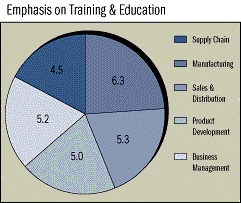
The survey, conducted by a third-party research firm, sampled nearly 500 manufacturers with fewer than 1,000 employees. Respondents were key decision-makers, with 75 percent of the sample consisting of company owner, president/CEO, vice president, CFO/controller, or heads of MIS. The study rated manufacturer priorities with regard to training and information technology (IT) investments in five areas: manufacturing, supply chain management, sales and distribution, new product development, or general business management. The key message from manufacturers is that they need solutions that work, not the latest and greatest hardware or operating system.
Manufacturers Vote with Their Pocketbooks
More than half the group reported business growth over the past two years. While a rising tide lifts all boats, most manufacturers believe they cannot sit back and let the booming economy grow their business for them. They feel that their investments in training, education and information technology have become necessary ingredients to success. The survey also revealed that this group made significant investments when averaged on a per employee basis.
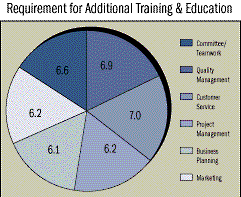
Where was all this investment directed? For training, manufacturers voted with their pocketbooks on improving quality. They rated product quality assurance and customer service as the top priority areas when it came to training. This reflects a perception that manufacturers believe that success is directly affected by customer perceptions of quality. Markets are won by companies that offer the best products and services.
Significantly, while manufacturers are using the Internet, they currently rely on traditional sources œ discussions with business acquaintances, subscriptions to trade publications as well as trade/professional meetings and conferences œ as the most important sources for training and educational information. Respondents indicated strong preferences for classroom training (onsite and offsite).
There were some differences in preferences by company size. Not surprisingly, larger companies, which require more sophisticated and formalized teamwork and coordination, rated training in teamwork and business planning skills very highly. Additionally, given that larger companies tend to have more complex IT applications and a greater degree of IT automation, it is not surprising that the most requested additional area of training is computing skills.
IT Helps Manufacturers Transform Knowledge to Success
For IT investments, the top priority was manufacturing, followed by sales and distribution and business management. The lower priorities accorded supply chain management and new product development could be explained by the fact that most smaller manufacturers operate as supplier to large manufacturers that produce finished products and deliver to customers or wholesalers. Consequently, suppliers often have less complex supply chains focused on serving a handful of �hub� manufacturer customers; additionally, the rate of change in components or intermediates is often not as volatile as that for finished products.
Just about the only difference between discrete and process manufacturers here was that process manufacturers rated new product development far lower than their discrete counterparts.
Future spending is likely to increase, according to most manufacturers. What was especially significant was the rate of investment in new ERP systems. A majority of respondents stated that they had either installed a new ERP system within the last two years, or would do so in the next two years. Installs were markedly higher in larger enterprises, with nearly all companies numbering more than 500 employees either already making ERP investments, or planning to do so within the survey period. Significantly, the proportions were fairly even between discrete and process manufacturers, reflecting the fact that process manufacturing-oriented ERP systems have matured.
Given the rate of technology flux currently underway in enterprise solutions, manufacturers were asked whether they preferred bundled (integrated) or component (point) solutions. While a slight majority voted in favor of bundled solutions, a closer look indicated differing preferences by company size.
Companies larger than 50 employees stated a clear preference for bundled solutions, reflecting a need to integrate complex information and workflows that characterize larger organizations. Conversely, most small manufacturers surveyed preferred component solutions. Because smaller organizations tend to have more constrained budgets, they are forced to prioritize their points of pain, and will often choose solutions that address specific vulnerabilities. Additionally, smaller firms do not have the same overriding need to integrate all operations since the communications process is much simpler when there are relatively few employees, often situated at the same facility.
Electronic commerce is viewed as a frontier by small and midsize manufacturers. Currently, almost half of all respondents reported using e-commerce, with the proportion slightly higher in the process industries. Furthermore, roughly half of all manufacturers in the group plan to invest further in this area, with the proportions roughly equivalent in process and discrete segments. E-commerce is growing at a steady pace, according to the survey group; on a scale of 1 to 10, manufacturers rated e-commerce growth at a level of five, with the proportion slightly higher among the largest firms. That is not surprising since EDI, the original e-commerce technology, began with larger organizations.
Most manufacturers consider external expertise critical to successfully implementing IT solutions. Following the downsizing of the late '80s and early '90s, relatively few organizations continue to maintain large IT staffs that can be dedicated to ambitious systems integration projects. Small and midsize manufacturers are no different; with fairly lean IT staffs, over two-thirds of the respondents pointed to using third parties at least some of the time.
Measuring the Results
The survey polled respondents about the use of ROI (Return on Investment) and ROA (Return on Assets) metrics for gauging financial performance. Both measures proved equally popular in each segment, regardless of company size. However, actual use was much higher in larger organizations. Most large companies numbering more than 500 employees used ROI or ROA metrics; the proportions were reversed with smaller firms.
And, over the past two years, most companies reported improved ROAs and ROIs. The greatest improvements were in ROAs, reflecting the fact that manufacturers are better utilizing their assets, such as equipment, information systems and materials. Conversely, there was more room for improvement in deriving returns on major capital investments. This fact is often not surprising, since new technologies often require learning curves for effective use.
Has ERP helped? More than half of all small and midsize manufacturers surveyed reported at least some improvement due to ERP, with the benefits more frequently showing up where it was needed œ in improved ROIs.
Summary
Small and midsize manufacturers firmly believe that they must be proactive to leverage a booming economy. IT investments and training are considered essential for survival in the age of the Internet. Virtually all manufacturers surveyed indicated that staff training and information technology go hand in hand with competitiveness. In fact, this is a major change in climate from the 1970s and '80s, where such investments were considered luxuries limited to large organizations.
Yet, small and midsize manufacturers know that raw technology will not solve their competitive challenges. They require more than the latest client/server platform technology. They require knowledge, and the solutions that help them capitalize on market knowledge.
A combination of factors have brought this about. The accelerating pace of change in world markets, the erosion of trade barriers, growing robustness of solutions for all manufacturing sectors, large and small, process and discrete, and dramatic improvements in information technology price/performance, have made it clear to even the smallest manufacturers that knowledge is no longer a luxury.
| Survey Documents Use of Education as a Management Strategy |
According to the IBM/APICS survey, many decision-makers in small and midsize manufacturing firms use investments in staff training and education as key elements in their management strategy. The survey polled nearly 500 senior level managers in manufacturing firms with fewer than 1,000 employees. Conducted by the firm Colwell and Salmon, the 15-minute telephone survey was based on companies that were randomly selected from Dun & Bradstreet listings. The statistics were reported in three categories: Among the IBM/APICS survey's findings relating to education and training:
|
John T. Herlihy is director, enterprise resource planning, IBM Small and Medium Business; Carol A. Ptak, CFPIM, CIRM, is executive vice president of APICS.
Copyright © 1998 by APICS — The Educational Society for Resource Management. All rights reserved.
 Web Site © Copyright 2020 by Lionheart Publishing, Inc.
All rights reserved.

Lionheart Publishing, Inc.
2555 Cumberland Parkway, Suite 299, Atlanta, GA 30339 USA
Phone: +44 23 8110 3411 |
E-mail:
Web: www.lionheartpub.com
Web Design by Premier Web Designs
E-mail: [email protected]