

April 1998 • Volume 8 • Number 4
APICS Business Outlook Index:
Effect of Asian "Crisis" Wanes
By Michael K. Evans, Ph.D.
The APICS Business Outlook Index rebounded in February to 48.4 from 46.8. The gain was caused by a substantial rise in the Future Component, which improved to 47.9 from 41.9. The Current Component slipped to 48.8 from 51.8.
The overall index still indicates below-average growth in the manufacturing sector for February. However, the improvement in the Future Component, notably the rebound in new orders, suggests the decline associated with the Southeast Asian crisis has been shorter and milder than originally anticipated. For the first time since September, the production planning index has moved back to 50.
The only two weak areas identified by the APICS survey this month are employment and actual-to-desired inventory stocks. The survey results indicate that the rapid employment gains in the manufacturing sector came to an end in February, as firms finally managed to fill long-vacant positions.
The actual inventory/sales (I/S) ratio remains well above its desired level in spite of a rebound in shipments in February; this is attributed to continuing logistics problems in the transportation industry. The actual I/S ratio has been at or above desired levels since September.
Thus, the APICS index does not indicate above-average growth in the months ahead. On the other hand, the survey also shows that the long-anticipated slowdown caused by declining exports is unlikely to materialize in the near future. The overall growth rate should remain near average levels.
Current Conditions Components
This decline can be attributed to several factors. First, employment generally lags behind orders and shipments, which started to weaken as early as August. Second, while the probable effects of the Southeast Asian crisis have been exaggerated, there have been some cutbacks in the high-tech sector which should be reflected in the February employment figures. Third, sluggish car sales and declining employment in aircraft probably reduced employment in the transportation industry. Fourth, many firms have finally filled long-vacant positions; catch-up hiring has been completed.
Future Condition Components
Signs of 1998 Slowdown Recede
It didn't take the economists long to react to the Southeast Asian crisis. The forecast for 1998 real growth, which had already been set 1 percent below the 1997 gain of 3.8 percent, was sliced another 0.7 percent, bringing it down to 2.1 percent for 1998 — which is still the latest consensus forecast.
However, that knee-jerk response may have been an overreaction for two reasons. First, forecasts of slower growth in 1998 failed to take into account the expansionary impact of the drop in bond yields last year. Second, the impact of slower growth in Southeast Asia, plus the negative impact from the general strengthening of the dollar, were overstated.
We're not intimating that the trade deficit won't balloon this year. However, that negative impact on the gross domestic product (GDP) will be offset by strength in domestic consumption and fixed investment.
As early as August, the APICS survey identified a slowdown in manufacturing shipments and orders that did indeed materialize. However, this slowdown did not extend to production, employment or total GDP. Consumer spending remained strong, buttressed by unusually large gains in real wages and the drop in bond yields. Also, inventory investment rose sharply, partly because of the gains in shipments and orders earlier in the year, and partly because of snafus in the transportation system. Even though export orders declined, shipments of exports remained strong because of orders that had been placed earlier in the year.
New orders for exports fell to a lower level and have not recovered. However, domestic new orders also weakened briefly because of the widespread concern that domestic growth would be hurt by the drop in exports. Gradually, it has become clear this is not the case. Not only have domestic sales remained strong, but the boom in the stock market and consumer confidence seems to suggest that rumors of a slowdown in the U.S. economy were greatly exaggerated.
Consumer spending has remained strong because of the big gains in real wages and lower interest rates. This strength in the domestic economy caused many firms to reconsider whether the outlook was as bad as they thought. Hence, domestic orders picked up again — even though export orders remained weak.
Looking ahead, we need to balance the impact of three major sectors. Domestic final demand remains strong with the help of low interest rates, which won't change soon. Inventory stocks are too high, so some adjustment can be expected over the next several months. Export orders will remain weak — although probably not as weak as many thought a few months ago.
It turns out that none of the gloom-and-doom scenarios have come to pass; there is no global meltdown. The countries of Southeast Asia are grudgingly meeting their obligations; they realize there is no other sensible choice. Of course U.S. exports of discretionary goods to Southeast Asia are down sharply, but exports of capital goods are not. These countries know they must continue to purchase the latest cutting-edge technology for their export industries.
Last month, we discussed our concern that higher labor costs and inflation would lead to Fed tightening later this year. That is still a valid concern. However, at the moment, it appears no one else is worried. Hence, interest rates probably will not rise very much until after midyear; and except for an immediate reaction in stock prices, the U.S. economy will not be affected until early 1999.
The rebound in the future component of the APICS index in February suggests the worst of the Asian crisis has passed, which means real growth this year will remain at or above average rates.
All opinions expressed in this report represent the viewpoints of the Evans Group and are not necessarily those of APICS.
APICS Index Performance
•CURRENT CONDITIONS COMPONENT: Manufacturing
shipments, employment, industrial production, inventory
stocks
•FUTURE CONDITIONS COMPONENT: Future Component
lagged 2 months. Durable goods new orders (excluding
aircraft and defense), production plans, unfilled orders,
ratio of actual-to-desired inventory/sales ratio APICS
members and others from companies that might be potential
participants in the APICS Business Outlook Index are urged
to call Dr. Michael Evans at (847) 328-2468. APICS staff
contact for the index is Barbara Gleason, APR, senior
communications manager, APICS Headquarters, (703) 237-8344,
ext. 2271. APICS Index Performance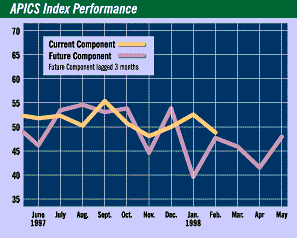
The APICS Business Outlook Index was created and
developed by Michael Evans of Northwestern University, in
conjunction with APICS. The index consists of the following
components, based on Evans' monthly survey of participating
manufacturing firms:
APICS Business Outlook Index
|
| ||||||
|
CURRENT COMPONENT | ||||||
|---|---|---|---|---|---|---|
|
|
|
|
|
|
|
|
|
1997 | ||||||
|
|
|
|
|
|
|
|
|
|
|
|
|
|
|
|
|
|
|
|
|
|
|
|
|
|
|
|
|
|
|
|
|
|
|
|
|
|
|
|
|
|
|
|
|
|
|
|
|
|
|
|
|
|
|
|
|
|
|
|
|
|
|
|
|
|
|
|
|
|
|
|
|
|
|
|
|
|
|
|
|
1998 | ||||||
|
|
|
|
|
|
|
|
|
|
|
|
|
|
|
|
|
FUTURE COMPONENT | |||||
|---|---|---|---|---|---|
|
|
NEW ORDERS |
PRODUCTION PLANNING |
I/S RATIO |
FUTURE COMPONENT |
|
|
1997 | |||||
|
|
|
|
|
|
|
|
|
|
|
|
|
|
|
|
|
|
|
|
|
|
|
|
|
|
|
|
|
|
|
|
|
|
|
|
|
|
|
|
|
|
|
|
|
|
|
|
|
|
|
|
|
|
|
|
|
|
|
|
|
|
|
|
|
|
|
|
|
|
|
1998 | |||||
|
|
|
|
|
|
|
|
|
|
|
|
|
|
|
| |||||
Copyright © 2020 by APICS — The Educational Society for Resource Management. All rights reserved.
 Web Site © Copyright 2020 by Lionheart Publishing, Inc.
All rights reserved.

Lionheart Publishing, Inc.
2555 Cumberland Parkway, Suite 299, Atlanta, GA 30339 USA
Phone: +44 23 8110 3411 |
E-mail:
Web: www.lionheartpub.com
Web Design by Premier Web Designs
E-mail: [email protected]