

April 1997 € Volume 7 € Number 4
Don't Automate Inventory Tracking, Eliminate it.
Effective implementation of technology must be rooted in a foundation of common sense, accompanied by a fundamental shift in traditional thinking. How we manage and track inventory is one of those very fundamental shifts in thinking that must take place to effectively benefit from much of the new methodologies.
By Robert A. Stahl, CPIM
Today we understand the objective of A manufacturing company is more than simply making a profit. While making a profit is certainly an imperative, it cannot be done in sustainable fashion without also satisfying customers and employees as well.
Some rather high profile companies have been late to realize that owners (profit), customers (service), and employees (work processes) are equally important. Some have waited until they lost much of their competitive advantage and a considerable market share before they learned this tough lesson. Sustainable competitive advantage only happens when all of these constituencies enter into a mutually beneficial partnership.
Acknowledging that equally serving these three constituencies is essential, the real challenge remains -- how does one do that?
The traditional mind-set claims that the way to achieve competitive advantage is to weigh one constituency against another, looking for the optimum point of trade-off.
In recent years, however, through the implementation of improved technology and understanding, this trade-off type thinking has become obsolete and is becoming a serious liability to making change and improvement.
A proper manufacturing mission must be geared at satisfying all of the constituencies. Such a mission might be stated as follows:
Achieve superior performance in your ability to --
- Reliably satisfy the expectations of the customer (high quality)
- Improve work processes (low cost)
- Be quick to change direction (quick response, flexibility)
Obviously, this presents the same trade-off dilemma as the playing
of one constituency against another. However, this trade-off type
thinking is unnecessary with proper understanding and a changed
mind-set.
Traditional Manufacturing and Inventory Tracking
Relative to inventory management, the overall objective of a
manufacturing company was best stated by George Bevis (late executive
vice president of the Tennant Co.) when he said, " � the objective of
a manufacturing company is to manage the flow of inventory to satisfy
customers' needs." He further stated, "� do this well, and the
profits will come in the mail."
The operative word here is flow. That means without stopping. A manufacturing process involves a series of steps (often called a supply chain) that add value to purchased parts and materials that become in economic demand by customers.
The traditional mind-set disconnects the individual steps of a manufacturing operation by placing inventory as a buffer between each step in the sequence. This inventory would supposedly allow each operation to run at its own rate, gaining economies through the independent efficiency of each operation. Additionally, this disconnect was made more dramatic by large lot sizes geared at gaining economies of scale. We have learned that both of these tend to be false economies.
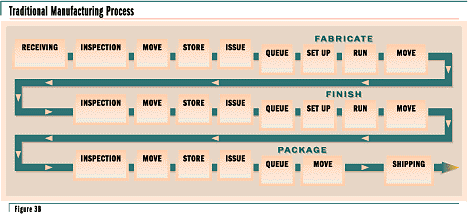
On top of these costs is the tracking of inventory that is necessary as material is received, stored, issued, added to WIP (work in process), and then received through each of these manufacturing cycles. All of this made the manufacturing process the opposite of the objective, resulting in low quality, high cost and slow response.
For some period of time, inventory management focused on how to handle inventory tracking activities more efficiently. Automatic storage and retrieval systems (AS/RS) were added; the relief of component inventory by the use of backflushing was automated; bar coding to make recording more efficient was added; and most recently, radio frequency transmission (RF) units have been brought into play. Under traditional conditions, these things seemed to help, but in fact were treating the symptom -- too much inventory.
Recently there has been an awful lot said and done about gaining a synchronous flow to all manufacturing processes, linking together the various steps of a manufacturing operation and creating the flow that Bevis referred to.
The most popular term for this notion is Just-in-Time, meaning in
a specific sense to have inventory only when it is needed -- not
sooner, not later, not more, not less, but just in time at each and
every step of the manufacturing process.
Inventory: An Asset or An Expense?
One of the reasons we have failed, until recently, to focus on the
elimination of inventory rather than on efficient handling is that
our primary performance measure didn't recognize inventory for what
it truly is -- an expense, not an asset. Traditional inventory
accounting adds all inventory to the balance sheet as an asset,
taking it to cost of sales (an expense) only when it is sold, rather
than when it is incurred.
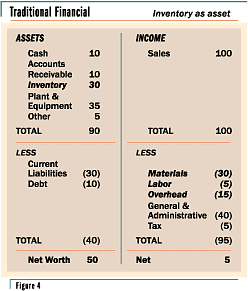
From a traditional accounting standpoint, this would be displayed in the financial statements, with inventory shown as a line item in the asset column, and cost of sales (material, labor and overhead) as an expense on the income side (see Figure 4 ). With this type of financial reporting, if manufacturing produced or received more inventory than was needed (clearly something that is not the ideal), this would not be seen as an adverse condition.
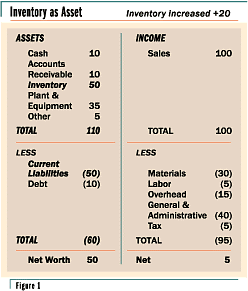 For
example, what would happen if inventory goes up by 20. Figure 1
displays how this would be reflected in the traditional financial
statements: Inventory would increase from 30 to 50, and Current
Liabilities (Accounts Payable) would also increase from 30 to 50,
causing Net Worth and Net Profit to remain unchanged.
For
example, what would happen if inventory goes up by 20. Figure 1
displays how this would be reflected in the traditional financial
statements: Inventory would increase from 30 to 50, and Current
Liabilities (Accounts Payable) would also increase from 30 to 50,
causing Net Worth and Net Profit to remain unchanged.
In other words, with traditional accounting the financial statements would not reflect that something undesirable had occurred -- that is, you produced or received more inventory than was needed.
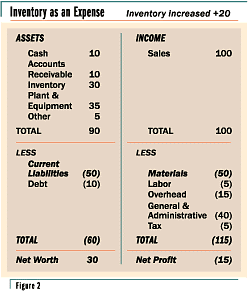
As an alternative, suppose that all inventory was considered an expense (cost of sales). How would this look? As can be seen in Figure 2, Cost of Sales would increase by 20, increasing Total Expenses from 95 to 115, and Current Liabilities (Accounts Payable) would increase by the same 20, from 30 to 50, causing Total Liabilities to raise to 60. In this case, Net Worth would drop from 50 to 30, and Net Profit (Loss) would drop from 5 to (15), clearly reflecting the unfavorable condition that took place until the excess inventory was indeed sold -- a point when this effect would be reversed. This process would indeed direct attention to the problem when it occurred, rather than two years later when it was obsolete inventory.
The net result: When things are not done as you'd like, it is properly reflected in the financial statements (performance measures) at the time it happened.
 In
traditional manufacturing environments where inventory does rise and
fall regularly and sharply, reporting such swings externally would
not necessarily be wise. This should, however, be no reason to report
internally with the same misdirecting information.
In
traditional manufacturing environments where inventory does rise and
fall regularly and sharply, reporting such swings externally would
not necessarily be wise. This should, however, be no reason to report
internally with the same misdirecting information.
If this more accurate financial reporting were done as part of
performance reporting, it would hasten progress on those things that
would enable the elimination of excess inventory. Doing the right
things is often a function of performance measurements. In other
words, performance measurements must align with desired performance,
and traditional financial reports simply do not properly align in
this regard.
Ideal Manufacturing Process
Having established the need to have performance measurements which
reward progress toward the ideal performance, we must recognize that
understanding, desire and performance measurements alone do not make
the ideal process possible. We must be sure to not try and live in
the ideal vision of the future, but rather we must live in the
reality of the present. That reality is that we have not eliminated
all of the obstacles which make inventory unnecessary.
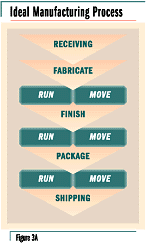
The ideal flow in a manufacturing company is to receive and produce today only what is needed by customers today. If this ideal were to be pictured, it might look like that seen in Figures 3A & B, juxtaposed with the traditional manufacturing process. You will note that most of the non-value adding "boxes" of the traditional manufacturing process have been eliminated in the ideal process. This is more than a wish, but a lot of hard work eliminating some very specific constraints, such as setup time, lot sizing, process reliability and the like.
 Once
achieving these ideal circumstances, whether you treat inventory as
an asset or an expense is a moot point because you would never
receive more inventory than was needed in any given time period;
thereby bringing to Cost of Sales all inventory as an expense,
regardless of the accounting method.
Once
achieving these ideal circumstances, whether you treat inventory as
an asset or an expense is a moot point because you would never
receive more inventory than was needed in any given time period;
thereby bringing to Cost of Sales all inventory as an expense,
regardless of the accounting method.
Clearly not the case in most circumstances, however.
Generally speaking, tracking of inventory through its various
stages of manufacturing (stock rooms and WIP) is done for two
reasons: inventory valuation (financial reporting) and to support
proper planning and scheduling. In the ideal environment, tracking
inventory is also a moot point, because all inventory received would
make its way to cost of sales within the same day, thereby
eliminating the need to track for either valuation or planning and
scheduling.
How to Begin the Journey
While action is the clear objective of getting started with any
project, action is not the first step. Gaining a consensus in concept
by the leadership function is.
Gaining a consensus in concept means coming to an agreement on how you would like things to be in the future. Obviously, one indication of a change in mind-set is a willingness to create internal financial reporting (performance measurement) to reflect inventory as an expense rather than an asset. If an agreement in concept cannot be reached, no actions will be successful, but rather create conflicts and frustration.
Once a consensus in concept is reached, then all of the things needed to be put in place to make it so must be identified. This strategy list is likely to be larger than the time and the resources available. It is therefore necessary to prioritize this list to come up with a "how and in what order will you begin work" list. Only then will the energy of an organization be aligned so that consistent and rapid progress toward the ideal can be achieved.
Once actions begin to take place, then the result of those actions must be audited and evaluated in order to assure consistent support of the original concept being sought.
General Strategy About a Pilot
The creation of a pilot area is normally part of a successful path
forward. To do otherwise will often create more trauma than an
organization can handle, both inside and out. This is because you
cannot totally consider inventory as an expense until there is very
little of it, which is not the case when you begin.
This pilot type of thinking is necessary to "isolate" an area that will be treated with this new mind-set and new performance measurements.
By policy, this area would "receive" inventory from the stockroom only in amounts that were going to immediately be put to use. This "received" quantity would, by policy, be expensed as it was delivered, forcing the necessary improvement to material handling practices for incoming materials in order to make them more effective and efficient. This would then evolve to the outside suppliers also learning how to handle smaller and smaller quantities of materials so that they could deliver directly to "point of use," resulting in the elimination of the stockroom itself.
Some organizations have foolishly eliminated inventory control and
discipline before eliminating inventory. This is a mistake! As long
as there is lots of inventory, it must be controlled and disciplined
with traditional methods (cycle counting and the like). The real
payoff comes when the inventory has been substantially eliminated,
which gives the sustainable double-edged advantage of high quality
(conformance), low cost (inventory), and quick response
(flexibility).
Robert A. Stahl, CPIM, is the president of the R.A. Stahl Co. in
Attleboro, Mass., and is a senior partner in the education and
consulting firm Partners for Excellence. Bob is also a member of the
Association for Manufacturing Excellence (AME), and the Operations
Management Association (OMA). He was elected the Best Conference
Speaker in basic concepts at the 1995 APICS International Conference
in Orlando, Fla.
For more information about this article, input
the number 1 in the appropriate
place on the
April
Reader Service Form
Copyright © 1998 by APICS — The Educational Society for Resource Management. All rights reserved.
 Web Site © Copyright 2020 by Lionheart Publishing, Inc.
All rights reserved.

Lionheart Publishing, Inc.
2555 Cumberland Parkway, Suite 299, Atlanta, GA 30339 USA
Phone: +44 23 8110 3411 | br> E-mail:
Web: www.lionheartpub.com
Web Design by Premier Web Designs
E-mail: [email protected]