

April 1997 € Volume 7 € Number 4
The TOC Management System For Manufacturers
Theory of constraints provides concepts which serve as effective starting points and processes for improving performance. Application of these processes have created a wide range of generic, "best practice" solutions which can be combined and tailored to meet specific situations.
By Thomas B. McMullen, Jr.
Using the theory of constraints (TOC) management system [3, 4] involves adopting the suite of TOC principles and processes, applying proven TOC best practices, and using TOC approaches to invent new and self-documenting best practices.
The TOC financial management system differs in important ways from
traditional absorption cost, activity-based, and economic value-added
(EVA) financial systems. The TOC system corrects the flaws in these
systems by emphasizing a more correct definition of "economic
value-added." This alternative value stream is referred to
interchangeably as throughput [1, 5], financial throughput,
throughput value added (TVA), and TOC value added (TVA) [3].
The TOC Management System
The management system based on TOC has been used by industrial
corporations, service companies, not-for-profit organizations,
military and intelligence operations, and individuals worldwide. They
have used TOC to improve performance, make better analyses of
opponents, create better work environments, improve relationships,
increase the experience of satisfaction in day-to-day living, and
solve all manner of life's large and small problems.
TOC and the TOC management system serve best as an individual's or organization's primary approach to self-management. The TOC approaches may also be used in support of other approaches to improved performance.
Case studies from Avery-Dennison, Delta Airlines, National
Semiconductor, Zycon Corp., ITT, Torrington Co., U. S. Air Force
Medical Service, Hannah's Do-Nut Shop, Harris Semiconductor, Dresser
Industries, Allied-Signal, U. S. Air Force Logistics Command,
Bethlehem Steel, United Airlines, Morton International, Johnson
Controls, the U.S. Navy/U.S. Department of Commerce Best
Manufacturing Practices (BMP) Center of Excellence, Rockwell
Automotive, Ruckels Middle School, and many more are available
directly from APICS. These are in the form of published proceedings
and audiotaped presentations from the annual APICS Constraints
Management Symposia.
TOC: An Overview
The Theory of Constraints is a science of management [1, 2, 3] that
applies the methods of science -- specifically, the methods of
physics -- to the general problem of management, including within
manufacturing companies.
The phrase "methods of physics" indicates the disciplines of cause-and-effect thinking. It implies an aggressive search for the minimum number of simplest concepts which provide maximum practical explanatory and predictive power.
TOC provides a structured process that invites and verbalizes intuition, thereby capturing the best of both the analytical and intuitive modes of experience.
By placing the priority of the generalist view over the specialist, and by synthesizing intuitive and analytical experience, TOC dramatically increases the range of circumstances over which practical, commonsense, and "win-win" combinations of policies and actions can be formulated and successfully implemented.
The principles and thought processes of TOC create, communicate and improve upon a common sense of any situation. With TOC, people can: agree on definitions of "improved performance," define measurements, establish scales of importance, and methodically sort out cause-and-effect relationships. This speeds identification of constraints and sharpens the focus of planning and implementation activities.
Whatever impedes progress toward an objective, or a goal, is called a constraint.
Some constraints -- those with lesser impact -- impede progress along only one or a few measures of limited importance. Other constraints -- those with greater impact -- impede progress along many lesser measures, along at least a few measures of great importance, or both. Every situation contains many relatively lower-impact constraints, but only a single or a few higher-impact constraints. The higher-impact constraints are called core problems or root causes. Since time is every company's prime constraint, maintaining an individual's or management's focus on identifying and acting on the higher-impact constraints uses scarce time effectively. Resources are focused on deep causes, not squandered repeatedly on the same symptoms. Using scarce time effectively allows individuals and organizations to do more, or do better, in less time, thereby opening up additional opportunities.
One set of TOC tools is provided for use when limited physical resources are the primary constraint on performance. This type of situation involves a physical constraint. Drum-buffer-rope and dynamic buffering approaches to finite capacity factory scheduling, buffer management methods of logistics control, and critical chain approaches to project management are examples of these TOC tools.
More importantly, TOC provides general-purpose and structured-thinking processes for use in dealing with the more subtle and complicated situations where thinking alone, in its many forms, holds back progress. These situations are said to involve policy constraints. This structured thinking process leads to high effectiveness in problem-solving, high productivity of company personnel and assets, and a deliberate series of simple and practical breakthrough solutions in support of the company's goal.
The same structured thinking tools -- the famous TOC "logic tree" processes and diagrams -- can also be organized into systems for increasing productivity in other domains of management skill. Examples include empowerment, communication and conflict resolution.
Use of the TOC principles and thinking processes gave rise, among
other things, to the policies and procedures known as the TOC
financial management system, and to the TOC manufacturing systems
solutions now being employed throughout industry.
TOC Financial Management System
A manufacturing enterprise must create value for its stakeholders.
Many procedures have been proposed and used to guide and measure the
creation of value. Examples include allocation-based absorption cost
accounting (traditional management accounting), activity-based
costing, activity-based management, and the so-called "economic
value-added" (EVA) system.
All of these procedures have been useful; in other words, they each delivered certain advantages over predecessor technologies and each continue to deliver at least a subset of what an appropriate financial system should provide. However, none of these still-popular systems have provided all of the features which would constitute the correct solution for manufacturing decision-support and financial control. By the term "correct solution," I'm indicating an optimum combination of concepts and processes which delivers the maximum amount of the most necessary benefits with the least unintended negative consequences and the least consumption of scarce resources.
The TOC financial management system for manufacturers is formed from the following concepts and processes:
- The manufacturing enterprise is viewed as a system, with owners who determine its goal and stakeholders who influence establishment of necessary conditions
- for continued system operation.
- For most operational purposes, the goal of the company is established as making money now and
- in the future.
- In the context of decisions concerning potential improvements, the goal of the company is established as making more money now and in the future.
- The word "money" is understood primarily to mean the economic value added by the operations of the firm.
TOC Value-Added (TVA)
Of the many competing definitions of "value," the TOC value-added
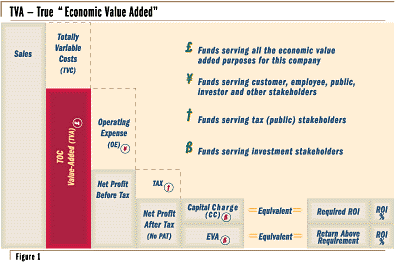
(TVA) is defined as: All the money the system generates through
sales. This means TVA is calculated as sales, less any sales
discounts, less any true variable costs. Accountants will recognize
that the TVA portion of the TOC financial system is similar to direct
margin analysis, with two exceptions. First, direct labor is treated
as period (vs. variable) cost. Second, TOC companies treat this as
gospel and actually do it, as opposed to treating variable costing as
an academic exercise learned in school.
TOC value-added was introduced as "throughput," as in the throughput of a system, by Dr. Eliyahu M. Goldratt, the inventor of TOC [1, 5]. Goldratt demonstrated the importance of organizing management financial systems around the correct definition of "economic value-added." These new TVA terms simply place new labels on Goldratt's initial formulation in order to improve efficiency of communications. The new terms bring the reader's thinking more quickly into the financial arena. They remove the need to repeatedly clarify for many audiences that the term "throughput" is a financial and management accounting term and not a reference to the units of physical throughput of some machine, department or company. Throughput, financial throughput, TOC value-added, throughput value-added, and TVA are all different names for the same underlying flow of money.
TVA is the economic value available to satisfy legitimate demands
of all the company's stakeholders, not just the shareholders. By
contrast, the primary shortcoming of the EVA system is that it
measures and emphasizes the wrong portion of value that is added,
overemphasizing the claims of shareholders at the expense of effects
which can be observed among customers, employees, and other
stakeholders in the firm.
Making the Pie Bigger
A management system based around TVA makes the economic "pie" bigger,
without interfering with -- and, in fact, supplying the funds for --
any reengineering or other programs to reduce relative or absolute
asset or expense expenditure levels, as appropriate during the life
cycles of a company, product or process. With the economic pie
growing, these reductions in expenditure levels can be made while
maintaining high levels of employment stability, without cutting
corners on legal or other established obligations, and while gaining
the economic, moral and societal respect advantages of satisfying the
legitimate needs of all the company's established stakeholders.
The pie does not grow by itself. People must focus on it, plan it, do it and succeed in their efforts. To fail to focus every day on growing the pie is eventually to back the management team into the self-defeating corner of cost-cutting without growth, and to force them -- in order to appear as successes in their careers -- to persuade others that such cost-cutting is the hallmark of superior management. It isn't. Only cost-cutting within the context of growing the pie, and while delivering a reasonable degree of employment and operations stability, is superior management. Only by focusing a disproportionate amount of management attention on the economic value entity pointed to via the concept of TVA will get the right thing done.
TVA focus leads to effective balance in combined marketing, product development and expenditure control programs.
Build your management system around TVA, deal logically with
operating expense and investment reduction as priorities two and
three, and superior employment stability, loyalty, legitimacy,
respect, return on investment and EVA will all come along in the
process.
Scale of Importance Issues
The TOC scale of importance principle states that not all
measurements are to be treated with equal priority.
The "throughput world" financial policies (I'll call them policies of the TVA financial system) state that protecting and increasing TVA should always be treated with higher priority than reducing investment or reducing operating expense. Cause-and-effect thinking processes and diagrams should be used to ensure investment and operating expense levels are understood at appropriate levels of detail. Investment and operating expense levels should be controlled and, where appropriate, reduced -- whenever such reduction activities don't interfere with efforts to increase current or future TVA. Reductions in the relative levels of operating expense and investment, as expressed by the ratios of operating expense to TVA (OE/TVA), and investment to TVA (I/TVA), should be aggressively pursued as additional desirable effects automatically coming from the programs to increase TVA.
Global (companywide) measures take priority over local (departmental or product) measures. Therefore, once the global TVA and operating expense are known for a specific manufacturing business plan or decision scenario, the effort to calculate allocation-based product costs is a waste of time that creates confusion and wrong decisions.
To be aware of cause-and-effect relationships affecting how consumption rates of staff (and other resources represented in period operating expense) vary with changing assumptions in the business plan is a good and important thing to do; to translate that awareness into allocations of overhead, to form a fictional math entity called allocation-based product cost, is a bad, wasteful and dangerous idea. A company can "know its costs" in excruciating detail and know exactly where it stands and is going economically -- without ever allocating a bit of overhead to form a single allocation-based "product cost." Think about that.
Where factory department efficiency and utilization measures conflict with maintaining and increasing global TVA, the global TVA must take priority.
In contrast to the competing activity-based and other
allocation-based cost accounting systems, the TOC financial system is
clear and persuasive to industrial employees ranging from factory
machine operators to chief executive officers. It is easier to use,
less prone to mistakes and less costly to administer.
TVA's Advantages Over EVA
With respect to the so-called "economic value added" (EVA) system,
the TVA system's advantages include:
- a superior definition of "economic value added" (EVA is a subset of net profit, which is a subset of profit before taxes, which is a subset of direct margin, which is a subset of that expression of true economic value added -- TVA.)
- a more effective framework for accomplishing growth and maintenance of the company's revenues and cash flows
- a greater ability for inculcating loyalty, legitimacy and productivity in the employer/employee relationship via more logical workplaces and greater employment stability
- a greater ability to fund and balance activities which meet appropriate requirements of all established stakeholders
- greater comprehensiveness
- an avoidance of unnecessary and counter-productive conceptual and process complexity.
TOC Manufacturing Systems
Traditional planning systems are built around an implicit, but
functionally very real assumption of infinite resource capacity in
the departments of the company.
TOC manufacturing systems provide manufacturing companies and the professionals who serve them with a means for upgrading the traditional computing systems based on assumptions of infinite work center capacity [4, 6]. As public domain constraints-based computing concepts [7, 8] are adopted by an increasing number of systems vendors, they present manufacturing companies with an attractive menu of choices: the traditional "closed-loop" suite of systems, and a well-integrated generation of newer TOC manufacturing systems. Having both technologies "on the menu" enables manufacturers to set their own pace in migrating to public domain TOC finite capacity systems architectures, and to avoid the extensive semi-custom internal development and integration efforts which, in some plant environments, has been required to gain access to the benefits of TOC systems [6].
The TOC computing systems, as described in [7], were created to
support the TVA emphasis of the TOC Financial Management System; in
other words, to create the right solution to the long-standing
problems presented by traditional management accounting. The
breakthrough solutions in logistics control, scheduling and focusing
of improvements were unavoidable and very valuable by-products
invented along the way.
References
- 1 Goldratt, E.M., "The Goal: A Process of Ongoing Improvement," (1992, APICS bookstore item #03201).
- 2 Goldratt, E.M., "It's Not Luck," (1994, #03291).
- 3 McMullen, T.B., "Introduction to the Theory of Constraints (TOC)," (1997, #03521).
- 4 McMullen, T.B., TOC: The Infrastructure of Agile Manufacturing, "APICS 1996 Conference Proceedings," (#04018; Also included in #05021).
- 5 Goldratt, E.M., 1983. Cost Accounting: Public Enemy Number One of Productivity, "Selected Readings in Constraints Management," (1996, #05021).
- 6 McMullen, T.B., The Systems Industry is Giving MRP (and ERP) Implementors a Choice: Traditional and TOC Systems, "Selected Readings in Constraints Management," (1996, #05021).
- 7 Goldratt, E.M., "The Haystack Syndrome: Sifting Information from the Data Ocean," (#03125).
- 8 Stein, Robert, "Reengineering the Manufacturing System: Applying the Theory Of Constraints," (1996, #03480).
Tom McMullen is the founding chairman of the APICS Constraints
Management SIG, advisor to the APICS/St. Lucie Press TOC publications
series, and an independent consultant and educator based in Weston,
Mass.
For more information about this article, input
the number 5 in the appropriate
place on the
April
Reader Service Form
Copyright © 2020 by APICS — The Educational Society for Resource Management. All rights reserved.
 Web Site © Copyright 2020 by Lionheart Publishing, Inc.
All rights reserved.

Lionheart Publishing, Inc.
2555 Cumberland Parkway, Suite 299, Atlanta, GA 30339 USA
Phone: +44 23 8110 3411 | br> E-mail:
Web: www.lionheartpub.com
Web Design by Premier Web Designs
E-mail: [email protected]