

April 1997 € Volume 7 € Number 4
Slight Rebound In February
By Michael K. Evans, Ph.D.
The APICS Business Outlook Index rebounded slightly in February, rising to 47.8 from 45.9. The current component of the index rose to 48.8 from 42.3, while the future component fell to 46.9 from 49.6. This leaves manufacturing activity below its long-term average growth rate of about 3 percent and suggests sluggish gains ahead for the next few months.
Production and employment rose substantially in February, but orders remained quite weak. Not only was there a further decline in inventory stocks, but an unusually large proportion of firms lowered their desired inventory/sales (I/S) ratio with the result that, on balance, the ratio of the actual to desired I/S ratio rose slightly.
The results of the latest APICS index do not suggest robust activity ahead for manufacturing activity over the next few months. New orders are below 50 for the second month in a row -- the first time that has happened since the end of 1995 when the economy also temporarily weakened.
Also, production planning dropped back to 48.4 after surging to
56.5 in January. Based on the weakness in orders and the desire to
reduce equilibrium inventory stocks even further, the bounceback in
February production is thus seen more as a return to normal levels
from the drop in January rather than a harbinger of stronger growth
ahead.
Current Conditions Component
- Manufacturing Shipments failed to rebound in February
after dropping sharply in January. The February level of 47.5 is
just about the same as the average reading of 48.2 over the
previous three months. These figures suggest that, on balance,
there has been almost no gain in shipments since October.
- Manufacturing Employment, on the other hand, continues
to rise, with an estimated 15,000 gain in February, just about the
same as the 18,000 gain reported by the Bureau of Labor Statistics
(BLS) in its preliminary January figures. After running up record
overtime hours, some firms have decided to expand their work force
rather than continue to rely so heavily on overtime. On the other
hand, layoffs and cutbacks continue, so the slight gain in
manufacturing employment is not an unalloyed sign of strength.
- Manufacturing Productivity, which declined 0.1 percent
in January, probably rebounded 0.3 percent in February. However,
the drop in January reflected overstated production gains in
November and December, rather than pointing to an outsized gain in
February. On balance, the manufacturing sector is expected to be
substantially weaker this quarter than it was during the latter
half of 1996, when production rose at an unusually rapid annual
rate of 5 percent. According to the recent APICS survey results,
that gain is unsustainable.
- Unfilled Orders, which are now included in the current
component index, were fairly weak in February, although they also
rebounded from depressed January levels, rising from 40.5 to 47.4.
Nonetheless, they continue to show a slight decline, which is in
line with the other signs of cautiousness shown in the survey
figures this month.
- Manufacturing Inventory Stocks continued to decline in
February -- the third consecutive month they have fallen. Part of
the decline represents the average drop of about 3 percent in the
equilibrium I/S ratio in nonrecession years, and part reflects the
fact that the manufacturing sector is likely to be growing at a
slower rate in the first half of 1997 than during the last half of
1996. So some further inventory paring is appropriate.
- New Orders for durable goods, excluding transportation,
fell sharply again in February for the second month in a row. In
particular, there seems to be continued softening in nondefense
capital goods, excluding electronics. Industrial investment has
now been in a slump for over a year, and the latest survey results
do not suggest any turnaround in that sector.
- The index for Production Planning showed a big rise in
January, but that was probably because the January figure was so
low that planners were looking for a sharp rebound in February.
Now that the rebound has occurred, the expected increase for the
next three months is not nearly as bullish.The APICS index
projects average monthly gains in production of only 0.1 to 0.2
percent for the next three months. While that may seem low by
recent standards, we point out that manufacturing production rose
an average of only 0.1 percent per month from July through October
before taking off late last year. Hence we view first-half
activity as moderation from late 1996 levels.
- The actual to desired Inventory/Sales ratio rose slightly in February; since it is included in the index on an inverted basis, the index is down slightly. This month, more firms than usual lowered their desired I/S ratio.
There is a general downward drift in the desired ratio, but the
extra decline in February is probably tied to increased caution that
the robust growth of late 1996 will not continue this year.
Why are manufacturers so cautious?
The figures for the February APlCS index are somewhat less ebullient
than might be expected based on the recent comments about the
economy, which suggest that growth is surging ahead on all eight
cylinders and the primary problem facing the economy is overheating,
not deficient demand.
However, if the results of this month's survey ultimately turn out to be correct, the economy, while still performing reasonably well, is certainly not overheating. Manufacturing productivity should rise about 3 percent this year, compared to the reported 4.8 percent gain on a monthly average basis for 1996; and real gross domestic product should rise somewhat less than the reported 3.2 percent gain last year.
Based on an industry breakdown, the February APICS survey results suggest that electronics remains strong. Industrial machinery and construction are weakening and consumer spending is mixed.
To a certain extent this is a continuation of what occurred in 1996. While the overall economy was robust, not all sectors shared equally in the gain. For example, constant-dollar purchases of industrial equipment rose only from $115.4 to $116.2 billion during the course of last year. By comparison, purchases of information processing equipment rose from $214.4 to $257.4 billion in constant dollars, and from $191.8 to $213.4 billion in current dollars.
The construction sector is also likely to be weaker than in 1996. While housing starts rose 120,000 last year, they will probably decline slightly in 1997. Also, nonresidential construction should only grow about half as fast as the superheated 8.4 percent growth last year. The APICS survey results indicate declining shipments and orders in those industries tied most closely to construction.
The 20 percent increase in the dollar from its lows in May 1995 has also begun to take its toll on exports. The APICS survey does not request information specifically on exports, but aside from electronics, many manufacturing firms are starting to report that the overvalued dollar is paring back the growth in overseas sales. While the complaints are perhaps loudest from the motor vehicle industry, they are also being heard with increasing frequency from textiles and apparel, chemicals, primary and fabricated metals, and industrial machinery.
The other major development is the continued determination to reduce the desired I/S ratio as more cost-effective methods are incorporated into the production process. This is, of course, part of the continuing tendency to pare costs wherever possible, which in the long run always brings about beneficial results. Nonetheless, the determination to reduce inventory stocks has probably been accelerated by the recent strength in the dollar.
We think that the recent sluggishness in the manufacturing sector
is thus based on (a) the slump in industrial machinery orders (b) a
modest decline in housing starts, (c) slower growth in exports, and
(d) greater pressure to reduce inventory stocks.
APICS Index Performance
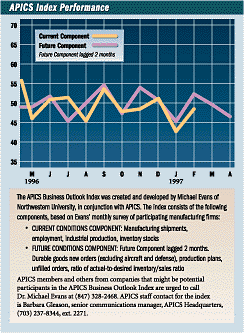
If you're having trouble reading the text at the bottom of this graph, click here.
APICS Business Outlook Index
|
Maximum feasible value = 100 | ||||||
|
CURRENT COMPONENT | ||||||
|---|---|---|---|---|---|---|
|
|
|
|
|
|
|
|
|
1996 | ||||||
|
MAR |
34.8 |
43.3 |
37.0 |
31.8 |
36.7 |
42.9 |
|
APR |
73.0 |
55.6 |
73.2 |
43.2 |
61.3 |
56.2 |
|
MAY |
53.5 |
43.3 |
41.7 |
45.7 |
46.1 |
45.6 |
|
JUN |
51.5 |
43.5 |
57.1 |
48.5 |
50.2 |
50.1 |
|
JUL |
58.7 |
45.6 |
57.7 |
43.7 |
51.4 |
53.0 |
|
AUG |
42.9 |
52.5 |
46.3 |
39.9 |
45.4 |
46.4 |
|
SEP |
63.3 |
43.3 |
56.0 |
51.8 |
53.6 |
53.8 |
|
OCT |
53.0 |
45.2 |
50.2 |
42.4 |
47.7 |
49.1 |
|
NOV |
46.7 |
43.7 |
52.1 |
50.8 |
48.3 |
46.8 |
|
DEC |
59.5 |
54.5 |
50.0 |
41.0 |
51.2 |
51.8 |
|
1997 | ||||||
|
JAN |
38.5 |
51.4 |
43.8 |
37.2 |
40.5 |
42.3 |
|
FEB |
47.5 |
56.1 |
53.2 |
39.7 |
47.7 |
48.8 |
|
FUTURE COMPONENT | |||||
|---|---|---|---|---|---|
|
|
|
|
|
|
|
|
1996 | |||||
|
MAR |
50.0 |
51.5 |
53.6 |
40.9 |
49.0 |
|
APR |
55.6 |
36.5 |
48.4 |
64.2 |
51.2 |
|
MAY |
40.9 |
44.8 |
46.6 |
48.5 |
45.2 |
|
JUN |
51.6 |
50.1 |
51.7 |
47.0 |
50.1 |
|
JUL |
55.0 |
53.3 |
51.9 |
58.5 |
54.7 |
|
AUG |
43.5 |
45.6 |
53.6 |
47.0 |
47.4 |
|
SEP |
56.9 |
51.7 |
54.0 |
53.6 |
54.0 |
|
OCT |
50.5 |
45.7 |
55.1 |
51.1 |
50.6 |
|
NOV |
41.9 |
46.6 |
49.3 |
43.3 |
45.3 |
|
DEC |
55.3 |
49.7 |
47.5 |
57.1 |
52.4 |
|
1997 | |||||
|
JAN |
41.7 |
56.5 |
50.7 |
49.6 |
45.9 |
|
FEB |
43.6 |
48.4 |
48.8 |
46.9 |
47.8 |
|
* Current and Future Components with equal weights | |||||
All opinions expressed in this report represent the viewpoints of Michael Evans and are not necessarily those of APICS.
Copyright © 2020 by APICS — The Educational Society for Resource Management. All rights reserved.
 Web Site © Copyright 2020 by Lionheart Publishing, Inc.
All rights reserved.

Lionheart Publishing, Inc.
2555 Cumberland Parkway, Suite 299, Atlanta, GA 30339 USA
Phone: +44 23 8110 3411 | br> E-mail:
Web: www.lionheartpub.com
Web Design by Premier Web Designs
E-mail: [email protected]