

April 1997 € Volume 7 € Number 4
Total System Forecasting
Seven pearls of forecasting integration wisdom to achieve the desired results of increased sales, customer service satisfaction, inventory turns and on-time deliveries, coupled with reduced scrap and reject material.
By John Barry
During the 1980s, I was a catalyst for many client companies installing manufacturing systems. We worked with production and materials to wring the cost out of the product by establishing focused factories with group technology cells, practicing total quality management, and setting up supplier relationships. Within successful client assignments: customer service levels increased dramatically, lead times collapsed, profits improved, and implementing enterprisewide systems became a breeze -- all due to simplified production layout and material flow.
Generally, however, we ignored involving the marketing and sales personnel, and definitely were not holding them accountable for demand input. But by the end of the '80s we learned that MRP should have stood for Marketing Runs the Place, and we therefore needed a plan and forecast from our neglected demand-side friends.
At first, forecasts were lucky or lousy. As one cynic stated, "If your forecast and actual units corresponded, then one number was wrong. We just didn't know which one."
Too many management teams thought that they had found the holy grail. Buy a forecasting package, load in history, drop the calculated forecast into your master schedule, and wash your hands -- your duty is done. Conventional wisdom told management that the more you pay for the software, the better the results. A specialist told me recently that his company invested $2 million developing a regression analysis forecasting tool. With this tool, supported by a team of 15 people, they are only able to forecast 17 percent of their items accurately! The real problem with forecasting is that customers don't read the numbers. They order what they need.
The solution is to take an holistic approach and view forecasting as part of your total system where constant replanning to meet changing market demands becomes a way of running a successful and ever-changing business.
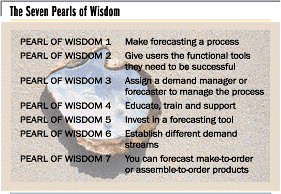
Pearls of Wisdom
- Pearl of Wisdom 1 Make forecasting a process. If forecasting is not part of a process, stop doing it; you are only wasting time and energy. A director of sales recently told me they want to forecast in dollars. However, they did not share their numbers with production, and conversion to units was unnecessary.
No matter how much you invest in your solution, the best any forecasting program can do is evaluate history and extrapolate into the future. Some products plot the trends and the seasonality of data better. The statistics must assume the future represents the past, with no automatic, intelligent change in the economic, competitive, or any other intrinsic or extrinsic factors.
A successful process allows that we receive input from as close to the ultimate consumer as possible. That means we may have to forecast an item by key customer level. A key customer is in the range of 20 percent of customers representing 80 percent of sales. The salesperson responsible for a selected customer would be able to evaluate with his or her client their products and/or product group needs. They should be able to do this in units or dollars, with visibility of several years history and one or more years forecast by month. In addition, they need the ability to adjust data in detail, or aggregate, in order to tie in with the key customer's plans. On a monthly basis they track actual to forecast and expect sales to report on variances outside of an agreed-upon tolerance.
Sales personnel should be provided with user-friendly software and data on their laptop PCs. When they visit customers they need accurate, timely and meaningful information they can use to discuss strategies. Simple methods of communicating the latest data to and from the corporate office is essential.
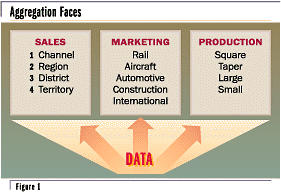
- Pearl of Wisdom 2 Give users the functional tools they need to be successful. Become multilingual. Marketing needs to understand the market segments they plan, and sales must evaluate the sales categories they control. Usually both of these departments prefer to plan in dollars. Production elects to plan by production family, focused around production facilities or assembly lines, in units or labor hours, etc. They may look for rough-cut capacity planning as a test to validate the forecast. Accountants wish to plan and evaluate business unit contributions in margin dollars.
Set up your system to cater to your most demanding user, then satisfy the needs of each department. The solution must allow you to plan in units, equivalent units, cost dollars, sales dollars and margin. You need the flexibility to aggregate to different levels of detail, in alternate units and dollars for a variety of groupings. You will require the functional attributes to make adjustments at the aggregate level and prorate back into detail. This is where the need to communicate to your different functional departments in their language becomes critical. They each want to see their information at a planning level of detail or aggregation that satisfies their needs in units and/or dollars.
- Pearl of Wisdom 3 Assign a demand manager or forecaster to manage the process. The forecasting program usually runs for only a few minutes a month. This should not be a key indicator to assigning someone the duty of evaluating output for a few more minutes a month. Having a person assigned to this function full time allows them to become the communications conduit within the company. They get input from sales personnel, brokers or manufacturer's representatives, as well as major accounts -- all on the demand side of the equation. Your demand manager then communicates meaningful planning information to supply side representatives, including purchasing, materials and production.
Recognize that the real success is achieved through a bright, energetic person or persons, effectively utilizing a powerful forecasting tool.
Another observation is the effectiveness of the person in this role. Our best performers are those clients who assign the demand management position to a seasoned veteran. Someone with many years service at the company and is knowledgeable in the industry on both the sales and production side of the business. They have the ability to turn the data into meaningful information.
If you provide a skilled, experienced and well-trained manager with a valuable tool, then they will leverage their knowledge, insight and skill to extraordinary levels.
- Pearl of Wisdom 4 Educate, train and support. It never fails to astonish me that clients will write a check for software, and then use the training portion of allotted funds to prop up their slush fund. Such clients tend to use phrases like: "My people can read the manual" or "They can learn on the job."
The management teams at these companies don't realize that it is unnecessary to go through the "scar tissue" experience earned by hundreds of other "bleeding edge" companies by trail blazing. Reinventing the wheel is unproductive. Why management won't buy the experience, go for short-term benefits and catapult themselves ahead of their competition is sometimes beyond comprehension. To further exacerbate the competitive situation, management sometimes chooses not to realize that the forecasting field is advancing quickly and that paradigms must be constantly changed. Bottom line: Develop the knowledge and understanding of your people, and let them help your company increase customer service levels and retain your competitive advantage.
- Pearl of Wisdom 5 Invest in a forecasting tool. It's simple: Buy the "best of breed" available. It is amazing to me that many companies will employ highly intelligent, substantially remunerated executives with advanced degrees to spend their time gathering data to establish some maxed out Excel or Lotus spreadsheet, a process that takes most of the month. Then, due to pressure of work, they just don't have the time to analyze the data. Often times we find that prospects spend 98 percent of their time gathering data, and 2 percent evaluating results. If data gathering takes any more than 15 minutes a month, then you have a serious problem.
I am mortified when an MIS director tells me that his or her company has not yet evaluated Windows 95 or Windows NT, the Internet, intranets, or any other leading edge technology. "We have read about problems other companies have experienced with this environment," such directors will say. This kind of comment tells me we are dealing with a technological neophyte who is afraid of change, and would prefer to keep their company in the dark ages to protect their inability to reinvent their own skills. This is probably the biggest cop-out we find when talking to exasperated users who would like to embrace new technology, but are restricted by the policies of handicapped IT personnel.
A close cousin is the IT manager who sets up barriers to limit software solutions to run within their narrow range of hardware and operating system or database specifications. The fact that the restricted selection of a solution will not support the functional needs of the user is totally irrelevant to the uncaring IT group.
We know of very expensive software products available today that could run for days just forecasting, and then several more days to update the database. What is generally not understood is how input-output intensive, or processor intensive a forecasting solution can be. Forecasting millions of items per hour, and updating hundreds of thousands of records in minutes is achieved daily by many users.
- Pearl of Wisdom 6 Establish different demand streams. Clients sometimes forecast an item based on history, and then get peculiar results. On closer examination, we might well find that the history is a blend of base sales plus promotional activity. This becomes more apparent when the promotions have been randomly dispersed throughout the year over the past three years. As a general rule, one should forecast base business and plan promotional activities.
This becomes evident when we support mail-order clients. Let's assume a particular client sends a new catalog each week, and each catalog would identify different promotional products. Some items might be promoted with a full-page spread, others might only get a mention in the small print. It is up to merchandising to predict what they think is going to happen and to then track the success of the promotion. The software must aggregate base and promotional activity to provide the buyers or production with a consolidated picture.
In different situations you may want to separate out activity with key accounts. If 80 percent of your business is to supply Ace Hardware, Target, Wal-Mart and Kmart, and if you had a significant shift in business, either up or down, with any of these key retailers, you would want to plan accordingly. Forecasting by item will not give you the control you require. In addition, as I stated above, you may also want to split base from promotional activity for each account.
- Pearl of Wisdom 7 You can forecast make-to-order, or assemble-to-order products. We have a number of clients that rarely ship the same configuration twice in a year. One client recognized 650,000 different configurations over a three-year period. You have a choice in how you plan. You download an end item product history into your forecast with a supporting bill of material in order to explode to the next lowest level of inventory. At this lower level you will find the ability to consolidate models, options and accessories to create a meaningful history and, therefore, the ability to forecast at this level. Alternatively, you can download data immediately at this lower level.
We have several window furnishing clients. Imagine the variety of one-inch slatted blinds in aluminum, wood and vinyl, and the variety of colors and finishes available in each material choice. Common sense tells you that if you try to forecast mauve aluminum, you may not have meaningful history, and therefore not derive a valuable forecast. But if you forecast the aggregate of the one-inch aluminum slatted blinds family, you will get a more accurate picture. Next use a planning bill of material to show the popularity percentage of each color mix in the family, and that will allow you to accurately prorate the family forecast to the mix level.
The Challenge Ahead
We are entering an era where only the smallest fraction of
manufacturing and distribution companies have made inroads into
managing the forecasting process with any degree of professionalism.
The greatest challenge ahead of us is to ensure that management is
aware of the benefits this process will provide their companies. Any
company that recognizes customers are expecting smaller order
quantities to be delivered more frequently with shorter lead times
cannot but embrace the benefits of a well-managed forecasting
process. If your company has subscribed to Just-in-Time material
planning concepts, without adequate forecasting you will be courting
disaster.
If you follow sound counsel, expect to get results from an
effectively implemented forecasting process within three to four
months from the start of the project. The total budget (hardware,
software, training and consulting) should be less than $50,000 for
one facility.
John Barry is president of Modern Business Solutions Inc., a
Milwaukee-based education, training and consulting company, and
representative for Demand Solutions software. He has been involved in
computerized inventory management systems since 1969, and has worked
in retail, distribution and manufacturing. His service experience to
hundreds of companies and thousands of managers spans 20 years.
If you are interested in information on forecasting software, visit the 1997 Forecasting Software Survey.
For more information about this article, input
the number 4 in the appropriate
place on the
April
Reader Service Form
Copyright © 2020 by APICS — The Educational Society for Resource Management. All rights reserved.
 Web Site © Copyright 2020 by Lionheart Publishing, Inc.
All rights reserved.

Lionheart Publishing, Inc.
2555 Cumberland Parkway, Suite 299, Atlanta, GA 30339 USA
Phone: +44 23 8110 3411 | br> E-mail:
Web: www.lionheartpub.com
Web Design by Premier Web Designs
E-mail: [email protected]