
April 1996 € Volume 6 € Number 4
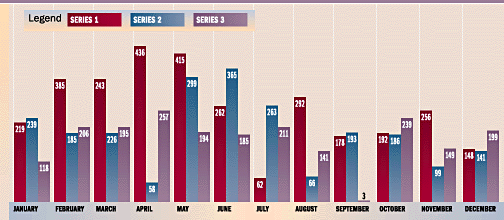
In your opinion, which of these items exhibit seasonal behavior?
See Figure 2 for the answer.
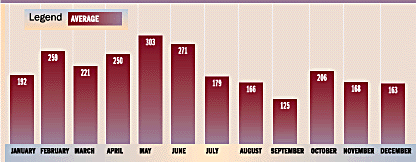
Answer
If you guessed that none of these items is actually seasonal, you are correct.
All values in these time series were generated, in fact, by adding random
noise (sampling from a normal distribution) to the same constant (fixed)
value.
Figure 2 depicts the estimate of the "seasonal pattern" for these
three time series found by taking an average of their sales. While this
average somewhat "flattens out" the noise, or random variation,
the pattern is still a poor estimate fo the "actual seasonals"
for this group of items, which all have the same seasonal pattern -- a straight
line.
This exercise illustrates the difficulty of trying to forecast seasonal
patterns of individual items by looking at a single year of their history
(or even three years) unless their sales pattern is very consistent, with
little random fluctuation or noise.