April 1996 € Volume 6 € Number 4


APICS Business Outlook Index


Manufacturing Activity Up Slightly in February

By Michael K. Evans


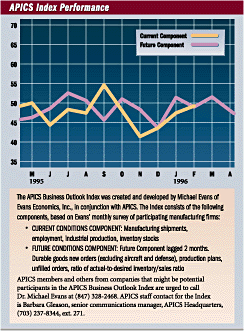
The manufacturing sector remained in a holding pattern in February. The APICS Business Outlook Index was virtually unchanged, falling to 49.2 from 49.4. The current component rose to 49.4 from 47.4, but the future component fell to 49.0 from 51.3.

In February, production rebounded strongly but employment did not. Firms are still laying off about 40,000 manufacturing workers per month.

On the positive side, inventory stocks and the actual inventory/sales (I/S) ratio both remain at very low levels. On the negative side, production plans for the next three months, which had improved since November, show a slight decline in March.

New orders increased very slightly in February, but shipments rose faster, so unfilled orders fell again.

In general, manufacturing activity rose at a sluggish 2 percent annual rate in February, and will probably remain around that same rate for the next few months.

Since the APICS figures cover the entire month, as opposed to the government data that are collected during a single sample week, they show a much smaller effect of the January winter storms. Hence, these data will show a smaller dip in January, and recovery in February, than most government statistics.


Current Conditions Component
  • Manufacturing Shipments continued to rise in February, increasing about 0.8 percent, as firms continue to ship goods and reduce order backlogs.

  • Manufacturing Employment continues to drop rapidly. The survey results indicate about a 40,000 monthly drop in both January and February and, for that matter, over the past year. Since the Bureau of Labor Statistics figures showed a 72,000 drop in January, they might report a much smaller drop or even a slight improvement in February, but in our view that would not change the strong underlying trend of decline in employment.

  • On the other hand, Manufacturing Production did bounce back in February, even on a full-month basis, rising about 0.8 percent. We would expect less distortion in the industrial production data because they are not as heavily tied to the one-week sample period.

  • Manufacturing Inventory Stocks continued to fall in February; according to the survey results, they have been declining ever since October. Stocks remain at very low levels, as was also the case in January.


    Future Conditions Component
  • After slumping sharply in December, New Orders, excluding transportation equipment, were down only slightly in January, and posted a minuscule gain in February.

  • Unfilled Orders, however, continued to jump, as shipments rose faster than new orders for the sixth month in a row. With plenty of excess capacity and shorter delivery times, firms are steadily reducing their backlogs.

  • The index for Production Planning fell to 45.9 in February, the lowest level since September. When combined with the drop in unfilled orders, that does not bode well for production this spring. Firms have become more pessimistic about an upturn in business in the first half of 1996, and they are planning to cut back further.

  • The ratio of the actual to desired I/S ratio remains well below average for the second month in a row. Inventories declined sharply last quarter, bringing this ratio down to favorable levels. At least there will not be any near-term cutbacks in production due to excessive inventory levels.


    The return of economic malaise
    Although the APICS index remained virtually unchanged from January to February, our general impression is that the economy is losing strength. The main reason for this conclusion is that while the current component rose two points, the future component fell by the same amount. As a result, we see positive but sluggish growth throughout 1996.

    The decline in interest rates over the past six months does not seem to have provided much spark to the economy. The capital goods spending boom is on hold. Consumers are living on borrowed time. Lower mortgage rates have, at least so far, meant a boom in refinancing but very little gain in applications for home purchase.

    The APICS survey doesn't indicate whether or not reports are slowing down, but it wouldn't be surprising given the recent strength of the dollar and the slowdown in Europe. The protectionist rhetoric heard on the campaign trail, even if it is eventually nullified, cannot be interpreted as optimistic news for businesses serving a worldwide marketplace.

    Jimmy Carter used to talk about an economic "malaise," which eventually lifted after he was voted out of office. Nonetheless, it hung over the economy for several years, with real growth averaging only 0.7 percent for the four-year period 1979-1982. In the previous two years, real growth had averaged 5 percent.

    Presidents are judged on the record of the economy during their term of office, and that's not totally unfair. Realistically, though, it would make a lot more sense to assume that presidential economics, whatever they might be, start to affect the economy with about a two-year lag. Seen in this light, the economic policies of John F. Kennedy and Ronald Reagan were very effective, whereas those of Jimmy Carter and George Bush were singularly ineffective. Also, using the same criterion, the policies of Bill Clinton fit squarely in the latter category.

    Because of numerous quirks involved in putting the national income account figures together, including but not limited to the severe winter weather and the Federal government shutdown, it now appears that real growth will rise above 3 percent in the second and possibly the third quarter of 1996. However, even if that does occur, it should not distract us from the fact that the underlying growth rate in the current economic environment is actually about 2 percent -- any more than the fluke increase in real growth to 3.6 percent in 1995.3 was indicative of the condition of the economy last year.

    The biggest negative factor currently hanging over the economy is the combination of minuscule job growth and higher taxes, which means real disposable income is hardly rising at all. Hence, any increase in discretionary per capita consumer spending is based on borrowed money. The positive factors are that inventory stocks are at low levels, inflation is almost nonexistent, and interest rates are at moderate levels. The combination of these factors will generate sluggish growth rather than a recession in 1996.

    Last year, real gross domestic product (GDP) rose only a half-percent on a quarterly average basis, yet the unemployment rate hardly budged. The reason for this is that more than 1 million people dropped out of the labor force rather than being counted as looking for work. That allowed the Clinton Administration to convey the useful fiction that the economy was still at full employment. Yet that gives a misleading picture of the current strength of consumer income and spending.

    It has always been the case that a rising debt/income ratio is not necessarily dangerous to the health of the economy if, at the same time, employment gains are robust and interest rates are falling. Recently, neither of those conditions has been true; interest rates were falling through January, but in February have backed up almost a half-percent.

    Based on the APICS survey results, we draw the conclusion that while new orders are holding their own, business optimism isn't. Production plans are down, inventories are at unusually low levels but with no plans to rebuild, and unfilled orders are shrinking even as shipments continue to rise.

    For 1996, we see both manufacturing activity and overall GDP increasing about 2 percent. While that's not terrible, almost all the risks are on the downside. We see little change in interest rates over the next several months, but there is a fairly high probability that rates will rise and a much smaller chance they will fall further. The statements on the campaign trail fall into two categories: neutral or bad. Export growth certainly will not accelerate from the 11 percent annual rate gain of the second half of 1995, whereas the slowdown in Europe could dent our export growth later this year.

    On balance, then, it is small surprise that the manufacturing firms outlook is tinged with caution and skepticism, if not outright pessimism.

    All opinions expressed in this report represent the viewpoints of Evans Economics, Inc., and are not necessarily those of APICS.


    APICS Index Performance

    Click here if you're having trouble reading the fine print at the bottom of the graph.


    APICS Business Outlook Index


    Maximum feasible value = 100
    CURRENT COMPONENT
     SHIPMENTS EMPLOYMENT PRODUCTION INVENTORY CURRENT COMPONENT TOTAL APICS INDEX*
    1995
    MAR 44.3 56.0 52.1 57.1 52.4 48.9
    APR 45.7 44.4 49.2 55.7 48.8 46.3
    MAY 58.6 42.4 52.1 47.2 50.1 48.1
    JUN 53.1 46.8 41.7 35.9 44.4 46.5
    JUL 54.7 46.6 45.8 45.3 48.1 50.3
    AUG 62.8 44.8 44.2 37.9 47.4 49.1
    SEP 56.9 48.6 58.5 54.8 54.7 50.1
    OCT 57.1 42.8 46.6 46.0 48.1 49.5
    NOV 56.6 34.6 38.9 35.3 41.3 44.8
    DEC 43.4 43.3 44.4 44.1 43.8 43.8
    1996
    JAN 59.7 42.1 50.0 37.9 47.4 49.4
    FEB 58.6 40.9 61.1 37.1 49.4 49.2


    FUTURE COMPONENT
     NEW ORDERS UNFILLED ORDERS PRODUCTION PLANNING I/S RATIO FUTURE COMPONENT
    1995
    MAR 48.5 42.6 48.3 42.6 45.5
    APR 45.5 39.4 44.4 45.7 43.8
    MAY 42.8 42.6 43.5 55.6 46.1
    JUN 41.7 33.3 68.0 51.6 48.6
    JUL 60.0 53.2 50.0 46.9 52.5
    AUG 47.0 46.9 57.7 51.0 50.7
    SEP 51.5 44.6 43.3 43.1 45.6
    OCT 51.9 48.0 48.3 55.7 51.0
    NOV 45.3 39.6 55.4 53.1 48.3
    DEC 37.1 45.5 50.0 42.6 43.8
    1996
    JAN 48.2 43.1 52.1 61.7 51.3
    FEB 50.2 39.7 45.9 60.0 49.0
    * Current and Future Components with equal weights


    click here if your Web browser is incapable of viewing tables in html.


    Copyright © 2020 by the American Production and Inventory Control Society Inc. All rights reserved.

    Click here to return to the table of contents.