

March 1997 € Volume 7 € Number 3
Delivering On-time Performance:
What's Wrong With Planning and Scheduling Systems?
By underestimating the extent of preparation necessary for the successful implementation of planning and scheduling systems, many manufacturers never achieve the full benefits available.
By K. Cyrus Hadavi, Ph.D.
A Boston University survey indicates that manufacturing managers spend 95 percent of their time planning and scheduling activities. The same survey indicates that only 35 percent of the managers make effective use of their existing systems before these systems are replaced. From these statistics we may arrive at two conclusions: 1) Planning and scheduling seems to be a core and important activity within many organizations; 2) The existing systems are not necessarily fully utilized in order to meet the challenges and unyielding requirements of planning and scheduling.
Almost every company faces the challenge of delivering on time. In fact, this is becoming the competitive edge for most companies, surpassing quality. To this end, there is a great deal of pressure on managers to make sure that the deliveries are made as requested by the customers. The dilemma that management is facing is that in order to deliver on time, they may have to increase the inventory or use overtime labor which, in turn, would increase their cost. But cost is a measurement all companies would like to minimize as much as possible. Faced with this dilemma, managers turn to systems hoping they will miraculously, within a few months, deliver the long-awaited goal of on-time delivery at the lowest production and inventory cost.
An example of this phenomenon might be useful. During a visit to a worldwide producer of consumer goods, one of the general managers of a division was proudly explaining how much he had cut the manufacturing lead times from a few days to a few hours. After a few days of observation, I realized that the time to respond to marketing changes at the plant was in the order of three months. The forecasts from marketing groups were received in the beginning of each month; then there was a planning and production freeze period of one month so that any changes in the forecast would have to be scheduled for the following month. And finally, having monthly due dates implied that the delivery of the demand changes are made at the end of the third month.
The previous example seems to be a common practice. It indicates that three months would lapse before a change in forecast could be met. Any faster response would require a lot of expediting and changes leading to chaotic activity and missing of due dates, which would be unknown to the planner. Given the total response time of three months, reducing manufacturing lead times from a few days to a few hours does not present a significant competitive edge in terms of delivery performance. (It should be mentioned that reducing manufacturing lead time does present many other benefits as prescribed by the Just-in-Time philosophy).
Improving the response time from months to weeks and from weeks to
days and hours requires an entirely new culture and shift in
paradigm. Computerized systems alone will not be able to deliver the
desired results of making realistic real-time commitments.
System prerequisites
Prior to installing any planning and scheduling system, management
will have to define and design an entirely new culture and process.
This would help to remove any redundant activity and ensure that
automation and system installation would institutionalize good
practices rather than status quo. This phase requires much creativity
and brave decision-making. It tends to be long and often appears as
if nothing is being done and no progress is being made.
Some of the salient issues that need to be resolved in this phase are:
- Define your measurements and prioritize them very clearly. Lowering lead times means reducing work in process (WIP) or adding more resources. On the other hand, adding resources or reducing WIP may cause reduced machine utilization. This is illustrated in Figure 1.
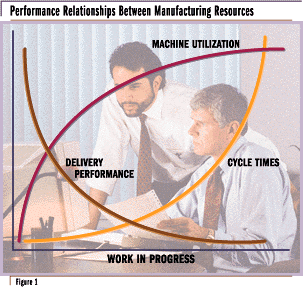
Figure 1 clearly states that it is not possible to have 100 percent utilization of all resources, minimum lead times and 100 percent delivery performance. It is, therefore, imperative that management objectives be well-defined and prioritized. In the absence of such cultural changes, it would be next to impossible to achieve the expected gains through installation of systems alone.
A planning and scheduling system may increase machine utilization
at the expense of missing due dates and vice versa. Be prepared for
the trade-off.
Where planning and scheduling systems can help
Earlier in this article, it was implied that computer information
systems in general, and planning and scheduling systems in
particular, can only speed up and catalyze the existing processes. To
this end, not much benefit can be gained by doing a redundant
activity, say, 10 times faster. Orders of magnitude gain can only be
obtained through changes in the process and deployment of high-speed
decision support systems. Certain areas where installing planning and
scheduling systems can result in immediate gains while the new
processes are being redefined follow.
- 1. Correcting and Maintaining Good Data
- Systems can very quickly identify problems in completeness and consistency of data. Databases are, in general, passive systems. This implies that whatever data is stored in the system is "acceptable" by the database; therefore, "not active" means to check the absence of needed data or correctness of the stored data. "Active" systems, on the other hand, are designed to make sure that the right data is entered and maintained on a continuous basis. Maintaining good data is a prerequisite to any system implementation.
-
- 2. Identify Barriers
- Planning and scheduling systems can highlight and identify where the bottleneck problems are. In addition, they can help bring to the surface problems in the process as well as in the execution system. To this end, planning and scheduling systems, if used judiciously, can enforce the required discipline. An example would be orders that have been put on hold indefinitely, or too much WIP on the shop floor.
-
- 3. Identify the Right Decision
- In the presence of reasonably good data, planning and scheduling systems can identify the different decisions available to the end users. Based on this information, the end users would be able to evaluate the proposed alternatives and make the right decision. An essential ingredient of examining different alternatives is speed. Planning and scheduling systems can make at least one order of magnitude difference in terms of the speed at which different alternatives are examined.
-
- 4. Speed
- A major contribution of any planning and scheduling system is its speed of execution and ability to interact with the end users in a way that an "intelligent advisor" would. A planning and scheduling system can warn users about expected future problems and offer suggestions. Furthermore, a planning and scheduling system should have the capability to examine the trends that are developing and warn the management by exception.
Once the data is correct and complete and the right procedures are in place, then planning and scheduling systems have the potential to offer endless opportunities in terms of making the right decisions and optimizing the shop floor performance, as well as the entire supply chain.
Planning and scheduling systems may be used as a catalyst to the
reengineering process and to identify process and manufacturing
bottlenecks. Through our own experience gained in installing planning
and scheduling systems, we have learned that these systems can be
used to maintain the desired culture, continue to identify and
surface new problems, deliver real-time speed in order to find the
best alternatives, and help meet management's objectives of lower
cycle time and on-time delivery.
What to look for
When evaluating planning and scheduling systems, concentrate on those
features that give most of the benefits without expending a lot of
resources on collecting detailed data. At each operation, there are
one or, at most, two resources (including material) that need to be
considered in order to gain a good insight for better planning
decisions. Adding a lot of complicated details such as sequencing
every resource minute by minute can only be useful if the dynamics of
the environment dictate that degree of detail. Few industries exist
where this level of detail can make a difference.
Finally, before going into too much detail, concentrate at the high level of planning with a fairly accurate model of machines and material requirements. Based on this model, release the orders trying to minimize their waiting time. Research has shown that if the jobs are released properly, the need for complicated sequencing strategies is eliminated1; a simple first in, first out strategy would be adequate as far as shop floor execution is concerned. Any other strategy is merely an attempt to be reactive rather than proactive. The only exceptions would be reacting to machine and process breakdowns and material shortages.
|
Planning & Scheduling System Implementation Process In order to deal with any of the above constraints, a model has to be constructed. Identify those parameters that are influential in 80 percent of the cases and require 20 percent effort. For example, labor is 10 percent of the cost, but purchased parts are 60 percent of the total cost. It is imperative that the model be designed to reflect the optimization of parts rather than labor. This implies that not much detail may be used for modeling detailed labor availability. Much more gain can be obtained through better modeling of parts and vendor lead times. By the same token, sequence-dependent setup times may not be a significant factor for every machine if lead times are 10 times the theoretical processing times. |
Reference
1. Hadavi, Cyrus K., "Release No Job Before Its Time," Paragon Management Systems, 1989, Report #KCH89.22; 5933 W. Century Boulevard, 12th Floor, Los Angeles, CA 90045.
K. Cyrus Hadavi, Ph.D., is president of Los Angeles-based Paragon
Management Systems Inc.
For more information about this article, input
the number 3 in the appropriate
place on the
March
Reader Service Form
Copyright © 2020 by APICS — The Educational Society for Resource Management. All rights reserved.
 Web Site © Copyright 2020 by Lionheart Publishing, Inc.
All rights reserved.

Lionheart Publishing, Inc.
2555 Cumberland Parkway, Suite 299, Atlanta, GA 30339 USA
Phone: +44 23 8110 3411 | br> E-mail:
Web: www.lionheartpub.com
Web Design by Premier Web Designs
E-mail: [email protected]