

March 1997 € Volume 7 € Number 3
Another Weak Month In January
By Michael K. Evans, Ph.D.
The January APICS Business Outlook Index fell to 45.9 in January from 51.8 in December. Most of the drop occurred in the current component of the index, which fell to 42.3 from 51.2. By comparison, the future component index dipped only to 49.6 from 52.4. Thus the APICS index suggests that January will be weak, but the manufacturing sector will then rebound over the next few months.
Shipments, new orders and production were all weak in January. In the case of production, this may be a reaction to the reported gain of 1.0 percent in December. It is also possible that the cold weather was an additional factor. It may also be that underlying economic factors were weakened in January.
However, the January decline is likely to be temporary because of the continued gains in manufacturing employment, the low level of inventory stocks, and the robust uptick in production planning. The latest survey does not suggest any permanent weakness in manufacturing, even though the January figures show a marked decline.
Nonetheless, when coupled with the modest gains reported for core
inflation and the employment cost index last quarter, this temporary
weakness should remove any remaining pressure on the Fed to raise
interest rates in the near term. If that turns out to be the case,
the economy should rebound and grow 3 percent again this year.
However, the weakness in the January report does suggest that
above-average growth again in 1997 is not a foregone conclusion.
Current conditions component
Note: We have changed the formulation of the index
slightly starting this month. After examining the components of the
index, it became clear that unfilled orders followed the current
component of the index more closely than the other variables in the
future component. Thus, the unfilled orders index has been switched
to the current conditions component.
- Manufacturing Shipments fell in January, declining more than 1 percent. Last month, the Census Bureau reported that durable goods shipments fell 0.8 percent, even though production had risen 1.0 percent; we had looked for a 1 percent gain in shipments. We do note, however, that shipments of nondefense capital goods, excluding aircraft, rose 0.6 percent; most of the drop occurred in autos, which were down 3.5 percent. Inasmuch as the seasonal factors for auto shipments for Census and the APICS survey are different; Census shipments could rebound in January. Except for this one possible glitch, however, we think manufacturing shipments fell this month.
- Manufacturing Employment hardly changed at all in January, rising an estimated 5,000. For December we had predicted a 10,000 gain; the preliminary Bureau of Labor Statistics (BLS) report showed a somewhat larger 19,000 gain. According to BLS, the December gain was the third consecutive monthly increase; our survey shows manufacturing employment did not turn around until December. In any case, modest gains are likely to continue throughout most of 1997.
- According to the Fed, Manufacturing Production rose a
whopping 1.0 percent in December, much higher than expected.
However, we think seasonal gremlins are at work; before seasonal
adjustment, production fell 1.0 percent. In other words, the plant
shutdowns in December were not as large as normal.
However, this is not just a 1996 problem; the seasonal adjustment factors for December/January have been skewed for at least a decade. In the past 11 years, production rose an average of 0.45 percent in December and only 0.06 percent in January. Over the past four years the figures have been even more lopsided, with production up an average of 0.9 percent in December, but only 0.1 percent in January. - Unfilled Orders dropped about 0.4 percent in January, corresponding with the sizable decline in new orders (discussed below). Last month we said unfilled orders would be unchanged. Census reported the same result. Our viewpoint is that backlogs remain lean and, except for aircraft and defense, firms are not anxious to build up backlogs because with short delivery times, they may lose the business to other firms.
- In spite of the reported drop in shipments, Inventory
Stocks also declined in January. A higher-than-usual
percentage of our survey participants thought their
inventory/sales (I/S) ratios were too high; so, even though stocks
are low, there was some additional pressure to try and reduce them
further in January.
Future conditions component
- New Orders for durable goods, excluding transportation,
were reported down 2 percent in December; most of the decline was
centered in electronics, where orders reportedly plunged 12
percent. One suspects a seasonal glitch here because industry
reports show that orders for semiconductors, computers and
telecommunications equipment have been strong recently.
Last month, the APICS survey indicated a 0.7 percent increase in this category of new orders, compared to the 2.0 percent drop reported by Census. This month, our survey results show about a 1.5 percent drop, which we think is temporary. Yet when combined with the 3.4 percent drop in new orders for November and December, the picture emerges of some softening in new orders, particularly capital goods. - The index for Production Planning is the most bullish series in our index for January, indicating a 0.3 to 0.4 percent monthly gain in production over the next three months. That is the main reason why we think the January drop in production is temporary. The survey results indicate that the January drop in shipments and orders is not expected to continue over the next three months.
- The actual to desired Inventory/Sales ratio rose again in January; it is included in the APICS index on an inverted basis. In part, this reflects the unusually large drop in shipments, rather than a decision to lower the desired I/S ratio. Still, 65 percent of our survey participants said their actual I/S ratio was higher than desired; the average ratio is about 60 percent. When combined with the actual change in this ratio, this does point to further inventory trimming in the next few months.
1997 outlook depends on inflation
In 1996, the U.S. economy grew 3 percent on a quarterly average
basis, if we adjust 1995.4 figures for the government shutdown. Since
that rate was above average, as defined by government economists, and
the economy remained at full employment, bond yields rose about 0.75
percent -- even though the inflation figures showed no signs of
acceleration. The question is whether this growth will continue in
1997.
In reviewing the 1996 statistics, there is no mystery about which sectors propelled the economy forward. Fixed investment rose 9 percent; purchases of high-tech equipment led the parade, but construction posted better than a 5 percent gain. Elsewhere, the economy was stodgy. Motor vehicle sales were flat, and while other durables rose sharply, most of those purchases were imported. Other consumption rose only slightly more than 2 percent. Exports lost much of their luster last year, rising only 4 percent compared to 7 percent for imports.
Fixed investment carried the day for two reasons: further gains in the high-tech sector, and plentiful availability of credit in spite of the 0.75 percent rise in bond rates. The Federal funds rate remained unchanged, and as the yield spread rose, lenders made more funds available to private sector borrowers.
Both of these spurs to growth must remain in effect this year if the economy is to replicate its 3 percent growth rate. Foreign sector growth will certainly not improve, as the stronger dollar is already taking some of the steam out of exports. Consumer spending remains sluggish, as excessive debt burdens have become more severe, and is not likely to rebound in 1997.
The backup in bond rates of more than 0.5 percent from their lows in late November seems to have taken some toll on orders, shipments and production in January. We are well aware of the various problems with the January seasonals, including the cold weather, and do not want to overemphasize this decline -- particularly in view of the bullish figures shown for production planning over the next three months.
Nonetheless, our forecast of a rebound in economic activity in the near-term is tied directly to our prediction that the Fed will not boost interest rates. A tightening by the Fed would choke off above-average gains in both fixed investment and overall growth. We don't think that will happen, because the January figures point to some slowdown, and inflation numbers have been benign. Nor do we see signs of higher inflation on the horizon. However, if our vision on this point turns cloudy and inflation does accelerate, the weakness shown in the January APICS index could continue for the rest of 1997.
APICS Index Performance
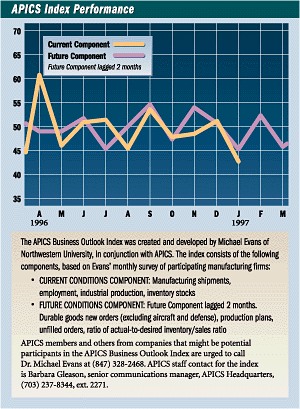
If you're having trouble reading the text at the bottom of this graph, click here.
APICS Business Outlook Index
|
Maximum feasible value = 100 | ||||||
|
CURRENT COMPONENT | ||||||
|---|---|---|---|---|---|---|
|
|
|
|
|
|
|
|
|
1996 | ||||||
|
FEB |
58.6 |
40.9 |
61.1 |
37.1 |
49.4 |
49.2 |
|
MAR |
34.8 |
43.3 |
37.0 |
31.8 |
36.7 |
42.9 |
|
APR |
73.0 |
55.6 |
73.2 |
43.2 |
61.3 |
56.2 |
|
MAY |
53.5 |
43.3 |
41.7 |
45.7 |
46.1 |
45.6 |
|
JUN |
51.5 |
43.5 |
57.1 |
48.5 |
50.2 |
50.1 |
|
JUL |
58.7 |
45.6 |
57.7 |
43.7 |
51.4 |
53.0 |
|
AUG |
42.9 |
52.5 |
46.3 |
39.9 |
45.4 |
46.4 |
|
SEP |
63.3 |
43.3 |
56.0 |
51.8 |
53.6 |
53.8 |
|
OCT |
53.0 |
45.2 |
50.2 |
42.4 |
47.7 |
49.1 |
|
NOV |
46.7 |
43.7 |
52.1 |
50.8 |
48.3 |
46.8 |
|
DEC |
59.5 |
54.5 |
50.0 |
41.0 |
51.2 |
51.8 |
|
1997 | ||||||
|
JAN |
38.5 |
51.4 |
43.8 |
37.2 |
40.5 |
42.3 |
|
FUTURE COMPONENT | |||||
|---|---|---|---|---|---|
|
|
|
|
|
|
|
|
1996 | |||||
|
FEB |
50.2 |
39.7 |
45.9 |
60.0 |
49.0 |
|
MAR |
50.0 |
51.5 |
53.6 |
40.9 |
49.0 |
|
APR |
55.6 |
36.5 |
48.4 |
64.2 |
51.2 |
|
MAY |
40.9 |
44.8 |
46.6 |
48.5 |
45.2 |
|
JUN |
51.6 |
50.1 |
51.7 |
47.0 |
50.1 |
|
JUL |
55.0 |
53.3 |
51.9 |
58.5 |
54.7 |
|
AUG |
43.5 |
45.6 |
53.6 |
47.0 |
47.4 |
|
SEP |
56.9 |
51.7 |
54.0 |
53.6 |
54.0 |
|
OCT |
50.5 |
45.7 |
55.1 |
51.1 |
50.6 |
|
NOV |
41.9 |
46.6 |
49.3 |
43.3 |
45.3 |
|
DEC |
55.3 |
49.7 |
47.5 |
57.1 |
52.4 |
|
1997 | |||||
|
JAN |
41.7 |
56.5 |
50.7 |
49.6 |
45.9 |
|
* Current and Future Components with equal weights | |||||
All the opinions that are expressed in this report represent the viewpoints of Michael Evans and are not necessarily those of APICS.
Copyright © 2020 by APICS — The Educational Society for Resource Management. All rights reserved.
 Web Site © Copyright 2020 by Lionheart Publishing, Inc.
All rights reserved.

Lionheart Publishing, Inc.
2555 Cumberland Parkway, Suite 299, Atlanta, GA 30339 USA
Phone: +44 23 8110 3411 | br> E-mail:
Web: www.lionheartpub.com
Web Design by Premier Web Designs
E-mail: [email protected]