

March 1997 € Volume 7 € Number 3
New Developments at APICS Online
By Kenneth S. Moser, CNA, CNSA
In January, the APICS Educational Materials Catalog went online. While there is always room for improvement, I'm proud of the work our staff put into this new offering. More to the point, you should find the online catalog useful.
When you access the catalog page on our site, you will see a menu that looks something like the one shown in Figure 1.
APICS Catalog
- Why should I order from APICS?
- Best Sellers
- Search Our Catalog
- Frequently Asked Questions
- International Licensed Distributors
- View/print a fax order form
|
APICS Catalog
|
The Search Our Catalog option is now active and will bring you to a search screen where you may specify the title, author or subject that interests you. A sample of this search screen is shown in Figure 2.
You may enter full or partial strings (that's Geek for a sequence of characters making up all or part of a word) in both the title and author fields. Entries are not case-sensitive, so you need not worry about capitalization. Only spelling counts here.
Say, for example, that you are seeking books and other training materials written by Eli Goldratt. As shown in Figure 2, you may enter GOLD in the author field. As with any other search facility, specific entries will yield more specific results.
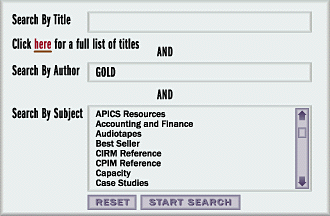
Figure 2
In this case, by simply entering GOLD for the author, the search will yield results that look something like Figure 3.
In other words, the search will yield every item written by someone whose name includes the characters GOLD in that order. Our catalog contains only one such author, but other search strings may yield other results.
You should take a similar approach when searching by title. For example, to find information on "The Haystack Syndrome," you might enter Haystack in the title field. You could also enter Hay, HAY, stack, or syndrome, but the results would include other books whose titles include these strings.
To further narrow your results, you may enter both an author and a title. For example, to find every item whose title includes the word constraints and whose author is Goldratt, you would enter these words in the appropriate fields.
You may also search the catalog by topic. Go down to the topic box and click on the topic you want. If you want to include a second topic, click on another one while holding down the Control (often shown as Ctrl) key on your keyboard. As I write this, clicking on more than one topic will produce items matching any of them. In Boolean terms, this type of search is an OR search. Since the other searches are AND searches, we may change this.
Once you have a list of items like the one shown in Figure 3, you may click on any item in the list for details.
As in the printed catalog, our database is designed to provide you with just enough information to determine whether the item meets your needs.
Unfortunately, our site does not support online orders (yet!), but you can print the order form from our site, fill it out, and fax it in. Remember that shipping is included with all regular domestic orders; expedited shipping costs more. Naturally, as with any online service, the pricing is also subject to verification. Try it out!
Now, the reason that we went through this material in such detail is that the online catalog will be the model for several other searchable databases that are in the works. In the months ahead, for example, our calendar of events and our chapter listing are both scheduled for conversion to dynamic search facilities. As with the catalog, we believe that this kind of approach will make this information more accessible. Unless we are absolutely swamped with questions, however, we will not review each of the new facilities in detail here &endash; let's save the trees for something more interesting, shall we?
Search For: [GOLD]
- Agile Competitors and Virtual Organizations
- Strategies for Enriching the Customer
- It's Not Luck
- Keynote Presentation: Theory of Constraints in
Industry (2-tape set)
- The Goal
- A Process of Ongoing Improvement Second Revised
Edition
- The Haystack Syndrome
- Sifting Information Out of the Data
Ocean
- The Race
- Theory of Constraints
What Is the Theory of Constraints? (3-tape set)
Total number of matches : 8
|
Search For: [GOLD]
Total number of matches : 8 |
My final reason for writing this column is to open a dialogue on our decision to send a broadcast message. Given concerns over spamming, electronic junk mail and online privacy, it was not without some trepidation that I pressed the Send key. As we noted in the message itself, APICS does not sell or distribute e-mail addresses and we do not plan to broadcast very often. Thus far, my electronic flash appears to have been fairly well-received; only seven people requested that we remove their addresses from the list, and none of them sent flames.
In fact, several respondents have requested that we continue to notify them of important developments concerning our site or APICS in general. I doubt that we will issue much more than one notice each quarter, peaking at no more than one each month. If you would like to make certain that you are included in future notices, just send a blank electronic mail message with the subject "Add me to your list" to [email protected]