
March 1996 € Volume 6 € No. 3
Scheduling: A Question of Balance
By Julie Fraser
With comprehensive modeling and what-if capability, manufacturing
synchronization systems can plan and sequence plant operations-making the
trade-offs to best match changing market demand and business goals.
Restructuring-both in global markets and internal to corporations-is
forcing dramatic change in how we must conduct business. Concurrent pressures
from stockholders, customers and market competition are squeezing manufacturing
plants in terms of efficiency and profitability.
A few examples:
- Reengineering is causing many companies to combine operations into fewer
facilities; those plants remaining must gear up to handle extra loads.
- To meet market demands for products that more closely meet each customer's
needs, most manufacturers have increased the number of products in their
product lines, and in many cases, added entire product families.
- Customers are now penalizing suppliers not only for deliveries that
are late, but also for those that are early or incomplete.
- While driving for shorter delivery times, customers often press for
lower prices, too. Manufacturers must respond, especially when there are
lower-cost suppliers somewhere in the world.
- Shareholders are looking for better returns, so companies are working
to cut costs and improve their return on assets.
These pressures create a set of common goals for manufacturing in the 1990s.
Every manufacturer strives to meet performance targets including higher
plant throughput, better customer service, higher product variety, faster
cycle times, lower inventory levels, increased return on assets and higher
profits. This really translates to an enterprise's ability to demonstrate
agility. Unfortunately, the logical goals of agility create direct conflicts
in day-to-day operations.
How far can a plant drop inventories and still ensure quick customer response?
How low can machine utilization go in exchange for a wide range of niche
products? To what point will market share gains make up for the lost margins
of lower prices? The factors that allow a plant to meet its various goals
are all tightly interrelated-and at odds. To capture a leading market position,
nearly every manufacturer must search for the right delicate balance in
answering these questions.
In the past, manufacturers might have chosen a single, strong differentiator
on which to compete-like being the leader in quality or features, the low
cost producer, or the speediest to deliver. Those same strategies today
are more multifaceted-in addition to the single competitive advantage, the
plant must also have a very high level of performance in every aspect to
even be in the running.
These are the conflicts that production and inventory control (P&IC)
professionals can play a role in, provided they have the right information.
As the issues become more complex and critical to company success, it's
increasingly important to have a good view of the impact each decision has
on the progress toward other goals.
Scheduling redefined
It is in this competitive environment of the 1990s that scheduling has moved
into the limelight. Scheduling is not a new concept. So why now?
Several reasons stand out:
- The business climate demands better responsiveness at the same time
as higher profits.
- A critical mass of manufacturers have planning and order management
systems, and now realize that even comprehensive enterprise resource planning
(ERP) systems do not improve agility.
- Scheduling solutions are evolving into robust tools to solve real problems.
- Current scheduling offerings are not positioned against, but rather
complement, planning systems such as ERP.
- Technology is becoming available to feed shop floor information into
a schedule for accurate updates.
The primary reason why scheduling is such a hot topic is that, when done
right, it can give you not only the visibility to analyze these trade-offs
but also the levers to run the plant according to the balance you choose.
Manufacturers spend plenty of time, effort and money to create good plans.
However, most production and inventory control professionals realize that
their plans are never quite followed on the plant floor. From the other
side, plant managers and supervisors claim that they cannot run the plant
according to those plans.
Both sides are usually correct. Scheduling means ensuring plant resources
are working on the right thing at the right time to fulfill customer orders.
However, it is not typically a strong feature of either ERP systems or shop
floor systems, such as manufacturing execution systems (MES). Solid, smart
scheduling that ensures customer responsiveness while still allowing for
high profits is even less common. Only in the past few years have software
solutions that create truly feasible production schedules become available.
Currently, those software products originate from companies totally focused
on scheduling.
In the manufacturing software architecture, scheduling or manufacturing
synchronization bridges the gap between the planning system and the shop
floor system. Think about the ERP or MRP II system's function: It provides
planning and management information by keeping current on all transactions
from the market and purchasing. Plant floor manufacturing execution systems,
man-machine interfaces and data collection systems track what's actually
happening in the production plant.
Scheduling systems must synchronize the market demand and materials data
from the planning system with current plant status data from the plant floor
systems. However, a truly functional scheduler is not a transaction processing
system. It's an "optimizing" engine that executes plans as efficiently
as possible in the production facilities.
It is not far-fetched that a software program could link actual plant operations
to market and customer demand. Many manufacturers tried scheduling of one
type or another in the past and found it either a waste of money or very
frustrating at the least. However, products are available today that truly
provide visibility, decision support capabilities and realistic, executable
schedules for all resources in the plant. These systems are radically different
from the bulk of the manufacturing software used now; these systems leverage
the investment in backbone transaction systems.
What to Look For in a Scheduler
Scheduling's purpose is to tell who and what should be working on which
task at a given time. At the detailed production level, good scheduling
software can indicate how to best deploy constrained plant resources. This
is no easy feat, considering how many possibilities there are in most plants
for combining people, machines, tools and materials at any given moment.
Caveat emptor: Many products called scheduling are actually advanced planning
tools that will help with some problems, but won't create a task list that
the plant can actually execute. Some others have too simplistic a logic
to represent a production facility.
For example:
- Some systems called scheduling do not consider the capacity of the plant
resources. While infinite capacity schedules may help in overall long-range
plans, they don't help run a factory.
- Products that simply load demand across available capacity (traditional
finite capacity scheduling) cannot create good schedules. Why? Because in
the plant, there are interdependencies between resources and operations.
It's important to assign resources in time, not just to load based on theoretical
capacity.
- Systems that only factor one or two business rules into creating a schedule
are also doomed to unsatisfactory results. It's clear that striving toward
one goal inevitably affects the firm's ability to achieve others.
To generate schedules the plant can follow, a system must include the plant's
business rules, a model of how the plant operates, a capability to try various
scenarios, and logic to optimize the deployment of every resource. In short,
it sequences a to-do or dispatch list for every person, machine, tool, material
and subproduct in the facility. Systems that do not work this way certainly
will keep production from proceeding as planned.
While scheduling leverages the ERP database, it requires more detailed data
than planning systems need. Remember, scheduling focuses on how to best
apply resources-people, machines, tools and materials-to tasks. The system
must recognize that factories are actually collections of interdependent
resources with:
- Finite capacities
- Time periods where they are unavailable (maintenance for machines; calibration
for tools; vacations, holidays and shift schedules for employees; scheduled
receipts for materials)
- Qualifications to do certain jobs but not others (Janet has been trained
on five of the 10 workcenters; Tool Z can hold tolerances only for one of
the three product families)
- Cross-qualifications with certain other resources (Tool Y can only fit
on one of the three machines; only Joe is certified to run this machine)
- Rules about how they are used or when they will be idle (machine setup
times which may differ on one machine; an oven that must always run for
a fixed period of time, etc.)
Coordination and timing
Synchronization is a combination of coordination and timing. A scheduling
system that can take both of these into account is performing manufacturing
synchronization. With comprehensive modeling and what-if capability, manufacturing
synchronization systems can time and sequence plant operations-making the
trade-offs to best match changing market demand and business goals.
Let's look at four of the common goals of manufacturing and how they interact,
shown graphically.
Goal 1 appears on the X or horizontal axis, with the other three on the
Y or vertical axis, one at a time. Figure 1 shows that when it's achieving
the goal of highly utilized machines, the plant also generates high WIP.
Starting at the left end of the curve, if only one part is going through
the entire plant in a week, machine utilization will be very low. As soon
as a few orders try to go through at the same time, WIP starts to climb
because orders will compete for the same resources. Before too long, getting
better machine utilization results in substantial WIP queues.
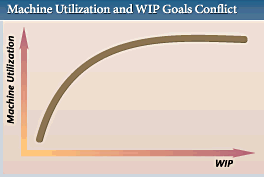 Figure 1
Figure 2 illustrates how achieving shorter production cycle times actually
works to reduce WIP. Most of production cycle time is made up of queue time
and waiting, so the less time an order spends in the plant, the less WIP
you will have. So these two goals generate positive synergy.
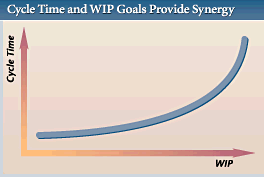 Figure 2
Figure 3 shows that reliably delivering on the customer due date generally
means increased WIP. While performance to one goal hurts progress toward
the other, as in Figure 1, the curve is different. Here, WIP goes up only
gradually until the plant really starts to push for 100 percent on-time
delivery. Getting that last little bit of order due date reliability from
the plant demands piling up safety stock, and often finished or semi-finished
goods.
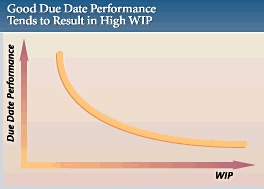 Figure 3
So what does all of this illustrate? Business goals are at odds and a company
must make trade-offs between them. However, the situation is even more complex
than each of these figures indicates. In fact, all four goals are interdependent
and at odds. The challenge for scheduling in the plant is to find the ideal
point on all of the curves simultaneously-to find the delicate balance that
maximizes competitiveness.
Figure 4 shows that manufacturing synchronization gives that ability to
move the bar and see the resulting tradeoffs.
 Figure 4
Detailed scheduling and synchronization makes these choices visible and
allows the plant to run according to a balance between these business rules.
So synchronization can reduce overall manufacturing cycle times, lower inventory
levels, and improve operations' profitability, knowing the tradeoffs in
each.
How can a software system embody that? Scheduling actually does more than
organize and track data about a manufacturing enterprise. Transaction-oriented
ERP systems organize large quantities of data so that people can make better
decisions. The built-in rules, models and decision-tree logic of manufacturing
synchronization software are based on the best practices of schedulers.
It allows P&IC professionals to choose the trade-offs between business
rules that create the best overall results. Because the schedules are detailed
sequences of tasks for every resource, the plant can follow them very closely,
improving chances that actual production will reflect the balance the scheduler
chooses.
What's best for your plant?
In the real world, leading companies have found effective tools to make
the trade-offs between business goals. Each manufacturer has propelled the
business forward by using a detailed scheduling software solution. Schedulers
and planners at every company can strike the delicate balance they need
to succeed, armed with the right tools and motivated with the right goals.
As long as everyone-including management and schedulers-knows they are choosing
trade-offs and optimizing operations across the entire enterprise, great
results are possible.
The key for success in manufacturing resides in balancing the trade-offs.
This is not static or theoretical. Business conditions change frequently,
and plant operating realities change even more often. It's critical to find
a scheduling product that can reflect those changes-and the particular balance
that spells success in your plant and your marketplace.
To view a sidebar story detailing an application of manufacturing synchronization,
click
here.
Julie Fraser is vice president, market strategy, for Berclain Group
Inc., a provider of detailed scheduling and manufacturing synchronization
software. She was formerly senior industry analyst at AMR, following plant
floor applications.
Copyright © 2020 by the American Production and Inventory
Control Society Inc. All rights reserved.
Click
here to return to the table of contents.