

February 1997 € Volume 7 € Number 2
Reinventing The Supply Chain:
Bringing Materials Management To Light
Arizona public service company revamps its materials management processes with new software and the importation of manufacturing best practices, enabling the utility to reduce consumer electric rates while driving down internal costs.
By Al Ettinger
Success has a way of attracting attention. it was true in 1882 when Edison installed a steam-driven generator and turned on the lights of the first public lighting project along New York City's Pearl Street at sunset, founding the utility industry. And the axiom still holds. About twice a month, Arizona Public Service (APS) Company hosts executives from such diverse businesses as mining and major manufacturing who are studying ways to drastically reduce inventory and purchasing costs. They want to see, step-by-step, how it's possible to reinvent the supply chain and successfully reduce material and service costs in less than two years.
Reinventing materials management at APS and then deploying a new materials and logistics management information system (MMS) to automate many of these processes, combined with many other changes at the company, have proven so successful at reducing bottom-line expenses that the company recently reduced consumer electric rates by approximately 5 percent.
Since APS reengineering began in 1993, and the initial
implementation of MMS in 1995, the company continues to score further
cuts to expenses that show up on the bottom line. For example, APS
trimmed inventory by more than 20 percent, is successfully managing
materials procurement processes with 25 percent fewer personnel, and
reduced purchasing costs by five percent. At the same time, company
shareholders and executives watched business revenues grow by almost
$100 million.
Legislating an industry revolution
What's prompting these changes for APS and other utilities? When
Congress returns in 1997, it will try to finish the monumental task
of deregulating the utility industry -- the last and largest of the
industrial monopolies. While utility executives devise their
strategies for shaping the impending regulatory legislation, which
will make the $200 billion-a-year utility market fully competitive,
they are also looking internally.
Billions in profits and added business costs are at stake for the more than 200 utilities that currently exist. Deregulation of the utilities, if it follows the process that took place in the transportation and telecommunications industries, will radically change the marketplace.
Utilities, in general, are preparing for this new marketplace largely by driving down operating costs on one side while improving customer services on the other. Some utilities are doing this faster than others, and some are more successful. APS anticipated a deregulated marketplace and began examining its operations in the early '90s.
The company's materials management strategy was to gain business
maneuvering ground in two dimensions. First, procurement managers
scrutinized the supply chain process for ways to increase efficiency.
IT and procurement managers together researched materials management
best practices, such as those espoused by consultancies including
A.T. Kearney, Hammer & Associates, or were already being used by
successful manufacturers in other industries. Second, the company
looked to embrace new technology in the form of a new materials
management system that embodied best practices, many of which had
been developed and proven by manufacturers in other industries.
Collaborative solution making
As the largest electric utility in Arizona, APS serves all or
portions of 11 of Arizona's 15 counties and approximately 705,000
retail customers. Recent annual revenues totaled $1.7 billion. The
company comprises two main business units: Generation (fossil and
nuclear) and Commercial Operations (transmission, distribution,
customer services and marketing). The collective materials management
needs of these business units had evolved in such a way that by 1992
it was no longer feasible to rewrite code and upgrade the original
centralized materials management information system. It contained
more than two million lines of COBOL code that was expensive to
maintain and very difficult to change. Further complicating matters,
the materials management system itself was running on a 15-year-old
mainframe, and its processing capacity was already maximized.
While studying the difficulties complicating its procurement processes, management discovered that as much as 20 percent of the items listed in the company's inventory catalog were duplicates. "It was also interesting to learn more than a third of our revenue expenditures were related to procurement of equipment and services. These are operations that directly link to our bottom line," said Frank Nagy, APS director of procurement. "With this in mind, we decided to tackle our materials process first. By reducing procurement costs, we saw a way to quickly boost company business results."
The new materials management system's design is characterized by fundamental changes to the processes. For one, the company departed from the utility industry's traditional approach to materials management of "just-in-case," in which even low-volume, high-cost items such as line transformers are kept in inventory in case one is needed to replace another that's failed in the field.
Second, where previously the company considered large inventories as value added to the business -- presumably enabling the fast replacement of failed items and requiring company buyers to be involved in every transaction to get the best spot prices -- it was now seen as an expensive and time-consuming practice. It was abandoned in favor of drastically reduced inventories and Just-in-Time delivery facilitated by electronic commerce in accordance with prearranged price, quality and delivery agreements.
|
|
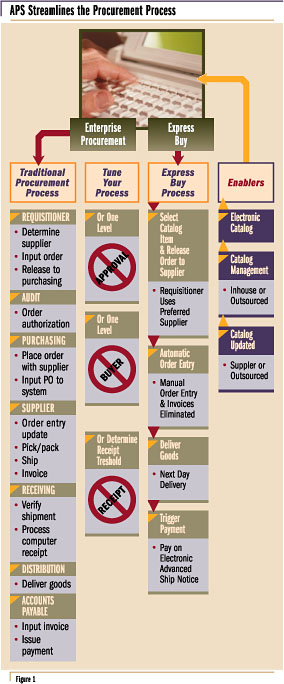
In its place, APS adopted an automated, hands-off approach to management and procurement (see Figure 1). Contrast this with procurement systems still commonly utilized in the utility industry which require handling at many layers in the company for buying, approvals, receiving, stocking, delivery, etc. However, the processes modeled in MMS are characterized by the fact that many transactions can be made by company users themselves without the direct involvement of purchasing personnel. These kinds of changes represent something on the order of a paradigm change for the IT organization as well as, ultimately, the company users. To support these changes, APS IT management considered buying application software, but concluded that roughly 40 percent of user requests would not be adequately addressed. |
|
Typical procurement processes involve numerous steps and procedures of questionable value. An improved model eliminates unnecessary steps and human intervention in the process. Supplier agreements, approvals, delivery, quality and other aspects can be pre-established so that requisitions are not stopped en route through the supply chain.. |
The solution was to enjoin materials management consultants from Texas Instruments' Software Division in a business process engineering (BPE) program. The work of this team was to first reengineer the materials processes, eliminating many steps and basing new processes on best practices and a successful materials management model already in place at TI. The team then used BPE and the Composer development toolset to co-create supplemental, new parts of the MMS software which would support the specific needs of our own utility operation. "We partnered with a manufacturing firm specifically to expand on our utility perspective. We wanted to challenge traditional thinking and leverage new ideas from companies that'd been seriously tuning procurement processes for years," said Wendy Greess, MMS development manager. "At the same time, we contributed to the reengineering and enhancements made to MMS that TI has now commercialized and made available for other businesses."
MMS deployed to APS comprises a series of software
modules which enable both buyers and company personnel to
buy products and services via several methods with
streamlined processes embodied in MMS software modules. The
modules comprise a complete procurement system. Modules
provide both ordering tools for requisitioners (Description
Buy, on-line Material Catalog, and Express Buy), as well as
access to parts information (in-house and through
suppliers), inventory planning and warehousing functions,
and information from company buyers about approved suppliers
and the agreements they've established with those
suppliers.
MMS Modules
- Material Catalog: This on-line catalog lists items kept on-hand in the company's own inventory at various warehouse locations in the business units. Requisitioners can list items contained in Material Catalog databases from their PC workstations. Items are bar coded so that warehouse storekeepers can use handheld computers to track and manage the movement of materials and record the data directly to the MMS.
- Description Buy: At APS, this has become the "conventional" method for procuring materials and services that are not in the company inventory. It is a significant improvement upon traditional processes now reengineered to involve only one or two steps, far fewer than the dozen or more steps required previously. It's also paperless, enabling company personnel to requisition materials or services from their desktop systems. Ordering is also simplified. Users can also look to see if selected items have been previously ordered by other users, or if the items are on an open purchase order, they may simply duplicate the order. Once items are selected, a point-and-click action submits the on-line material or service request form, which is then automatically routed to company buyers.
- Express Buy: A separate application linked to MMS, this module represents a further evolution of the process improvements begun with Description Buy and the Materials Catalog. Like Description Buy, Express Buy automatically routes purchases via electronic data interchange. However, Express Buy routes purchases initiated by users directly to the appropriate supplier without involving company buyers in the transaction. Purchase approvals have been pre-established by company buyers, eliminating extra handling that delays order fulfillment. This module links to a supplier's catalog that resides on an APS server and database of low-cost, high-volume items such as office supplies that are available from approved suppliers (listed in the Sourcing module). Items in this catalog aren't stocked at the company warehouse, but by agreements with the suppliers (described by the Agreements module), and can be ordered and quickly delivered from the supplier, usually within 48 hours or less. Procurement personnel have prearranged terms prices, payment terms and delivery. Suppliers provide the items' data for the catalog.
Other component modules contained in MMS and APS include:
- Agreements
- Sourcing
- Inventory planning
- Warehousing (includes receiving and stocking)
- Paperless routing & approval
MMS also utilizes lead time information to automatically determine when a purchase order must be issued. For example, if a materials request must be initiated three months before an item is needed, the system will calculate an adequate lead time and order the item to arrive when needed. This aspect continually helps contain APS inventory levels; it's also a key link of Just-in-Time processes. "By taking advantage of time-phased material planning in place of traditional reorder point replenishement, deliveries of inventory material can be delayed," said Mike Hobbs, TI's inventory planning functional architect. "Additional inventory reductions are realized by including material forecasting in the reorder process."
Another operating feature based on a best practice learned from the manufacturing environment is value-driven cycle counts. This practice specifically helps the utility meet the Federal Energy Regulatory Commission's requirement that all inventory be counted every 24 months, and enables APS to do so with a greatly reduced level of effort. APS now has the option of customizing cycle count frequency for each item stocked at APS. MMS can automatically schedule the frequency of counts based on the value of the part and its level of activity. APS also has the option of setting a specific time frame for an item. Another feature that has been designed into MMS enables these cycle counts to occur automatically during routine stores activities such as stocking, issuing, quantity adjustments, or item location changes.
"To support MMS users at APS requires approximately 2,500 PC
workstations. The workstations are tied to a Hewlett-Packard Series
800 Model K420 server that's now processing some 50,000-75,000
transactions daily. The server is easily capable of handling twice
the current volume. The client portion of the software is either
installed on individual PCs or on local area networks," said
Greess.
Reenergized procurement
One of the most noticeable outcomes of BPE, the MMS implementation,
and the creation of strategic alliances with long-term agreements
with key suppliers is that it has enabled APS to reduce its number of
suppliers from 10,000 in 1993 to less than 100 by 1996 for the bulk
of the company's purchases. This streamlining of processes and
automating agreements with suppliers reduced procurement cycle times.
Companywide, MMS handles approximately 50,000 to 80,000 transactions
per day. Presently, more than half of the company's purchase orders
are handled through MMS. And for 92 percent of these transactions,
users wait only a moment before the transaction is accepted into the
system and they can move on to other work.
Since implementing MMS, APS has reduced its requisition process from 22 days to four days for items from suppliers ordered through Description Buy. The Express Buy system underpins even faster response from suppliers, providing users with items they've ordered within 48 hours. Items selected from the Materials Catalog (in company inventory) are available within a few hours. "Companywide, the implementation of MMS helped improve materials management staff productivity by some 20 to 30 percent," said Jeff Hillary, manager, MMS implementation.
"We now are managing 75 percent of our low-value-item parts through partnerships with local suppliers," notes Mark Skelton, transmission and distribution team leader. "We have set up values for when we want a particular supplier to stock a certain item and then EDI the transaction out to the supplier. Our procurement process in this and other aspects is totally automatic. For example, work planning managers and other users can obtain items from a combined catalog that they've chosen to view. The system automatically routes requests through the Agreements module and places the order directly with the supplier before it will use the Description Buy process."
Big-ticket items or special orders still find their way through the purchasing department, but the process is much faster. In the past, an employee needing a quick response might have to walk a purchase request through the company to get appropriate approval for a purchase. Now, an electronic routing system allows the employee to automatically route the purchase request through the MMS system. Supervisors are alerted that a purchase request needs their immediate attention through an automatic electronic mail message. Once the approving parties sign off on the purchase, it is electronically routed through the purchasing department and sent on to the appropriate supplier.
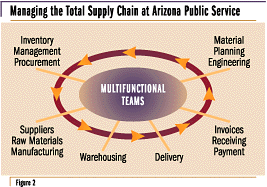
Prior to MMS, company managers scheduled jobs based on an assumption of inventory availability, a traditional practice that usually resulted in higher inventory levels. To reduce inventory, supply chain managers partnered with major suppliers for strategic materials and with several key, local distributors who regularly deliver a "laundry list" of items that are continually used up. This allows the company to reduce inventory by placing the responsibility of having key supplies available on the local supplier. The partnership also enables the company to save time by taking buyers out of the process. Company buyers now have more time to manage and improve the entire supply chain process (see Figure 2).
|
|
Planning new business processes |
|
The approach used by APS is based on multi-functional teams that have a goal of total cost reduction through the integrated materials and services processes at every step in the supply chain.
|
Al Ettinger, a supply chain manager at APS, has had a variety of assignments in the procurement field over the last 23 years. He has held leadership positions in APS' Generation, Transmission & Distribution, and Nuclear procurement departments. He also served on the APS Materials Management reengineering team
Copyright © 2020 by APICS — The Educational Society for Resource Management. All rights reserved.
 Web Site © Copyright 2020 by Lionheart Publishing, Inc.
All rights reserved.

Lionheart Publishing, Inc.
2555 Cumberland Parkway, Suite 299, Atlanta, GA 30339 USA
Phone: +44 23 8110 3411 | br> E-mail:
Web: www.lionheartpub.com
Web Design by Premier Web Designs
E-mail: [email protected]