

February 1997 € Volume 7 € Number 2
After Weak Start, Manufacturing Activity Improving
By Michael K. Evans, Ph.D.
The December APICS Business Outlook Index rebounded to 51.8 from 46.8 in December. The Current Component rose to 51.2 from 48.3, with the Future Component up to 52.4 from 45.3.
Production was flat in December, as a gain in shipments was offset by a decline in inventory stocks. This sets the stage for a rebound in production in early 1997, as inventory stocks have now declined to relatively low levels.
Last month, the index showed new orders dropping, which is precisely what happened. However, orders rebounded in December; the decline last month was only temporary.
The APICS index also shows a slight increase of about 10,000 in manufacturing employment in December. Several firms that reported big layoffs at the end of 1995 indicated no change in employment at the end of 1996. While employment is a coincident rather than a leading indicator, this finding suggests that firms are looking to somewhat faster growth in 1997.
The November APICS report indicated that manufacturing activity would be weak in early 1997; that projection still holds. However, the rebound will probably be a little sooner, and somewhat more vigorous, than indicated by last month's index because of (a) the fairly strong rebound in new orders in December, (b) the decline in inventory stocks, and (c) the modest gain in employment, reversing a three-month decline.
The gains in manufacturing indicated by the future component of
the APICS index probably will not be apparent immediately. Further
inventory readjustments are still likely in the near term, so overall
manufacturing activity probably will not show a noticeable
improvement until February or March.
Current Conditions Component
We would interpret these figures with some caution because, as it so happens, more than 5 percent of our survey respondents were dismissed from their positions in December. Usually there is little turnover in the personnel who respond to the survey. Yet in spite of this development, it seems that the major layoffs of the past few years have come to an end, and manufacturing employment is likely to stabilize in 1997.
Future Conditions Component
The explanation seems to be that a year ago production dropped in December 1995 and then rebounded strongly in early 1996, whereas this year production should be unchanged, hence the rebound will not be as strong. The other possibility is that in spite of the decline in inventory stocks in December, firms plan to reduce stocks further for another month or two.
Where is manufacturing heading?
In 1996, the APICS index exhibited more variability than in its first two years. In particular, the index reversed direction in every month except June and July, when it rose, and October and November, when it fell. While some may prefer a smoother index, these fluctuations are consistent with what actually happened in the manufacturing sector in 1996. The government data for production, shipments, orders and inventories have all exhibited an unusual degree of choppiness this year.
Both manufacturing and overall economic activity were fairly weak in the first quarter, rebounded strongly in the second quarter, then moderated in the third quarter. The jury is still out on fourth quarter activity, but another sluggish quarter seems most probable. This pattern is also indicated by the current component of the APICS index, which averaged 44.5, 52.5, 50.1 and 49.1 for the four quarters of 1996.
In recent years quarterly changes in economic activity have been closely related to changes in interest rates about a half a year earlier. Thus, for example, the strength of the economy in 1994 followed the steady decline of bond yields in 1993, while the weakness of the economy in early 1995 was traced to the sharp rise in rates during 1994.
This pattern did not hold as well in 1996. Since rates fell fairly steadily during 1995, that implied a robust first half for this year, whereas the rise in rates earlier this year indicated sluggish growth for the second half. Perhaps the first quarter slowdown was caused by an unusual confluence of exogenous events: the government shutdown, the bitter winter and the General Motors strike. One could then argue that these shortfalls were made up in the second quarter, with the 3.4 percent growth rate in the first half significantly above the estimated 2.4 percent growth rate for the second half. In this interpretation, those events, plus the second disruption from the GM strike in Canada this fall, caused the choppy behavior in 1996.
If this were the case, then the stability of interest rates in the third quarter of 1996 suggests moderate growth in the first quarter of 1997, while the drop in rates late this year would boost activity in the second and third quarters of next year.
Our overall macro forecast shows real gross domestic product rising 3 percent in 1997 on a quarterly average basis, well above the current 2 percent consensus estimate. The APICS index results do not cover that long of a horizon. Nonetheless, the information it provides is consistent with that outlook: manufacturing sector activity starts slowly in 1997, but as soon as the inventory overhang is worked off, accelerates to above-average growth. To the extent that interest rates remain relatively constant next year, such a recovery in manufacturing activity should boost the overall growth rate to above-average growth levels for the remainder of next year.
APICS Index Performance
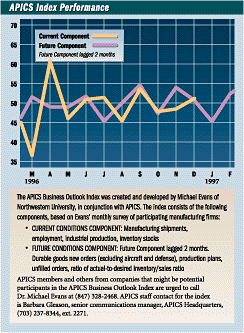
If you're having trouble reading the text at the bottom of this graph, click here.
APICS Business Outlook Index
|
Maximum feasible value = 100 | ||||||
|
CURRENT COMPONENT | ||||||
|---|---|---|---|---|---|---|
|
|
|
|
|
|
|
|
|
1996 | ||||||
|
JAN |
59.7 |
42.1 |
50.0 |
37.9 |
47.4 |
49.4 |
|
FEB |
58.6 |
40.9 |
61.1 |
37.1 |
49.4 |
49.2 |
|
MAR |
34.8 |
43.3 |
37.0 |
31.8 |
36.7 |
42.9 |
|
APR |
73.0 |
55.6 |
73.2 |
43.2 |
61.3 |
56.2 |
|
MAY |
53.5 |
43.3 |
41.7 |
45.7 |
46.1 |
45.6 |
|
JUN |
51.5 |
43.5 |
57.1 |
48.5 |
50.2 |
50.1 |
|
JUL |
58.7 |
45.6 |
57.7 |
43.7 |
51.4 |
53.0 |
|
AUG |
42.9 |
52.5 |
46.3 |
39.9 |
45.4 |
46.4 |
|
SEP |
63.3 |
43.3 |
56.0 |
51.8 |
53.6 |
53.8 |
|
OCT |
53.0 |
45.2 |
50.2 |
42.4 |
47.7 |
49.1 |
|
NOV |
46.7 |
43.7 |
52.1 |
50.8 |
48.3 |
46.8 |
|
DEC |
59.5 |
54.5 |
50.0 |
41.0 |
51.2 |
51.8 |
|
1997 | ||||||
|
FUTURE COMPONENT | |||||
|---|---|---|---|---|---|
|
|
|
|
|
|
|
|
1996 | |||||
|
JAN |
48.2 |
43.1 |
52.1 |
61.7 |
51.3 |
|
FEB |
50.2 |
39.7 |
45.9 |
60.0 |
49.0 |
|
MAR |
50.0 |
51.5 |
53.6 |
40.9 |
49.0 |
|
APR |
55.6 |
36.5 |
48.4 |
64.2 |
51.2 |
|
MAY |
40.9 |
44.8 |
46.6 |
48.5 |
45.2 |
|
JUN |
51.6 |
50.1 |
51.7 |
47.0 |
50.1 |
|
JUL |
55.0 |
53.3 |
51.9 |
58.5 |
54.7 |
|
AUG |
43.5 |
45.6 |
53.6 |
47.0 |
47.4 |
|
SEP |
56.9 |
51.7 |
54.0 |
53.6 |
54.0 |
|
OCT |
50.5 |
45.7 |
55.1 |
51.1 |
50.6 |
|
NOV |
41.9 |
46.6 |
49.3 |
43.3 |
45.3 |
|
DEC |
55.3 |
49.7 |
47.5 |
57.1 |
52.4 |
|
1997 | |||||
|
* Current and Future Components with equal weights | |||||
All the opinions that are expressed in this report represent the viewpoint of Michael Evans and are not necessarily those of APICS.
Copyright © 2020 by APICS — The Educational Society for Resource Management. All rights reserved.
 Web Site © Copyright 2020 by Lionheart Publishing, Inc.
All rights reserved.

Lionheart Publishing, Inc.
2555 Cumberland Parkway, Suite 299, Atlanta, GA 30339 USA
Phone: +44 23 8110 3411 | br> E-mail:
Web: www.lionheartpub.com
Web Design by Premier Web Designs
E-mail: [email protected]