
December 1996 € Volume 6 € Number 12
The Art and Science of Forecasting
How to achieve excellence in demand planning
Despite a dubious reputation, forecasting for
manufacturers is much more than smoke and mirrors. But making it work
requires a clear understanding of its abilities, its limitations, and
the expectations of management.
By Hans Levenbach, Ph.D.
Some people call demand forecasting an art. Others consider it a
science. Most call it impossible (although I do not adhere to this
pessimistic point of view).
Demand forecasters are in the business of making statements about
future demand for products and services in the face of uncertainty. A
forecast is not just a number, outcome or task. It is part of an
ongoing process, integrating excellence into sales, marketing,
inventory, production and all other aspects of the supply chain. A
sound forecasting process incorporates both art and science into a
logical and coherent series of steps that if conducted in an
organized, management-supported fashion, it can improve forecasting
effectiveness, reliability and accuracy in your organization.
The art and science of business forecasting
The art of forecasting has to do with the relational aspects of
forecasting: How well do you present the value of the forecast to its
users? Weather forecasters are very good at this. But on a more
practical front, many business executives, financial investors and
government officials hope to find answers to questions such as:
- What will the information superhighway look like?
- If the electric vehicle becomes practical, how will things
change?
A review of many important innovations, from the steam engine to
the laser, shows that we can seldom predict the full technological,
economic and social impact of new products and services. Scientists
at 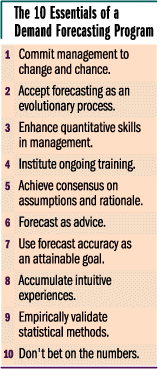 AT&T's Bell Laboratories, which has recently
become part of Lucent Technologies, invented the laser more than 30
years ago. Management initially hesitated to apply for a patent on
it. Even IBM saw no large potential market for the computer in 1949
and predicted the eventual world market for computers at about 10 to
15. Today, the installed base worldwide in computers is in the
hundreds of millions. The list goes on and on and can be very
amusing.
AT&T's Bell Laboratories, which has recently
become part of Lucent Technologies, invented the laser more than 30
years ago. Management initially hesitated to apply for a patent on
it. Even IBM saw no large potential market for the computer in 1949
and predicted the eventual world market for computers at about 10 to
15. Today, the installed base worldwide in computers is in the
hundreds of millions. The list goes on and on and can be very
amusing.
The science of forecasting deals with the strategic issue, which
has to do with how you prove the value of your forecast and models to
management. In demand forecasting, there is still a big gap between
what economics and statistics can offer us and the judgmental aspects
of business decision-making required to develop accurate forecasts.
Looking to the future we need new ways to close the gap.
The role of a business forecaster
At one time, demand forecasting was equated with economic or macro
forecasting. In recent years economic forecasting has suffered from a
lack of credibility, media ridicule and shortcomings in accuracy
goals. Quotes from business journals and newspaper articles
frequently bore into the quality of the ability of economic
forecasters at predicting recessions. To quote from a recent issue of
Fortune magazine: "The biggest problem with economic forecasters is
that they generally can't tell us what we most want to know."
Nowadays, the meaning of business forecasting has broadened
considerably and includes "micro forecasting," or "forecasting of the
firm." This deals with more detailed elements than demand in
classical economics. Expressions of such demands are shipments or
sales of goods to supply warehouses, distributors, food brokers,
channels and end customers. The need for demand-driven forecasting of
the right amount of the right product in the right place and the
right time is one of the key underpinnings of what is now known as
supply chain forecasting.
Not everyone, however, has fully embraced this concept. While
demand-based forecasting is the hallmark of grocery and discount
retailers, many retailers in drugs, apparel and durables still do not
trust their suppliers to deliver products without intervention.
How do we deal with this lack of credibility and turn a problem
into an opportunity for excellence in forecasting? I am going to make
a modest attempt to offer what I believe are the top 10 ingredients
you need to have in place to succeed with a demand forecasting
program in today's business world. This list is neither exhaustive
nor exclusive, but it does include the essential elements of a
successful forecasting process.
Management initiatives
- 1. Commit management to change and chance
- Management tends to avoid dealing with forecasting issues
because of its aversion to dealing with change and uncertainty.
Forecasting is all about change and chance. Like many human
beings, managers don't want to bother with forecasts, because when
forecasts are OK, you don't need to hear from forecasters. But,
when they are off, forecasters are wrong. Nobody wants to be
wrong.
- 2. Accept forecasting as an evolutionary process
- Forecasting seems to become a high priority with management at
times of crises and when unexpected changes occur in the business
environment. Forecasting must be accepted as an evolutionary
process responsive to change. It does not deal with status quo
situations.
- 3. Enhance quantitative skills in management
- Managers can absorb and use tools that work for them. Most
forecasting techniques, no matter how sophisticated, are only as
good as the underlying data. With more and better data, the value
of quantitative methods will become more evident to managers. By
giving management access to internal and external data and the
tools they need, you will have won as a forecaster.
- 4. Institute ongoing training
- Our idea of what a forecaster needs to know today may be
obsolete in the very near future. Companies need to maintain a
training program in forecasting methods and best practices. Just
as the management process is subject to change, so is
forecasting.
- 5. Achieve consensus on assumptions and rationale
- While sitting in forecast review meetings with marketing and
production managers, forecasters must strive towards a consensus
on assumptions and rationale, rather than a confrontation.
Forecasters have techniques and methodologies for laying out these
future scenarios based on assumptions about the economy,
demographics, industry and market forces. Debate assumptions, not
the numbers!
Business objectives
- 6. Forecast as advice
- Sell a forecast as advice and seek management approval. The
forecaster should be useful and provide information that is
relevant to the decision maker. One does this by communicating
with all user groups, including purchasing, finance, production
and marketing. By providing advice that is useful, forecasters
will not work themselves out of a job. Finally, in securing
management approval, forecasters should not wow them with
technical know-how, sophisticated modeling output or even
excessive wit.
- 7. Accuracy as an attainable goal
- Use forecast accuracy as an attainable goal, not as a fiat.
Managers deal with changing market realities and uncertainties.
Confronted with competitive pressures, management must view the
future subject to a broad range of dissimilar influences. It is
not certainty that forecasters want, it is an understanding of
alternatives and possibilities.
- 8. Accumulate intuitive experiences
- Forecasters must learn how to better incorporate their
intuition with the formal, mechanical forecasting tools available
on the computer. Forecasters often know what is going on by gut
feeling, but can rarely formalize this experience in quantifiable
terms. Usually, we tend to interact with mathematical and
statistical models through software to build our forecasting
models. We then take quantitative outputs and judgmentally
(usually external to the computer) incorporate adjustments to
formulate our forecasting advice for the decision maker. Expert
systems are becoming more commonplace. What this will do for
forecasting is to more closely link management judgment and
quantitative modeling as a unified process.
- 9. Empirically validate statistical methods
- Modern, computer-based techniques (data warehousing) now let
us effectively analyze large amounts of data, much of this through
effective graphical means, in less time than required before and
with increased insight. The computer has made it feasible to
warehouse relevant data and perform complex analytical
calculations in a very short time. Better forecasting performance
with these methodologies may be constrained by the quality,
consistency and availability of relevant data. While accuracy of
forecasts prepared by individual forecasters and years of
experience may be related, an individual's judgment may be more
important to the success of forecasting than reliance on
increasingly sophisticated modeling efforts. As the well-known
statistician George P. Box once noted, "All models are wrong, but
some are useful."
- 10. Don't bet on the numbers
- To remind you of some other statements about forecasts as
numbers:
- Business Week in 1958 stated that "With over 50
foreign cars already on sale here, the Japanese auto industry
isn't likely to carve out a big slice of the United States
market for itself."
- Thirty years ago, Time magazine publisher Henry Luce
was quoted as saying: "By 1980 all power (electric, atomic,
solar) is likely to be costless."
- Only 20 years ago, a well known movie mogul said that
television won't be able to hold on to any market it captures
after the first six months. People will soon get tired of
staring at a plywood box every night.
In business applications, demand forecasters must focus on the
process, user and management needs, as well as their own needs, to do
the best job possible. Arguing about numbers will be
counterproductive!
I have presented 10 vital steps for achieving excellence in demand
forecasting for business applications. Each step on its own will not
blaze a trail to the top. But each is critical to the success of any
forecasting endeavor designed to lower costs and improve customer
satisfaction in the supply chain. Make forecasting crucial to your
organization's goals and you will end up with the right quantity of
the right product on the right truck.
Hans Levenbach is founder and president of Delphus Inc., a
statistical, consulting and software development firm specializing in
forecasting applications for marketing, inventory and production
planning organizations. He has a Ph.D. in statistics from the
University of Toronto and spent the first dozen years of his career
at Bell Labs and AT&T.
For more information about this
article, input the number 2 in the appropriate
place on the
December
Reader Service Form
Copyright © 2020 by APICS The Educational Society for
Resource Management. All rights reserved.
Click
here to return to the table of contents.