
December 1996 € Volume 6 € Number 12
December 1996 € Volume 6 € Number 12
In today's demanding business environment, shorter delivery cycles are frequently a key competitive weapon. Delivery cycles often can be improved in job shop facilities by speeding up order entry processing, reducing machine set-up times, and utilizing equipment arrangements that are known as cells.
A traditional cell is an area in the shop where dissimilar machines are located close to each other so that all productive work on a specific part can be done in that one location. Significant cycle time savings are possible because parts do not need to be queued up behind various machines waiting their turn to run, little movement of material is required, and the machines in the cell are dedicated to producing a limited number of items. Also, setups can be eliminated or drastically reduced by dedicating machines in the cell to producing a small variety of parts.
In many manufacturing situations, however, establishing traditional cells proves to be difficult or impossible for various reasons. There may be uncertainty about which machines and part numbers to use, plant floor space may be limited or unavailable, or some of the equipment required for a cell may be "monuments"&emdash;machines that are too difficult or too expensive to relocate because they require heavy foundations or need complicated "tethering" central systems for dust collection, cutting oil filtration, etc.
As a result, even though cells could be a positive factor in
improving delivery cycles, they often are unachievable.
Virtual cell solution
Fortunately, a solution to this dilemma can be found in the use of a
"virtual cell." It is created&emdash;without moving equipment from
functional departments&emdash;by temporarily dedicating one or more
machines in different departments to simultaneously run sequential
operations on the same shop order. Then, by moving small quantities
of parts continuously, lead times are reduced just as they are with
traditional cells, but without rearrangement costs or any
implementation delays. Departmental machines not used in a virtual
cell continue to be assigned batch work per the production schedule.
The virtual cell approach was developed in a recent consulting assignment to help achieve substantial reductions in cycle times to meet competition. The client's manufacturing facility included a number of monuments in the process flow, and machines were grouped in traditional functional departments such as mills, lathes, and so on.
This plant also had a number of manpower, material systems and
machine problems that were being solved over time with various
corrective action programs. However, there was an immediate, critical
need to start shipping "on time" to prevent further erosion in new
customer order levels. The virtual cell concept was developed and
implemented to deal with this "life or death" issue before the longer
term action programs were completed.
Cut cycle times in half
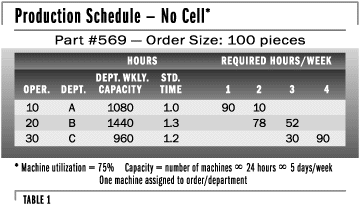
The cycle time reductions can be seen by comparing a traditional job
shop schedule for functional departments to one utilizing the virtual
cell concept.
In Table 1, parts are run in batches of 100, then moved to the succeeding departments and queued up for their turn in the production cycle. In Table 2, parts are run simultaneously in more than one department after being moved in small quantities. Significant lead time savings are achieved because parts do not wait in order-size batches while setups are being performed or other parts are run.
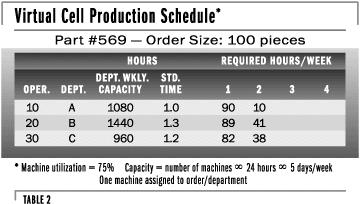
In actual practice, because the mix and volumes of part numbers produced varied widely, up to 44 percent of the weekly load in key departments was scheduled with virtual cell volumes. Total machine loads frequently ranged from 50 percent to 72 percent of utilized capacity. The number of virtual cells running at one time ranged from zero to three. Sometimes cells were put together for a single order, then dismantled and the dedicated machines returned to job shop operations. If there was only a short interval, direct labor productivity may decline if the planned work flows do not materialize. The inevitable disparities in run times lead to queues building up or to incoming material drying up. These may be handled by working overtime or, if necessary, by reassigning manpower temporarily until in-bound material starts to show up.
Using virtual cells in functional departments eliminates the
foreman's capability to assign the dedicated cell machines to regular
job shop orders. During periods of high machine utilization, if
relatively large amounts of virtual cell work coincide with major
volumes of critical job shop work, the resultant loss of flexibility
may prove unacceptable. Ultimately, plant management must determine
when it makes sense to reduce increments of flexible job shop
capacity and dedicate them to simultaneously running single orders in
virtual cells.
Powerful operations technique
Implementation of virtual cells can provide substantial reductions in
job shop cycle times. They can be installed in a very short period of
time with minimum implementation expenditures. However, during
periods of high machine utilization, the benefits of cycle time
reductions may be outweighed by the loss of individual machine
capability and scheduling flexibility. In the end, judicious use of
the virtual cell concept can be a powerful operations technique in
job shop operations.
|
Contributors note: |
Dietrich L. "Pete" Petersen, Ph.D., CPIM, is a senior
associate with Glass & Associates, a consulting firm that
provides general management, operations and turnaround services. He
holds a Ph.D. in Industrial Economics from the University of
Pittsburgh and has served in senior management and manufacturing
positions with several industrial companies.
For more information about this
article, input the number 12 in the appropriate
place on the
December
Reader Service Form