
December 1996 € Volume 6 € Number 12
December 1996 € Volume 6 € Number 12
The APICS Business Outlook Index fell to 49.1 in October from 53.8 in September. The Current Component declined to 47.7 from 53.6, while the Future Component fell to 50.6 from 54.0.
Last month, the APICS index was quite accurate, calling for big gains in shipments and new orders at the same time that employment dropped sharply. We do not expect a similar dichotomy in October; activity is muted for almost all indicators.
Unlike last March, when the General Motors strike pulled the Current Component of the APICS index way down to 36.7 but the Future Component remained near 50, the various work stoppages associated with the Canadian GM strike during October do not seem to have had much impact on these numbers.
Instead, the significant declines in shipments, new orders, and unfilled orders taken together suggest that higher interest rates on discretionary consumer spending and housing are now starting to take their toll on the manufacturing sector.
On the bright side, production plans for the next three months are still reasonably robust, showing a slight pickup in the next three months relative to normal seasonal patterns. Also, the data do not provide any evidence that excess inventory stocks are beginning to accumulate. Nonetheless, the economy appears set for another bout of slower growth over the next few months.
Future Conditions Component
The pause that refreshes
The economy is heading into another slowdown, but we see no chance
that it will turn into an outright recession. Instead, this appears
to be another "rolling adjustment" similar to the one that occurred
in 1995, but this one should be even milder for several reasons. The
inventory buildup has been absent this time, interest rates did not
rise nearly as much in the first half of 1996 as they did in 1994,
and exports should continue to rise at normal rates instead of taking
a sharp dip, as they did in early 1995 when the Mexican economy
collapsed.
Back in 1976, some wag called the slowdown that year "The Pause That Refreshes," suggesting that a welcome slowdown in the growth rate would keep the economy from overheating. As it turned out, that stop-go pattern didn't work out very well, because once the economy started rising at above-average rates, inflationary pressures built to the point where the Consumer Price Index eventually soared 13.5 percent in 1980.
This time around, though, the aphorism seems more appropriate. At least as measured by the Bureau of Economic Analysis (BEA), real growth cannot exceed 2.5 percent without severely straining the use of available resources (we think the actual growth rate is about 3.5 percent because the contribution of the high tech industry is woefully understated, but that's another issue). Thus if the economy rises at a 3.5 percent rate in one half of the year, it has to increase only 1.5 percent in the other half in order to keep both product and factor markets in equilibrium.
Over the past 15 years, interest rates have done a very good job at equilibrating this growth rate. The only recession that did occur during that period was in large part due to exogenous factors: the Persian Gulf War and the shortage of credit following the S&L crisis.
Thus it is no surprise that the 1 percent rise in interest rates in the first half of the year has resulted in slower growth in the second half. The slowdown started in discretionary consumer spending and housing; the October figures are the first major sign that it has spread to the manufacturing sector.
Looking beyond the horizon of this survey, the decline in interest rates since they reached their June peak has been very limited considering that the growth rate has slowed at least by half from its second quarter rate. There seem to be two main concerns: potential for Democratic control of Congress and higher inflation stemming from rises in wages and oil prices.
While these concerns are understandable, we think they are overblown and will dissipate after a few months. As soon as that happens, interest rates will fall another 0.5 to 1 percent, which in a few months will boost real growth, sending it back to the 3 percent range by mid-1997.
In the interim, though, October new orders are flat instead of declining, inventory stocks remain lean, and the production planning component shows about a 3 percent annual growth rate for the next three months. These all indicate that the slight rise in interest rates in the first half of this year was not sufficient to damage the economy&emdash;it merely slowed the growth rate enough that the expansion can continue indefinitely.
A methodological note: Some have wondered why the APICS index bounces around so much more from month to month than other monthly indexes. We are tempted to say "because that's what actually happens," but the issues are slightly more complicated than that. The biggest monthly fluctuation in the Current Component index, namely the decline in March and rebound in April, was tied to the GM strike; the fluctuations in the summer months reflected the fact that there were fewer shutdowns in July. The current component is supposed to provide the first snapshot of what happened in the month just ended, and to predict either what the government statistics will show, or indicate where our methodology will lead to different results.
All of the opinions expressed in the report represent the
viewpoints of Michael Evans and are not necessarily those of
APICS.
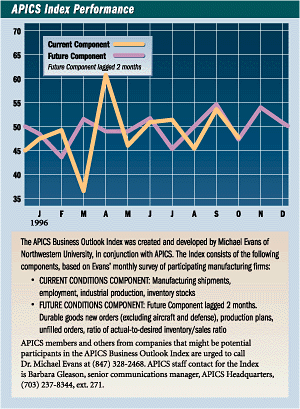
If you're having trouble reading the text at the bottom of this graph, click here.
|
Maximum feasible value = 100 | ||||||
|
CURRENT COMPONENT | ||||||
|---|---|---|---|---|---|---|
|
|
SHIPMENTS |
EMPLOYMENT |
PRODUCTION |
INVENTORY |
CURRENT COMPONENT |
TOTAL APICS INDEX* |
|
1995 | ||||||
|
NOV |
56.6 |
34.6 |
38.9 |
35.3 |
41.3 |
44.8 |
|
DEC |
43.4 |
43.3 |
44.4 |
44.1 |
43.8 |
43.8 |
|
1996 | ||||||
|
JAN |
59.7 |
42.1 |
50.0 |
37.9 |
47.4 |
49.4 |
|
FEB |
58.6 |
40.9 |
61.1 |
37.1 |
49.4 |
49.2 |
|
MAR |
34.8 |
43.3 |
37.0 |
31.8 |
36.7 |
42.9 |
|
APR |
73.0 |
55.6 |
73.2 |
43.2 |
61.3 |
56.2 |
|
MAY |
53.5 |
43.3 |
41.7 |
45.7 |
46.1 |
45.6 |
|
JUN |
51.5 |
43.5 |
57.1 |
48.5 |
50.2 |
50.1 |
|
JUL |
58.7 |
45.6 |
57.7 |
43.7 |
51.4 |
53.0 |
|
AUG |
42.9 |
52.5 |
46.3 |
39.9 |
45.4 |
46.4 |
|
SEP |
63.3 |
43.3 |
56.0 |
51.8 |
53.6 |
53.8 |
|
OCT |
53.0 |
45.2 |
50.2 |
42.4 |
47.7 |
49.1 |
|
FUTURE COMPONENT | |||||
|---|---|---|---|---|---|
|
|
NEW ORDERS |
UNFILLED ORDERS |
PRODUCTION PLANNING |
I/S RATIO |
FUTURE COMPONENT |
|
1995 | |||||
|
NOV |
45.3 |
39.6 |
55.4 |
53.1 |
48.3 |
|
DEC |
37.1 |
45.5 |
50.0 |
42.6 |
43.8 |
|
1996 | |||||
|
JAN |
48.2 |
43.1 |
52.1 |
61.7 |
51.3 |
|
FEB |
50.2 |
39.7 |
45.9 |
60.0 |
49.0 |
|
MAR |
50.0 |
51.5 |
53.6 |
40.9 |
49.0 |
|
APR |
55.6 |
36.5 |
48.4 |
64.2 |
51.2 |
|
MAY |
40.9 |
44.8 |
46.6 |
48.5 |
45.2 |
|
JUN |
51.6 |
50.1 |
51.7 |
47.0 |
50.1 |
|
JUL |
55.0 |
53.3 |
51.9 |
58.5 |
54.7 |
|
AUG |
43.5 |
45.6 |
53.6 |
47.0 |
47.4 |
|
SEP |
56.9 |
51.7 |
54.0 |
53.6 |
54.0 |
|
OCT |
50.5 |
45.7 |
55.1 |
51.1 |
50.6 |
|
* Current and Future Components with equal weights | |||||