
December 1996 € Volume 6 € Number 12
December 1996 € Volume 6 € Number 12
Speed, fast response, efficient customer response&emdash;words and phrases that drive materials professionals today. Everyone wants to be able to move faster, to stay ahead of customer demand and do it with less inventory. Some companies have done well and reaped substantial rewards&emdash;Wal-Mart and Toys R Us. Some have failed:
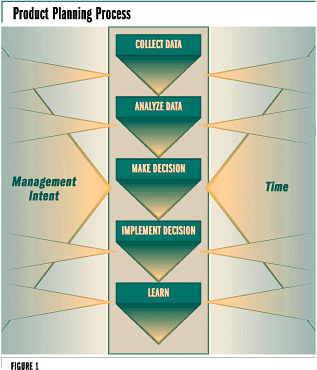
The lesson is clear: If you don't move fast, you will pay for it in excess inventory, lost market share or both. But to move with speed and certainty takes careful planning and hard work. The planning side of the equation takes a carefully thought-out system (or process) that combines information systems and management action. The steps in the process are shown in Figure 1.
Figure 1 shows a five-step process, but note the two driving functions that affect the steps: Management Intent and Time. Management Intent shows the impact and requirement for the system to support management's strategy or purpose in the marketplace.
Two very different missions with two very different systems, but one thing in common&emdash;management has defined very clear objectives for how the systems are to support the business strategy. Everyone in the organizations knows what the systems are to do and how their success will be measured.
The other message here is that management intent can change. Strategies and objectives change, so systems may have to change also.
For example, Caterpillar is now working on developing systems to allow it to monitor its products in the field and identify a problem while the machine is still operational. The system will then order and deliver a part before the machine goes down. The result is zero down time&emdash;an ambitious project that builds on Caterpillar's previous success. But it means major changes to existing systems, new systems and new ways of acting for Caterpillar.
Time is the second driver, and it depends totally on management intent and the marketplace. If you are supplying product to Wal-Mart or Compaq, you will have to respond on a daily or weekly basis. If you are supplying to Boeing or Caterpillar, responding on a weekly or monthly cycle may be adequate. System designers must understand the requirements of the marketplace and design their systems accordingly. Failure to be sensitive to the time issue can doom a new system or company.
Once the drivers of Management Intent and Time are understood, you
can then move through the process of designing the system.
Step One: Collect the data
Obviously, collecting order entry data as quickly and accurately as
you can is the first, but not the only, step. This means a
point-of-sale (POS) system working on a real-time or daily basis in
most cases. But now some other complicating factors come in. In
today's com-petitive world just having an SKU number, quantity and
date sold isn't enough. If possible, data should be collected on the
buyer, the more the better. This means the POS system may have to
interface with a payment system of some sort, such as a credit card.
A good example of this can be seen in retail. Now retail customers at
supermarkets can pay with credit cards, can use store cards to get
discounts on products or earn "bonus" dollars for free gifts. The
retailer and the manufacturer can collect a lot more data on the
buyer and on his or her buying habits or preferences. But obviously,
a lot more system and administration have to be developed.
Collecting data now also means collecting service, warranty and repair data for quality and sales information. This data is a gold mine for companies that know how to use it.
Example: Lexus has an outstanding sales and support system. Besides tracking all new car sales, it tracks warranty and service for each car on a nationwide basis. The system also collects sales leads from responses to magazine, TV and radio ads on a nationwide basis. Lexus can now identify and fix a problem before it has any impact on customers, and can proactively manage its customers to continue their buying of Lexus products and services, and more important, be a word of mouth sales representative for Lexus.
Example: Wal-Mart's system of order entry and tracking inventory is an example of a system that set a new standard in operations for the retail industry. This system is now directly affecting Wal-Mart's suppliers. But the system has grown from just an order entry system into a system that helps Wal-Mart and its suppliers to better manage customer relations and new product development.
Collecting the data is the foundation for all other steps and it
looks deceptively simple, but anyone who has worked with systems
knows how complex and costly this step is. Fundamental questions of
amount and type of data, speed of collection, and security will have
to be answered based on real business needs. Wrong answers to these
questions can and have cost companies millions of dollars in cost,
excess inventory, lost sales and market share.
Step Two: Analyzing the data
This step is where the data is reviewed and sense is made out of it.
The review should tell you trends&emdash;where a product is strong or
weak. The data should immediately tell you whether to produce more of
a product or cut back production. The data could be telling you to
cut prices, add features, do more advertising or even stop selling a
product or come out with a new one. In other words, the data has
tactical and strategic ramifications. Your first priority is to
identify short-term tactical considerations then move to strategic.
Example: A computer company is analyzing its current sales versus the plan. It's seeing a shift from lower-cost units to higher-cost units with faster processors and more multimedia options. The immediate tactical decision is to switch production to the higher-priced units. The strategic decision is to push forward a new design that incorporates some new multimedia features versus a low cost simple unit for the home. This is an example of how one set of data has several uses.
Systems today will have executive reporting modules that can take
raw data and graph and chart it in dozens of different ways. The key
is to find the right format for the data and have a process ensuring
that the right people will be looking at the data on a routine basis.
The people reviewing and analyzing the data should have the
background&emdash;in both intellect and experience&emdash;to
understand what they are looking at. The lowest level possible should
be doing the analysis&emdash;headquarters types can't be doing this.
The analysis should include action to be taken. This recommendation
should list different alternatives.
Step Three: Make a decision
After the data has been collected, analyzed and alternative actions
identified, a decision has to be made. The key is having the right
level make the decision in the appropriate time. The lowest level
person should be making the decision, and be responsible for the
results. Passing decisions up the chain of command only postpones the
decision and can make it obsolete. But where and how the decision
maker is identified and empowered is a senior management decision
made at the design of this process&emdash;it cannot be a
spur-of-the-moment decision.
Example: Shifting production from one model of computer to another is fairly straightforward and should be done by a production planner or master scheduler for the assigned product line. But there are problems&emdash;some real and some political. The real problem might be that management mistook the marketplace and demand. Reality is that adjustments must be made in the production plan, but changes may also be necessary in the advertising budget, in engineering efforts for the follow up on products, and so on. Now the political snake raises its head. How often have you seen necessary action postponed while everyone fought over who is to blame? The decision-making process must be designed to quickly get decisions made and action taken. Senior management must take careful and prolonged action to ensure the analysis is clear, that decisions are made quickly and that lessons are learned quickly and completely in an environment that minimizes finger pointing.
Step Four: Implement the decision
The decision has been made &emdash;now all of the thousands of follow
up actions must be taken quickly and competently. The system must
allow replanning to be done on a reasonable basis. Things to think
about include:
Interesting points aren't they? How many times have you seen decisions made that fall apart once implementation begins? How many times have suppliers built to old schedules because no one told them? Engineering releases the wrong prints? Or when everybody in manufacturing and engineering performs but no one told sales, so the advertising campaign calls out the wrong product?
The same amount of time and energy spent designing the information
flow and decision-making process must be spent in ensuring the
systems and processes that execute the decision work effectively and
efficiently.
Step Five: Learning
Now that information has been collected and analyzed, decisions made
and implemented, it is time to sit back and think through what the
organization has learned. This is a key step because, if done
properly, it can set the stage for further action in the
organization.
Example: Let's look at the computer company that misread the demand for particular machines. Further analysis can be done on why the original forecast was wrong. Which assumptions didn't prove out and what does it mean? New advertising could be developed, new distributors added, changes in design could be made, or new forecasting techniques could be developed. In other words several things could be done&emdash;the key is learning and taking action. The marketplace is dynamic. You and your organization must be dynamic and be willing to learn.
The steps in this process are simple and straightforward but the
simple things are the hardest to do well on a consistent basis. Time,
energy and money must be spent on doing these things well. But
remember what happens when you don't do them well&emdash;you have
inventory you can't sell and lost sales because you didn't have the
product that the market wanted.
Philip E. Quigley, CPIM, is a manager with ATT Solutions in Southern
California. He is a member of the Orange County Chapter where he has
been a board member, vice president of Publicity and Membership. He
teaches management and operations management at the University of
Phoenix, Southern California Campus.
For more information about this article, input the number 3
in the appropriate
place on the
December
Reader Service Form