
November 1996 € Volume 6 € Number 11
November 1996 € Volume 6 € Number 11
T he APICS Business Outlook Index rebounded in September, rising to 53.8 from 46.4. The Current Component rose to 53.6 from 45.4, while the Future Component moved up to 54.0 from 47.4.
Last month we pointed out that the August dip was only temporary, caused by a change in summer vacation schedules, and a recovery was likely in September. However, the September figures show more than a mere rebound, because the 53.8 value of the index is substantially higher than the 49.7 average of the past two months. Hence the pace of manufacturing activity has accelerated in September.
Based on the macroeconomic figures showing slumping retail sales in conjunction with still robust gains in production, we might have expected to see signs that inventory stocks were increasing to unwarranted levels. However, the September data do not contain any evidence of this development. Indeed, inventory stocks hardly increased at all this month and the inventory/sales ratio remains at satisfactory levels. Production plans call for further gains in the fourth quarter.
Apparently the economy was not hurt very much by the rise in interest rates during the first half. While retail sales are flat and housing is sluggish, the survey results suggest that capital spending and exports remain strong. Now that interest rates have retreated from their midyear highs, real growth should remain at average or better rates next year.
Nonetheless, the latest figures suggest continuing signs of nervousness. After increasing briefly in August, manufacturing employment slipped again in September and will probably head lower for the rest of the year. The buildup in order backlogs remains at very modest levels. Firms are apparently pleased about the recent gains in new orders but a bit skeptical about the durability of the recovery, ready to power down at the first signs of approaching weakness.
In a real sense, this heightened sensitivity to nuances of the
business cycle is likely to prolong the boom since the excesses that
often used to appear at business cycle peaks are now absent. Hence we
see the expansion continuing indefinitely.
Current Conditions Component
Future Conditions Component
It just keeps on ticking
We are now in the 66th month of the current business cycle expansion.
It is notable enough this is the third longest expansion on record
(excluding World War II), but even more remarkable, nothing untoward
has happened. In the 1961-69 expansion, there had already been a
credit crunch by the 66th month; only increased spending on the
Vietnam War postponed the recession for a while. In the 1982-1990
expansion, the stock market collapse had already occurred by the 66th
month; only the opening of the credit floodgates kept that plunge
from hurting the economy, an act that may have laid the groundwork
for the rise in inflation during 1988-89 that eventually led to the
1990 recession. But at least so far, we are enjoying what has been
called the "Goldilocks economy."
There has never been a business cycle that died of "old age." Years ago, some economists used to believe that after consumers had bought "everything," and businesses had purchased all the capital goods they needed, the economy would head into a slump. Today we know that business cycle expansions come to an end only when the following imbalances occur:
The only hint of any of these developments so far this year has been number 1. The Fed has not found it necessary to tighten; instead, market forces did the trick with an average increase of 1 percent in market interest rates during the first half of this year. This resulting decline in retail sales and housing has led to concerns that continued robust gains in production would thus lead to an inventory imbalance and much slower growth.
Yet the September APICS figures contain no sign of any such development. Indeed, production is expected to rise at a more rapid rate this quarter than it did in the third. The only sign of weakness was the drop in manufacturing employment but that can also be interpreted as a positive sign in the sense that firms remain lean, hence further reducing the chances of massive cutbacks later on in this cycle.
Some day, say the pundits, all this must come to an end. We would hardly disagree with that general proposition. However, until clear and present evidence of the warning signals 1-5 arises, we will continue to predict continued prosperity in the months and quarters ahead.
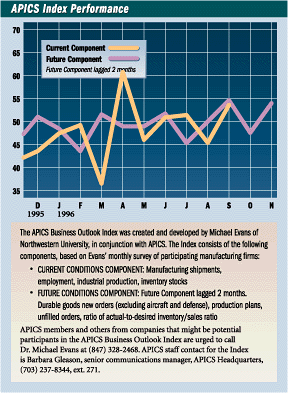
If you're having trouble reading the text at the bottom of this graph, click here.
|
Maximum feasible value = 100 | ||||||
|
CURRENT COMPONENT | ||||||
|---|---|---|---|---|---|---|
|
|
SHIPMENTS |
EMPLOYMENT |
PRODUCTION |
INVENTORY |
CURRENT COMPONENT |
TOTAL APICS INDEX* |
|
1995 | ||||||
|
OCT |
57.1 |
42.8 |
46.6 |
46.0 |
48.1 |
49.5 |
|
NOV |
56.6 |
34.6 |
38.9 |
35.3 |
41.3 |
44.8 |
|
DEC |
43.4 |
43.3 |
44.4 |
44.1 |
43.8 |
43.8 |
|
1996 | ||||||
|
JAN |
59.7 |
42.1 |
50.0 |
37.9 |
47.4 |
49.4 |
|
FEB |
58.6 |
40.9 |
61.1 |
37.1 |
49.4 |
49.2 |
|
MAR |
34.8 |
43.3 |
37.0 |
31.8 |
36.7 |
42.9 |
|
APR |
73.0 |
55.6 |
73.2 |
43.2 |
61.3 |
56.2 |
|
MAY |
53.5 |
43.3 |
41.7 |
45.7 |
46.1 |
45.6 |
|
JUN |
51.5 |
43.5 |
57.1 |
48.5 |
50.2 |
50.1 |
|
JUL |
58.7 |
45.6 |
57.7 |
43.7 |
51.4 |
53.0 |
|
AUG |
42.9 |
52.5 |
46.3 |
39.9 |
45.4 |
46.4 |
|
SEP |
63.3 |
43.3 |
56.0 |
51.8 |
53.6 |
53.8 |
|
FUTURE COMPONENT | |||||
|---|---|---|---|---|---|
|
|
NEW ORDERS |
UNFILLED ORDERS |
PRODUCTION PLANNING |
I/S RATIO |
FUTURE COMPONENT |
|
1995 | |||||
|
OCT |
51.9 |
48.0 |
48.3 |
55.7 |
51.0 |
|
NOV |
45.3 |
39.6 |
55.4 |
53.1 |
48.3 |
|
DEC |
37.1 |
45.5 |
50.0 |
42.6 |
43.8 |
|
1996 | |||||
|
JAN |
48.2 |
43.1 |
52.1 |
61.7 |
51.3 |
|
FEB |
50.2 |
39.7 |
45.9 |
60.0 |
49.0 |
|
MAR |
50.0 |
51.5 |
53.6 |
40.9 |
49.0 |
|
APR |
55.6 |
36.5 |
48.4 |
64.2 |
51.2 |
|
MAY |
40.9 |
44.8 |
46.6 |
48.5 |
45.2 |
|
JUN |
51.6 |
50.1 |
51.7 |
47.0 |
50.1 |
|
JUL |
55.0 |
53.3 |
51.9 |
58.5 |
54.7 |
|
AUG |
43.5 |
45.6 |
53.6 |
47.0 |
47.4 |
|
SEP |
56.9 |
51.7 |
54.0 |
53.6 |
54.0 |
|
* Current and Future Components with equal weights | |||||