

January 1997 € Volume 7 € Number 1
Manufacturing Activity To Decline In Early 1997
By Michael K. Evans
The APICS Business Outlook Index declined in November, falling to 46.8 from 49.1 in October. Unlike last month, when the bigger decline occurred in the Current Component, that part of the index rose slightly to 48.3 from 47.7.
However, the Future Component of the index plunged to 45.3 from 50.6 in October and 54.0 in September, the biggest two-month decline since November 1994. Hence the APICS index is signaling a downturn in manufacturing activity in early 1997.
All four of the indicators in the Future Component -- new orders, unfilled orders, production planning, and the actual to desired level of the inventory/sales ratio -- moved below 50 in November, reinforcing the projection of lower manufacturing activity during the next three months.
The decline in new orders was the largest change, but a sharply higher proportion of firms reported that their inventory/sales ratio had edged above desired levels, a condition that had not been observed earlier this year. Also, production plans for the next three months, after having remained above 50 since June, edged down to 49.3 in the November results.
The upcoming decline in manufacturing sector activity is not expected to turn into a recession. By midyear, lower interest rates should stimulate housing and discretionary consumer spending. It does appear, however, that the economy is heading into another rolling readjustment or "soft landing."
Except for fluctuations associated with the auto strikes, the APICS index has indicated a reasonably steady decline in manufacturing employment all year. By comparison, the Bureau of Labor Statistics (BLS) figures have careened wildly from one extreme to the other each month -- but their average monthly decline of 13,000 has been right in line with the APICS figures.
According to the BLS, over the past three months, manufacturing employment rose 24,000, fell 59,000, and rose 6,000. In our view, nothing of the sort occurred; yet the monthly average decline of 10,000 is probably close to the mark. This decline is likely to widen in November because of the generally weaker manufacturing sector.
To a certain extent this development reflected the drop in
November sales, but it should also be noted that the index for
inventory stocks also moved back above 50. Both these developments
indicate further trimming in production schedules over the next few
months.
How serious is the upcoming slowdown?
If the APICS index offers an accurate portrayal of what lies
ahead, early 1997 will feature the third temporary slowdown in
economic activity in as many years. In the first half of 1995, real
growth declined to 0.5 percent from the robust 3.5 percent growth
rate of 1994. In late 1995 and early 1996, growth again slowed to 1.1
percent before rebounding to about 3.3 percent in the next two
quarters. Our survey results indicate there will be another decline
to the 1 percent range early next year before growth rebounds to 3
percent or more in the second half.
The pattern is similar for manufacturing production. After having risen 7.2 percent during 1994 (on a monthly average basis), production fell at a 0.8 percent rate in the first half of 1995; after a substantial summer rebound, it then rose at only a 0.6 percent rate the next six months. Production rebounded at a superheated 11.4 percent rate in the second quarter, but since then has been almost flat.
The decline in early 1995 was clearly tied to the rise in interest rates the previous year. When rates fell, the economy started to rally, but the gains in sales were less robust than anticipated, resulting in an inventory correction in 1995.4 and 1996.1 that caused production to flatten out.
The gains this spring were the result of a rebound in inventory investment and the delayed reaction of discretionary consumer spending and housing to lower rates. Yet when rates rose 1.0 percent in the first half of this year, the gains in final sales were short-lived. That sluggishness will mean lower inventory investment for the next two quarters.
If this is correct, then the next phase of the recovery should start when (a) lower interest rates stimulate consumption and housing, and (b) the latest inventory retraction ends.
Most interest rates have now fallen about 0.75 percent from their midsummer peaks, and if the APICS index forecast is correct, should fall about another 0.5 percent in the next few months. That decline should be sufficient to trigger a rebound in purchases of consumer durables, semi-durables, and housing by spring. One quarter after that, inventory investment should start to pick up. That would point to a modest gain in manufacturing activity by spring and a bigger gain by summer.
The Fed will have to decide whether such a scenario warrants reducing the Federal funds rate further. In 1995, the sluggish first half growth did not result in any cut in the funds rate until July, and even then the decrease was only 0.25 percent; the slowdown later in the year generated another 0.5 percent cut by early 1996. So it is clear that further cuts will be made grudgingly, in small amounts and only after a substantial lag.
Other market rates, by comparison, are much less reticent about moving quickly in response to economic data. By the time the Fed had decided to ease in mid-1995, bond yields had already fallen 1.5 percent. For that matter, the 0.75 percent decline in the past two months has also indicated the ability of bond yields to decline without any overt action from the Fed.
Thus the chances of further Fed easing early next year because of very sluggish growth are only 50-50; but our forecast does not depend on it. The decline in market rates -- whether or not the Fed eases -- should be sufficient to pull the economy out of its latest rolling readjustment by mid-1997.
All the opinions that are expressed in this report
represent the viewpoints of Michael Evans, and are not necessarily
those of APICS.
APICS Index Performance
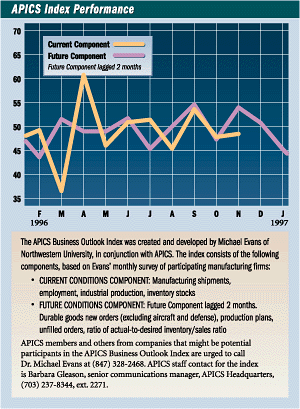
If you're having trouble reading the text at the bottom of this graph, click here.
APICS Business Outlook Index
|
Maximum feasible value = 100 | ||||||
|
CURRENT COMPONENT | ||||||
|---|---|---|---|---|---|---|
|
|
|
|
|
|
|
|
|
1995 | ||||||
|
DEC |
43.4 |
43.3 |
44.4 |
44.1 |
43.8 |
43.8 |
|
1996 | ||||||
|
JAN |
59.7 |
42.1 |
50.0 |
37.9 |
47.4 |
49.4 |
|
FEB |
58.6 |
40.9 |
61.1 |
37.1 |
49.4 |
49.2 |
|
MAR |
34.8 |
43.3 |
37.0 |
31.8 |
36.7 |
42.9 |
|
APR |
73.0 |
55.6 |
73.2 |
43.2 |
61.3 |
56.2 |
|
MAY |
53.5 |
43.3 |
41.7 |
45.7 |
46.1 |
45.6 |
|
JUN |
51.5 |
43.5 |
57.1 |
48.5 |
50.2 |
50.1 |
|
JUL |
58.7 |
45.6 |
57.7 |
43.7 |
51.4 |
53.0 |
|
AUG |
42.9 |
52.5 |
46.3 |
39.9 |
45.4 |
46.4 |
|
SEP |
63.3 |
43.3 |
56.0 |
51.8 |
53.6 |
53.8 |
|
OCT |
53.0 |
45.2 |
50.2 |
42.4 |
47.7 |
49.1 |
|
NOV |
46.7 |
43.7 |
52.1 |
50.8 |
48.3 |
46.8 |
|
FUTURE COMPONENT | |||||
|---|---|---|---|---|---|
|
|
|
|
|
|
|
|
1995 | |||||
|
DEC |
37.1 |
45.5 |
50.0 |
42.6 |
43.8 |
|
1996 | |||||
|
JAN |
48.2 |
43.1 |
52.1 |
61.7 |
51.3 |
|
FEB |
50.2 |
39.7 |
45.9 |
60.0 |
49.0 |
|
MAR |
50.0 |
51.5 |
53.6 |
40.9 |
49.0 |
|
APR |
55.6 |
36.5 |
48.4 |
64.2 |
51.2 |
|
MAY |
40.9 |
44.8 |
46.6 |
48.5 |
45.2 |
|
JUN |
51.6 |
50.1 |
51.7 |
47.0 |
50.1 |
|
JUL |
55.0 |
53.3 |
51.9 |
58.5 |
54.7 |
|
AUG |
43.5 |
45.6 |
53.6 |
47.0 |
47.4 |
|
SEP |
56.9 |
51.7 |
54.0 |
53.6 |
54.0 |
|
OCT |
50.5 |
45.7 |
55.1 |
51.1 |
50.6 |
|
NOV |
41.9 |
46.6 |
49.3 |
43.3 |
45.3 |
|
* Current and Future Components with equal weights | |||||
Copyright © 2020 by APICS — The Educational Society for Resource Management. All rights reserved.
 Web Site © Copyright 2020 by Lionheart Publishing, Inc.
All rights reserved.

Lionheart Publishing, Inc.
2555 Cumberland Parkway, Suite 299, Atlanta, GA 30339 USA
Phone: +44 23 8110 3411 | br> E-mail:
Web: www.lionheartpub.com
Web Design by Premier Web Designs
E-mail: [email protected]